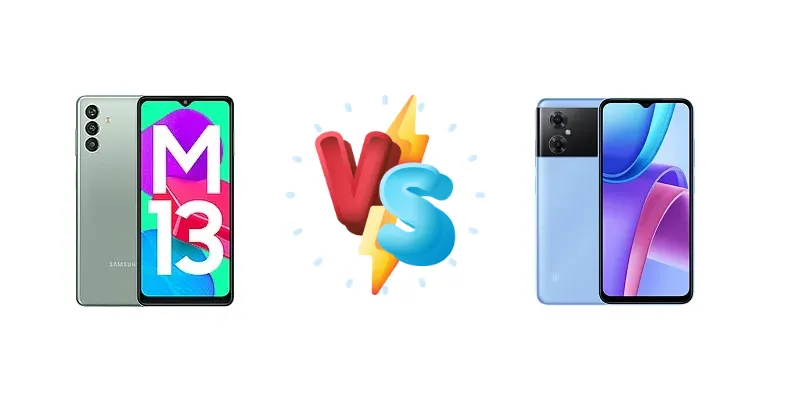
Both the Samsung Galaxy M13 (India variant) and the Xiaomi Redmi Note 11R target the highly competitive sub-₹15,000 Indian market. While both offer a large display and a focus on affordability, they diverge significantly in their core processing power and charging capabilities, making the choice less straightforward than it appears. This comparison dives deep into the specifics to determine which device delivers the best value.
🏆 Quick Verdict
For most users, the Xiaomi Redmi Note 11R emerges as the stronger contender. Its Mediatek Dimensity 700, built on a more efficient 7nm process, provides a noticeable performance uplift over the Samsung Galaxy M13’s Exynos 850, particularly in demanding tasks. While the M13 offers Samsung’s brand recognition, the Redmi Note 11R’s faster charging and superior chipset make it the better all-rounder.
| Network |
|---|
| 2G bands | GSM 850 / 900 / 1800 / 1900 | GSM 850 / 900 / 1800 / 1900 |
| 3G bands | HSDPA 850 / 900 / 2100 | HSDPA 850 / 900 / 1900 / 2100 |
| 4G bands | 1, 3, 5, 7, 8, 20, 28, 38, 40, 41 | 1, 3, 5, 7, 8, 34, 38, 39, 40, 41 |
| 5G bands | - | 1, 5, 8, 28, 41, 78 |
| Speed | HSPA, LTE | HSPA, LTE, 5G |
| Technology | GSM / HSPA / LTE | GSM / CDMA / HSPA / LTE / 5G |
| | - | CDMA 800 |
| Launch |
|---|
| Announced | 2022, July 14 | 2022, September 30 |
| Status | Available. Released 2022, July 23 | Available. Released 2022, September 30 |
| Body |
|---|
| Build | Glass front (Gorilla Glass 5), plastic back, plastic frame | Glass front, plastic frame, plastic back |
| Dimensions | 165.4 x 76.9 x 9.3 mm (6.51 x 3.03 x 0.37 in) | 164 x 76.1 x 8.9 mm (6.46 x 3.00 x 0.35 in) |
| SIM | Nano-SIM + Nano-SIM | Nano-SIM + Nano-SIM |
| Weight | 207 g (7.30 oz) | 201 g (7.09 oz) |
| Display |
|---|
| Protection | Corning Gorilla Glass 5 | - |
| Resolution | 1080 x 2408 pixels, 20:9 ratio (~400 ppi density) | 1080 x 2408 pixels, 20:9 ratio (~401 ppi density) |
| Size | 6.6 inches, 104.9 cm2 (~82.5% screen-to-body ratio) | 6.58 inches, 104.3 cm2 (~83.6% screen-to-body ratio) |
| Type | PLS LCD | IPS LCD, 90Hz, 400 nits (typ) |
| Platform |
|---|
| CPU | Octa-core (4x2.0 GHz Cortex-A55 & 4x2.0 GHz Cortex-A55) | Octa-core (2x2.2 GHz Cortex-A76 & 6x2.0 GHz Cortex-A55) |
| Chipset | Exynos 850 (8 nm) | Mediatek Dimensity 700 (7 nm) |
| GPU | Mali-G52 | Mali-G57 MC2 |
| OS | Android 12, One UI Core 4 | Android 12, MIUI 13 |
| Memory |
|---|
| Card slot | microSDXC (dedicated slot) | microSDXC (dedicated slot) |
| Internal | 64GB 4GB RAM, 128GB 6GB RAM | 128GB 4GB RAM, 128GB 6GB RAM, 128GB 8GB RAM |
| | eMMC 5.1 | UFS 2.2 |
| Main Camera |
|---|
| Dual | - | 13 MP, f/2.2, (wide), PDAF
Auxiliary lens |
| Features | LED flash, panorama, HDR | LED flash, HDR, panorama |
| Triple | 50 MP, f/1.8, (wide), PDAF
5 MP, f/2.2, 123˚ (ultrawide)
Auxiliary lens | - |
| Video | 1080p@30fps | 1080p@30fps |
| Selfie camera |
|---|
| Features | HDR | HDR |
| Single | 8 MP, f/2.2, (wide) | 5 MP, f/2.2, (wide) |
| Video | 1080p@30fps | 1080p@30fps |
| Sound |
|---|
| 3.5mm jack | Yes | Yes |
| 35mm jack | Yes | Yes |
| Loudspeaker | Yes | Yes |
| | - | 24-bit/192kHz audio |
| Comms |
|---|
| Bluetooth | 5.0, A2DP, LE | 5.1, A2DP, LE |
| Infrared port | - | Yes |
| NFC | No | No |
| Positioning | GPS, GLONASS, BDS, GALILEO, QZSS | GPS, GLONASS, GALILEO, BDS |
| Radio | No | No |
| USB | USB Type-C 2.0 | USB Type-C 2.0, OTG |
| WLAN | Wi-Fi 802.11 a/b/g/n/ac, dual-band, Wi-Fi Direct | Wi-Fi 802.11 a/b/g/n/ac, dual-band, Wi-Fi Direct |
| Features |
|---|
| Sensors | Fingerprint (side-mounted), accelerometer, compass | Fingerprint (side-mounted), accelerometer, proximity, compass |
| | Virtual proximity sensing | - |
| Battery |
|---|
| Charging | 15W wired | 18W wired |
| Type | Li-Po 6000 mAh | Li-Po 5000 mAh |
| Misc |
|---|
| Colors | Midnight Blue, Aqua Green, Stardust Brown | Black, Blue, Gray |
| Models | SM-M135FU, SM-M135FU/DS | 22095RA98C |
| Price | About 150 EUR | About 160 EUR |
| SAR | 0.56 W/kg (head) | - |
Samsung Galaxy M13 (India)
- Samsung’s One UI software experience
- Established brand reputation
- Potentially better software support (longer updates)
- Less powerful Exynos 850 chipset
- Slower 15W charging
- Likely less efficient processor
Xiaomi Redmi Note 11R
- More powerful Mediatek Dimensity 700 chipset
- Faster 18W charging
- More efficient 7nm process
- Xiaomi’s MIUI software can be polarizing
- Potentially shorter software support lifespan
- Brand perception may be lower for some users
Display Comparison
Neither device boasts a particularly standout display. Both likely utilize LCD panels, a common cost-saving measure in this segment. However, detailed specs like peak brightness and color gamut coverage are missing. The Redmi Note 11R’s potential advantage lies in its likely higher refresh rate (often 90Hz in this series), which would translate to smoother scrolling and animations, a feature not confirmed for the M13. Bezels are expected to be similar, with both aiming for maximized screen real estate within their price brackets.
Camera Comparison
Camera performance is difficult to assess without detailed sensor information. Both phones likely feature a primary camera, an ultrawide, and a depth/macro sensor. However, the Redmi Note 11R’s potential for a larger primary sensor (common in Redmi Note series) would give it an edge in low-light photography. The Exynos 850’s ISP capabilities are adequate, but the Dimensity 700’s ISP is generally considered more advanced, offering better image processing and noise reduction. The ubiquitous 2MP macro cameras on both devices are largely marketing fluff and offer limited practical utility.
Performance
The core difference lies in the chipsets. The Xiaomi Redmi Note 11R’s Mediatek Dimensity 700, fabricated on a 7nm process, offers a clear architectural advantage over the Samsung Galaxy M13’s Exynos 850 (8nm). The Dimensity 700 features two Cortex-A76 performance cores clocked at 2.2 GHz, alongside six Cortex-A55 efficiency cores, while the Exynos 850 relies solely on eight Cortex-A55 cores clocked at 2.0 GHz. This translates to significantly better single-core and multi-core performance for the Redmi Note 11R, especially noticeable in app loading times and gaming. The 7nm process also contributes to better thermal efficiency, potentially reducing throttling during sustained workloads.
Battery Life
The battery capacity is likely similar on both devices (around 5000mAh), but the charging speeds differ. The Redmi Note 11R supports 18W wired charging, while the Galaxy M13 is limited to 15W. This 3W difference translates to a noticeably faster charging time for the Redmi Note 11R, potentially shaving off 30-60 minutes for a full charge. While both should comfortably last a full day with moderate usage, the Redmi Note 11R’s faster charging is a significant convenience factor.
Buying Guide
Buy the Samsung Galaxy M13 (India) if you prioritize Samsung’s One UI software experience and a well-established brand reputation, and your usage primarily revolves around basic tasks like calling, messaging, and light social media. Buy the Xiaomi Redmi Note 11R if you prioritize performance for gaming and multitasking, faster charging speeds, and a more modern chipset architecture for future-proofing.
Frequently Asked Questions
❓ Does the Exynos 850 in the Galaxy M13 overheat during prolonged gaming sessions?
The Exynos 850, being built on an 8nm process, is more prone to thermal throttling than the Redmi Note 11R’s Dimensity 700 (7nm). While it won’t necessarily overheat to the point of being unusable, expect performance to dip after 30-45 minutes of demanding games like PUBG or Call of Duty.
❓ Is the 18W charging on the Redmi Note 11R significantly faster in real-world use?
Yes, the 18W charging on the Redmi Note 11R provides a noticeable improvement over the Galaxy M13’s 15W charging. Expect a full charge to take approximately 2-2.5 hours with the Redmi Note 11R, compared to 2.5-3 hours with the Galaxy M13.
❓ Can the Redmi Note 11R handle demanding games like Genshin Impact?
The Redmi Note 11R can run Genshin Impact, but you’ll likely need to lower the graphics settings to medium or low to achieve a playable framerate. The Dimensity 700 is capable, but it’s not a dedicated gaming chipset.
❓ How does Samsung’s One UI compare to Xiaomi’s MIUI in terms of bloatware?
MIUI is generally known for having more pre-installed bloatware than One UI. While Samsung has improved in this area, MIUI often includes a greater number of unnecessary apps and services. However, many of these can be uninstalled or disabled.