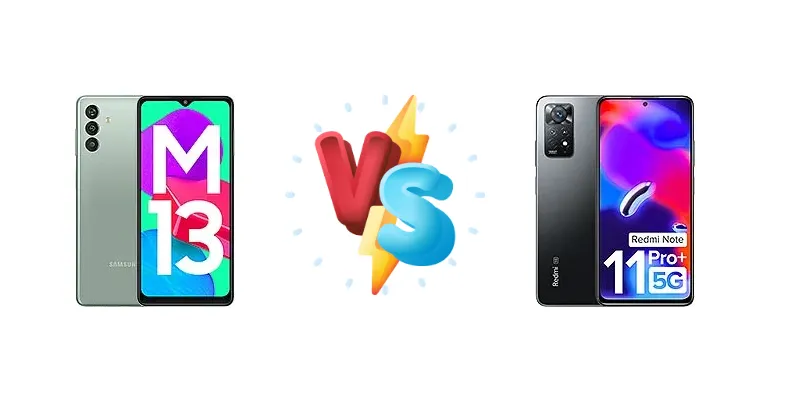
Both the Samsung Galaxy M13 and the Xiaomi Redmi Note 11 Pro+ 5G target the competitive Indian mid-range smartphone market, but they take distinctly different approaches. The M13 prioritizes affordability, while the Redmi Note 11 Pro+ 5G aims for a more premium experience with faster charging and a more powerful chipset. This comparison dissects the key differences to help you choose the right phone for your needs.
🏆 Quick Verdict
For the average user prioritizing speed and convenience, the Xiaomi Redmi Note 11 Pro+ 5G is the clear winner. Its Snapdragon 695 chipset, built on a more efficient 6nm process, and blazing-fast 67W charging significantly outperform the Galaxy M13’s Exynos 850 and 15W charging. However, the M13 remains a viable option for budget-conscious buyers.
| Network |
|---|
| 2G bands | GSM 850 / 900 / 1800 / 1900 | GSM 850 / 900 / 1800 / 1900 - SIM 1 & SIM 2 |
| 3G bands | HSDPA 850 / 900 / 2100 | HSDPA 850 / 900 / 1900 / 2100 |
| 4G bands | 1, 3, 5, 7, 8, 20, 28, 38, 40, 41 | 1, 3, 5, 8, 40, 41 |
| 5G bands | - | 1, 3, 5, 8, 28, 40, 78 SA/NSA |
| Speed | HSPA, LTE | HSPA, LTE-A (CA), 5G |
| Technology | GSM / HSPA / LTE | GSM / HSPA / LTE / 5G |
| Launch |
|---|
| Announced | 2022, July 14 | 2022, March 09 |
| Status | Available. Released 2022, July 23 | Available. Released 2022, March 15 |
| Body |
|---|
| Build | Glass front (Gorilla Glass 5), plastic back, plastic frame | Glass front (Gorilla Glass 5), glass back |
| Dimensions | 165.4 x 76.9 x 9.3 mm (6.51 x 3.03 x 0.37 in) | 164.2 x 76.1 x 8.1 mm (6.46 x 3.00 x 0.32 in) |
| SIM | Nano-SIM + Nano-SIM | Hybrid Dual SIM (Nano-SIM, dual stand-by) |
| Weight | 207 g (7.30 oz) | 202 g (7.13 oz) |
| | - | IP53, dust and splash resistant |
| Display |
|---|
| Protection | Corning Gorilla Glass 5 | Corning Gorilla Glass 5 |
| Resolution | 1080 x 2408 pixels, 20:9 ratio (~400 ppi density) | 1080 x 2400 pixels, 20:9 ratio (~395 ppi density) |
| Size | 6.6 inches, 104.9 cm2 (~82.5% screen-to-body ratio) | 6.67 inches, 107.4 cm2 (~86.0% screen-to-body ratio) |
| Type | PLS LCD | Super AMOLED, 120Hz, 700 nits, 1200 nits (peak) |
| Platform |
|---|
| CPU | Octa-core (4x2.0 GHz Cortex-A55 & 4x2.0 GHz Cortex-A55) | Octa-core (2x2.2 GHz Kryo 660 Gold & 6x1.7 GHz Kryo 660 Silver) |
| Chipset | Exynos 850 (8 nm) | Qualcomm SM6375 Snapdragon 695 5G (6 nm) |
| GPU | Mali-G52 | Adreno 619 |
| OS | Android 12, One UI Core 4 | Android 11, MIUI 13 |
| Memory |
|---|
| Card slot | microSDXC (dedicated slot) | microSDXC (uses shared SIM slot) |
| Internal | 64GB 4GB RAM, 128GB 6GB RAM | 64GB 6GB RAM, 128GB 6GB RAM, 128GB 8GB RAM, 256GB 8GB RAM |
| | eMMC 5.1 | UFS 2.2 |
| Main Camera |
|---|
| Features | LED flash, panorama, HDR | LED flash, HDR, panorama |
| Triple | 50 MP, f/1.8, (wide), PDAF
5 MP, f/2.2, 123˚ (ultrawide)
Auxiliary lens | 108 MP, f/1.9, 26mm (wide), 1/1.52", 0.7µm, PDAF
8 MP, f/2.2, 118˚ (ultrawide)
2 MP, f/2.4, (macro) |
| Video | 1080p@30fps | 1080p@30fps |
| Selfie camera |
|---|
| Features | HDR | - |
| Single | 8 MP, f/2.2, (wide) | 16 MP, f/2.5, (wide), 1/3.06" 1.0µm |
| Video | 1080p@30fps | 1080p@30fps |
| Sound |
|---|
| 3.5mm jack | Yes | Yes |
| 35mm jack | Yes | - |
| Loudspeaker | Yes | Yes, with stereo speakers |
| | - | 24-bit/192kHz audio |
| Comms |
|---|
| Bluetooth | 5.0, A2DP, LE | 5.1, A2DP, LE |
| Infrared port | - | Yes |
| NFC | No | No |
| Positioning | GPS, GLONASS, BDS, GALILEO, QZSS | GPS, GLONASS, BDS, GALILEO |
| Radio | No | Unspecified |
| USB | USB Type-C 2.0 | USB Type-C 2.0, OTG |
| WLAN | Wi-Fi 802.11 a/b/g/n/ac, dual-band, Wi-Fi Direct | Wi-Fi 802.11 a/b/g/n/ac, dual-band, Wi-Fi Direct |
| Features |
|---|
| Sensors | Fingerprint (side-mounted), accelerometer, compass | Fingerprint (side-mounted), accelerometer, gyro, proximity, compass |
| | Virtual proximity sensing | - |
| Battery |
|---|
| Charging | 15W wired | 67W wired, PD3.0, QC3, 50% in 15 min, 100% in 42 min (advertised) |
| Type | Li-Po 6000 mAh | Li-Po 5000 mAh, non-removable |
| Misc |
|---|
| Colors | Midnight Blue, Aqua Green, Stardust Brown | Mirage Blue, Phantom White, Stealth Black |
| Models | SM-M135FU, SM-M135FU/DS | 2201116SI |
| Price | About 150 EUR | About 250 EUR |
| SAR | 0.56 W/kg (head) | - |
Samsung Galaxy M13 (India)
- Potentially lower price point
- Samsung’s established brand reputation
- Reliable software support (likely)
- Slow 15W charging
- Less powerful Exynos 850 chipset
- Potentially limited gaming performance
Xiaomi Redmi Note 11 Pro+ 5G (India)
- Fast 67W charging with PD3.0/QC3 support
- More efficient Snapdragon 695 5G chipset
- Potentially better camera system
- Higher price compared to the Galaxy M13
- Xiaomi’s MIUI software can be polarizing
- Potential for bloatware
Display Comparison
While both phones likely feature LCD panels (data not provided), the core difference lies in performance. The Redmi Note 11 Pro+ 5G benefits from a more modern chipset capable of driving higher refresh rates, potentially offering a smoother visual experience. The Galaxy M13’s Exynos 850, while adequate for basic use, may struggle with demanding graphics. Without specific display specs, it's difficult to assess color accuracy or peak brightness, but the chipset difference suggests the Redmi Note 11 Pro+ 5G has the potential for a superior display experience.
Camera Comparison
Without detailed camera specifications, a direct comparison is limited. However, the Redmi Note 11 Pro+ 5G likely features a more advanced camera system, potentially including a larger main sensor and optical image stabilization (OIS) – features often found in phones at this price point. The Galaxy M13 likely relies on software processing to compensate for a potentially less capable sensor. The inclusion of a 2MP macro camera on either device is largely a marketing tactic, offering minimal practical benefit to most users.
Performance
The Xiaomi Redmi Note 11 Pro+ 5G’s Qualcomm Snapdragon 695 5G (6nm) holds a significant advantage over the Samsung Galaxy M13’s Exynos 850 (8nm). The 6nm process node translates to improved power efficiency and reduced thermal throttling, meaning sustained performance during gaming or intensive tasks. The Snapdragon 695’s CPU configuration – 2x2.2 GHz Kryo 660 Gold & 6x1.7 GHz Kryo 660 Silver – also offers a performance edge over the Galaxy M13’s octa-core setup with all cores clocked at 2.0 GHz. This difference will be most noticeable in app loading times and overall system responsiveness.
Battery Life
The Redmi Note 11 Pro+ 5G’s 67W wired charging is a game-changer. Advertised figures claim a 50% charge in 15 minutes and a full charge in 42 minutes. This drastically reduces downtime compared to the Galaxy M13’s slow 15W charging. While the Galaxy M13 may have a slightly larger battery capacity (data not provided, but typical for Samsung M-series), the Redmi Note 11 Pro+ 5G’s faster charging effectively mitigates any capacity difference, providing more usable uptime throughout the day.
Buying Guide
Buy the Samsung Galaxy M13 (India) if you need a reliable, basic smartphone for everyday tasks and prioritize a well-established brand with a focus on affordability. Buy the Xiaomi Redmi Note 11 Pro+ 5G (India) if you prefer faster performance for gaming and multitasking, and value significantly quicker charging speeds, even if it comes at a higher price point.
Frequently Asked Questions
❓ Does the Exynos 850 chip in the Galaxy M13 overheat during prolonged gaming sessions?
The Exynos 850, built on an 8nm process, is prone to thermal throttling under sustained load. While it can handle casual gaming, demanding titles may experience frame drops and reduced performance after extended play. The Redmi Note 11 Pro+ 5G’s Snapdragon 695 (6nm) is more efficient and will likely maintain higher performance for longer.
❓ Is the 67W charging on the Redmi Note 11 Pro+ 5G compatible with all power banks?
The Redmi Note 11 Pro+ 5G supports Power Delivery (PD) 3.0 and Quick Charge (QC) 3.0. While many power banks support these standards, not all deliver the full 67W output. To achieve the fastest charging speeds, you’ll need a power bank specifically rated for 67W PD or QC output.
❓ How does the software experience differ between Samsung's One UI and Xiaomi's MIUI on these devices?
Samsung's One UI is generally considered cleaner and more intuitive, with a focus on usability. Xiaomi's MIUI is highly customizable but often includes pre-installed apps (bloatware) and can be more aggressive with battery optimization, potentially impacting background app performance. Both offer regular software updates, but Samsung typically provides longer-term support.