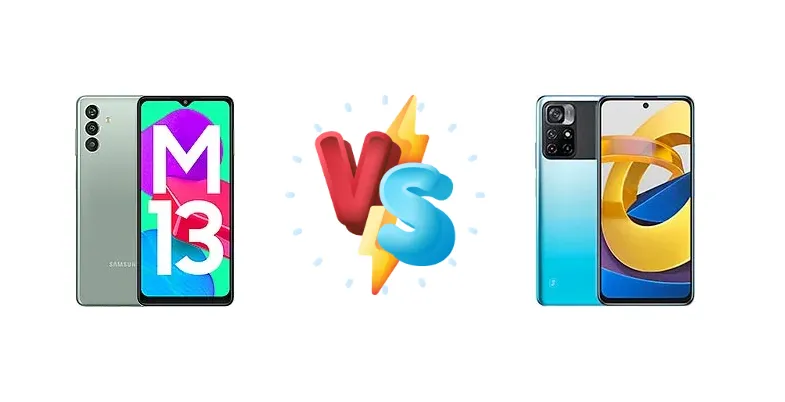
The sub-$200 5G smartphone market is fiercely competitive. Both the Xiaomi Poco M4 Pro 5G and the Samsung Galaxy M13 (India variant) aim to deliver 5G connectivity and essential features at an accessible price. However, they take different approaches to achieving this, with the Poco prioritizing faster charging and a more powerful chipset, while the Samsung focuses on brand recognition and a streamlined experience.
🏆 Quick Verdict
For most users, the Xiaomi Poco M4 Pro 5G is the better buy. Its Mediatek Dimensity 810 chipset offers a noticeable performance advantage over the Samsung Galaxy M13’s Exynos 850, and the 33W fast charging significantly reduces downtime. While both offer similar battery endurance, the Poco’s faster charging is a key differentiator.
| Network |
|---|
| 2G bands | GSM 850 / 900 / 1800 / 1900 | GSM 850 / 900 / 1800 / 1900 |
| 3G bands | HSDPA 850 / 900 / 2100 | HSDPA 850 / 900 / 1700(AWS) / 1900 / 2100 - International |
| 4G bands | 1, 3, 5, 7, 8, 20, 28, 38, 40, 41 | 1, 2, 3, 4, 5, 7, 8, 12, 17, 20, 28, 32, 38, 40, 41, 66 - International |
| 5G bands | - | 1, 3, 5, 7, 8, 20, 28, 38, 40, 41, 66, 77, 78 SA/NSA - International |
| Speed | HSPA, LTE | HSPA, LTE, 5G |
| Technology | GSM / HSPA / LTE | GSM / HSPA / LTE / 5G |
| | - | 1, 3, 5, 8, 28, 40, 78 SA/NSA - India |
| Launch |
|---|
| Announced | 2022, July 14 | 2021, November 09 |
| Status | Available. Released 2022, July 23 | Available. Released 2021, November 11 |
| Body |
|---|
| Build | Glass front (Gorilla Glass 5), plastic back, plastic frame | Glass front (Gorilla Glass 3), plastic back, plastic frame |
| Dimensions | 165.4 x 76.9 x 9.3 mm (6.51 x 3.03 x 0.37 in) | 163.6 x 75.8 x 8.8 mm (6.44 x 2.98 x 0.35 in) |
| SIM | Nano-SIM + Nano-SIM | Nano-SIM + Nano-SIM |
| Weight | 207 g (7.30 oz) | 195 g (6.88 oz) |
| | - | IP53, dust and splash resistant |
| Display |
|---|
| Protection | Corning Gorilla Glass 5 | Corning Gorilla Glass 3 |
| Resolution | 1080 x 2408 pixels, 20:9 ratio (~400 ppi density) | 1080 x 2400 pixels, 20:9 ratio (~399 ppi density) |
| Size | 6.6 inches, 104.9 cm2 (~82.5% screen-to-body ratio) | 6.6 inches, 105.2 cm2 (~84.8% screen-to-body ratio) |
| Type | PLS LCD | IPS LCD, 90Hz, 450 nits (typ) |
| Platform |
|---|
| CPU | Octa-core (4x2.0 GHz Cortex-A55 & 4x2.0 GHz Cortex-A55) | Octa-core (2x2.4 GHz Cortex-A76 & 6x2.0 GHz Cortex-A55) |
| Chipset | Exynos 850 (8 nm) | Mediatek Dimensity 810 (6 nm) |
| GPU | Mali-G52 | Mali-G57 MC2 |
| OS | Android 12, One UI Core 4 | Android 11, upgradable to Android 12, MIUI 13 |
| Memory |
|---|
| Card slot | microSDXC (dedicated slot) | microSDXC |
| Internal | 64GB 4GB RAM, 128GB 6GB RAM | 64GB 4GB RAM, 64GB 6GB RAM, 128GB 4GB RAM, 128GB 6GB RAM, 128GB 8GB RAM, 256GB 8GB RAM |
| | eMMC 5.1 | UFS 2.2 |
| Main Camera |
|---|
| Dual | - | 50 MP, f/1.8, 26mm (wide), PDAF
8 MP, f/2.2, 119˚ (ultrawide) |
| Features | LED flash, panorama, HDR | LED flash, HDR, panorama |
| Single | - | 16 MP, f/2.5, (wide), 1/3.06" 1.0µm |
| Triple | 50 MP, f/1.8, (wide), PDAF
5 MP, f/2.2, 123˚ (ultrawide)
Auxiliary lens | - |
| Video | 1080p@30fps | 1080p@30/60fps |
| Selfie camera |
|---|
| Features | HDR | Panorama |
| Single | 8 MP, f/2.2, (wide) | 16 MP, f/2.5, (wide), 1/3.06" 1.0µm |
| Video | 1080p@30fps | 1080p@30fps |
| Sound |
|---|
| 3.5mm jack | Yes | Yes |
| 35mm jack | Yes | Yes |
| Loudspeaker | Yes | Yes, with stereo speakers |
| Comms |
|---|
| Bluetooth | 5.0, A2DP, LE | 5.1, A2DP, LE |
| Infrared port | - | Yes |
| NFC | No | Yes (market/region dependent) |
| Positioning | GPS, GLONASS, BDS, GALILEO, QZSS | GPS, GLONASS, GALILEO, BDS |
| Radio | No | FM radio |
| USB | USB Type-C 2.0 | USB Type-C 2.0, OTG |
| WLAN | Wi-Fi 802.11 a/b/g/n/ac, dual-band, Wi-Fi Direct | Wi-Fi 802.11 a/b/g/n/ac, dual-band, Wi-Fi Direct |
| Features |
|---|
| Sensors | Fingerprint (side-mounted), accelerometer, compass | Fingerprint (side-mounted), accelerometer, gyro, compass |
| | Virtual proximity sensing | - |
| Battery |
|---|
| Charging | 15W wired | 33W wired, 100% in 59 min |
| Type | Li-Po 6000 mAh | Li-Po 5000 mAh |
| Misc |
|---|
| Colors | Midnight Blue, Aqua Green, Stardust Brown | Poco Yellow, Power Black, Cool Blue |
| Models | SM-M135FU, SM-M135FU/DS | 21091116AG, MZB0BGVIN |
| Price | About 150 EUR | About 150 EUR |
| SAR | 0.56 W/kg (head) | 1.07 W/kg (head) 1.09 W/kg (body) |
| SAR EU | - | 0.59 W/kg (head) 1.00 W/kg (body) |
| Tests |
|---|
| Battery life | - |
Endurance rating 123h
|
| Camera | - |
Photo / Video |
| Display | - |
Contrast ratio: 1553:1 (nominal) |
| Loudspeaker | - |
-24.9 LUFS (Very good)
|
| Performance | - |
AnTuTu: 296721 (v8), 353663 (v9)
GeekBench: 1797 (v5.1)
GFXBench: 13fps (ES 3.1 onscreen) |
Samsung Galaxy M13 (India)
- Familiar Samsung One UI experience
- Reliable brand reputation
- Comparable battery endurance
- Slower Exynos 850 processor
- Significantly slower 15W charging
- Lower peak display brightness
Xiaomi Poco M4 Pro 5G
- More powerful Mediatek Dimensity 810 chipset
- Much faster 33W charging (59 minutes to full)
- Higher peak display brightness
- Xiaomi’s MIUI software can be polarizing
- Potentially more bloatware
- Less established brand recognition in some markets
Display Comparison
Both phones feature displays with a 1553:1 contrast ratio, suggesting similar visual pop. However, the Poco M4 Pro 5G boasts a measured peak brightness of 510 nits, which will translate to better visibility outdoors compared to the Galaxy M13, which lacks a published brightness figure. While both likely use IPS LCD panels, the Poco’s higher brightness gives it an edge in real-world usability. The absence of high refresh rate panels on either device is a common cost-saving measure in this segment.
Camera Comparison
Both devices list 'Photo / Video' capabilities, but lack specific details. Given the price point, image quality will likely be similar in good lighting conditions. However, the Poco M4 Pro 5G may benefit from slightly better image processing due to its more powerful chipset. The inclusion of a 2MP macro camera on both devices is largely a marketing tactic, offering limited practical benefit due to the low resolution and lack of optical image stabilization (OIS). Focusing on the main sensor performance will be more crucial for discerning image quality.
Performance
The Poco M4 Pro 5G’s Mediatek Dimensity 810 (6nm) demonstrably outperforms the Samsung Galaxy M13’s Exynos 850 (8nm). The Dimensity 810 utilizes two Cortex-A76 cores clocked at 2.4 GHz alongside six Cortex-A55 cores, providing a significant uplift in single-core and multi-core performance compared to the Exynos 850’s homogenous octa-core setup of Cortex-A55 cores at 2.0 GHz. This translates to smoother app launches, faster multitasking, and a more enjoyable gaming experience on the Poco. The 6nm process node also contributes to better thermal efficiency, potentially reducing throttling during sustained workloads.
Battery Life
Both phones achieve an endurance rating of 123 hours, indicating comparable battery life under similar usage patterns. However, the Poco M4 Pro 5G’s 33W wired charging is a game-changer, achieving a full charge in just 59 minutes. The Samsung Galaxy M13 is limited to 15W charging, resulting in a significantly longer charging time. This difference is crucial for users who frequently need to top up their battery throughout the day. While battery capacity isn’t specified, the faster charging of the Poco effectively mitigates any potential capacity disadvantage.
Buying Guide
Buy the Samsung Galaxy M13 (India) if you prioritize the Samsung ecosystem, a familiar user interface, and a generally reliable software experience, even if it means sacrificing some performance. Buy the Xiaomi Poco M4 Pro 5G if you prioritize raw processing power for gaming and multitasking, and value the convenience of significantly faster 33W charging, making it ideal for users who are constantly on the go.
Frequently Asked Questions
❓ Does the Exynos 850 in the Galaxy M13 overheat during prolonged gaming sessions?
The Exynos 850 is a relatively efficient chip, but its performance is lower than the Dimensity 810. While it won't likely overheat, users may experience noticeable throttling and frame drops during demanding games like PUBG or Call of Duty, leading to a less smooth gaming experience compared to the Poco M4 Pro 5G.
❓ Is the 2MP macro camera on either phone worth using?
Generally, no. 2MP macro cameras offer limited detail and image quality. The small sensor size and lack of autofocus result in blurry and often unusable images. They are primarily included for marketing purposes and are unlikely to significantly enhance your photography experience.
❓ What kind of charging adapter does each phone include in the box?
The Samsung Galaxy M13 includes a 15W charger in the box. The Poco M4 Pro 5G typically includes a 33W charger, allowing you to take full advantage of its fast charging capabilities. Using a lower wattage charger with the Poco will still charge the phone, but at a significantly slower rate.
❓ How does the software experience differ between Samsung's One UI and Xiaomi's MIUI?
Samsung's One UI is known for its clean and intuitive interface, with a focus on usability and features. Xiaomi's MIUI is more customizable but can be more cluttered with pre-installed apps (bloatware) and a different aesthetic. Preference is subjective, but One UI is generally considered more user-friendly for those new to Android.