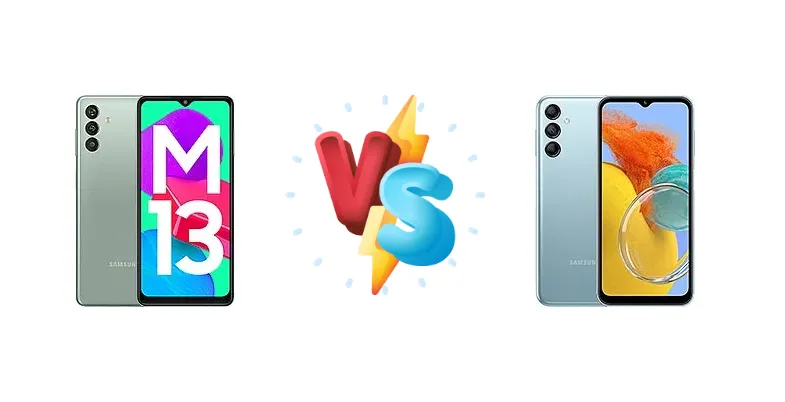
The Samsung Galaxy M series consistently delivers affordable smartphones packed with features. The M13 and M14 are two popular contenders in this space, but which one offers the best value? This comprehensive comparison will delve into their key differences to help you make an informed decision.
🏆 Quick Verdict
The Galaxy M14 is the clear winner. Its significantly more powerful Exynos 1330 chipset, improved camera capabilities, and faster charging (in India) provide a noticeable upgrade over the M13, justifying the slight price difference for most users.
| Network |
|---|
| 2G bands | GSM 850 / 900 / 1800 / 1900 | GSM 850 / 900 / 1800 / 1900 |
| 3G bands | HSDPA 850 / 900 / 2100 | HSDPA 850 / 900 / 1700(AWS) / 1900 / 2100 |
| 4G bands | 1, 3, 5, 7, 8, 20, 28, 38, 40, 41 | 1, 2, 3, 4, 5, 7, 8, 12, 17, 20, 26, 28, 38, 40, 41, 66 |
| 5G bands | - | 1, 3, 5, 7, 8, 20, 28, 38, 40, 41, 66, 77, 78 SA/NSA |
| Speed | HSPA, LTE | HSPA, LTE, 5G |
| Technology | GSM / HSPA / LTE | GSM / HSPA / LTE / 5G |
| Launch |
|---|
| Announced | 2022, July 14 | 2023, March 08 |
| Status | Available. Released 2022, July 23 | Available. Released 2023, March 08 |
| Body |
|---|
| Build | Glass front (Gorilla Glass 5), plastic back, plastic frame | Glass front (Gorilla Glass 5), plastic back, plastic frame |
| Dimensions | 165.4 x 76.9 x 9.3 mm (6.51 x 3.03 x 0.37 in) | 166.8 x 77.2 x 9.4 mm (6.57 x 3.04 x 0.37 in) |
| SIM | Nano-SIM + Nano-SIM | · Nano-SIM· Nano-SIM + Nano-SIM |
| Weight | 207 g (7.30 oz) | 206 g (7.27 oz) |
| Display |
|---|
| Protection | Corning Gorilla Glass 5 | Corning Gorilla Glass 5 |
| Resolution | 1080 x 2408 pixels, 20:9 ratio (~400 ppi density) | 1080 x 2408 pixels, 20:9 ratio (~400 ppi density) |
| Size | 6.6 inches, 104.9 cm2 (~82.5% screen-to-body ratio) | 6.6 inches, 104.9 cm2 (~81.5% screen-to-body ratio) |
| Type | PLS LCD | PLS LCD, 90Hz |
| Platform |
|---|
| CPU | Octa-core (4x2.0 GHz Cortex-A55 & 4x2.0 GHz Cortex-A55) | Octa-core (2x2.4 GHz Cortex-A78 & 6x2.0 GHz Cortex-A55) |
| Chipset | Exynos 850 (8 nm) | Exynos 1330 (5 nm) |
| GPU | Mali-G52 | Mali-G68 MP2 |
| OS | Android 12, One UI Core 4 | Android 13, One UI core 5.1 |
| Memory |
|---|
| Card slot | microSDXC (dedicated slot) | microSDHC (dedicated slot) |
| Internal | 64GB 4GB RAM, 128GB 6GB RAM | 64GB 4GB RAM, 128GB 4GB RAM, 128GB 6GB RAM |
| | eMMC 5.1 | - |
| Main Camera |
|---|
| Features | LED flash, panorama, HDR | LED flash, panorama, HDR |
| Single | - | 13 MP, f/2.0, (wide) |
| Triple | 50 MP, f/1.8, (wide), PDAF
5 MP, f/2.2, 123˚ (ultrawide)
Auxiliary lens | 50 MP, f/1.8, (wide), PDAF
2 MP (macro)
Auxiliary lens |
| Video | 1080p@30fps | 1080p@30fps |
| Selfie camera |
|---|
| Features | HDR | - |
| Single | 8 MP, f/2.2, (wide) | 13 MP, f/2.0, (wide) |
| Video | 1080p@30fps | 1080p@30fps |
| Sound |
|---|
| 3.5mm jack | Yes | Yes |
| 35mm jack | Yes | Yes |
| Loudspeaker | Yes | Yes |
| Comms |
|---|
| Bluetooth | 5.0, A2DP, LE | 5.2, A2DP, LE |
| NFC | No | Yes |
| Positioning | GPS, GLONASS, BDS, GALILEO, QZSS | GPS, GLONASS, GALILEO, BDS, QZSS, NavIC |
| Radio | No | Unspecified |
| USB | USB Type-C 2.0 | USB Type-C 2.0 |
| WLAN | Wi-Fi 802.11 a/b/g/n/ac, dual-band, Wi-Fi Direct | Wi-Fi 802.11 a/b/g/n/ac, dual-band, Wi-Fi Direct |
| Features |
|---|
| Sensors | Fingerprint (side-mounted), accelerometer, compass | Fingerprint (side-mounted), accelerometer, gyro, proximity, compass |
| | Virtual proximity sensing | - |
| Battery |
|---|
| Charging | 15W wired | 15W wired - international
25W wired - India |
| Type | Li-Po 6000 mAh | Li-Po 6000 mAh |
| Misc |
|---|
| Colors | Midnight Blue, Aqua Green, Stardust Brown | Navy Blue, Light Blue, Silver |
| Models | SM-M135FU, SM-M135FU/DS | SM-M146B, SM-M146B/DS, SM-M146B/DSN |
| Price | About 150 EUR | ₹ 10,990 |
| SAR | 0.56 W/kg (head) | - |
| SAR EU | - | 0.48 W/kg (head) 1.53 W/kg (body) |
Samsung Galaxy M13 (India)
- Very affordable
- Large battery
- Decent display
- Outdated chipset
- Slow charging
- Average camera
Samsung Galaxy M14
- Powerful Exynos 1330 chipset
- Improved camera
- Faster charging (India)
- 90Hz display (likely)
- Slightly more expensive
- Design may be less appealing to some
Display Comparison
Both phones feature large 6.6-inch displays, likely with FHD+ resolution. However, the M14 may offer slightly improved color accuracy and brightness due to advancements in Samsung's display technology. The M14 also often includes a 90Hz refresh rate, providing a smoother scrolling experience compared to the M13's standard 60Hz.
Camera Comparison
While both phones offer multiple rear cameras, the M14 generally boasts a more capable main sensor and improved image processing. Expect better low-light performance, more detail in photos, and potentially improved video recording capabilities on the M14. The M13's camera is adequate but lacks the refinement of the M14.
Performance
The Exynos 1330 in the M14 is a substantial upgrade over the Exynos 850 in the M13. The newer chipset's 5nm process and Cortex-A78 cores deliver significantly better CPU and GPU performance, resulting in smoother multitasking, faster app loading times, and improved gaming performance. The M13 will feel noticeably slower, especially with demanding applications.
Battery Life
Both phones typically feature a large 6000mAh battery, promising excellent battery life. However, the M14's faster 25W charging (in India) allows it to recharge significantly quicker than the M13's 15W charging. International versions of the M14 have 15W charging as well.
Buying Guide
Who should buy the Samsung Galaxy M13 (India)? Those on a very tight budget who prioritize affordability above all else. Who should buy the Samsung Galaxy M14? Anyone seeking a smoother performance, better camera, and faster charging experience without breaking the bank.
Frequently Asked Questions
❓ Is the Samsung Galaxy M14 worth the extra money compared to the M13?
Yes, the M14's improved performance and camera make it a worthwhile upgrade, especially if you value a smoother user experience and better photos.
❓ What is the difference in chipset between the M13 and M14?
The M13 uses an Exynos 850 (8nm), while the M14 uses an Exynos 1330 (5nm). The 1330 is significantly faster and more efficient.