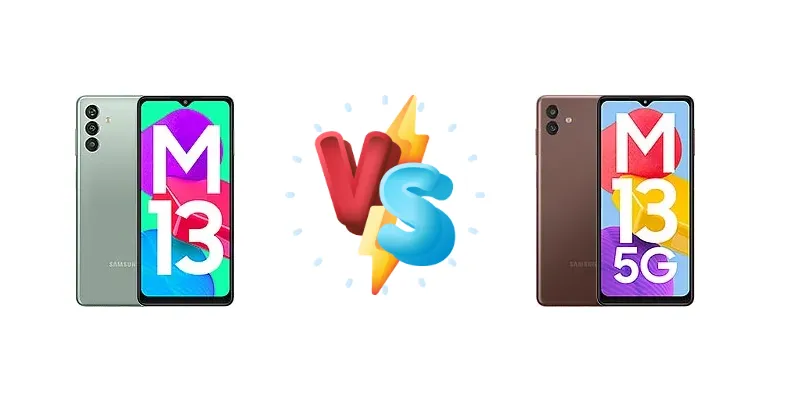
The Samsung Galaxy M13 series offers compelling budget-friendly options, but choosing between the standard M13 (India) and the 5G variant can be tricky. Both promise solid features, but their underlying hardware differs significantly. Let's dive into a detailed comparison to help you decide which one is right for you.
🏆 Quick Verdict
The Galaxy M13 5G offers a noticeable performance boost thanks to its 5G connectivity and more modern chipset. However, the M13 (India) might be a better value if 5G isn't a priority and you prefer the Exynos 850's efficiency. Ultimately, the 5G model is the better overall choice.
| Network |
|---|
| 2G bands | GSM 850 / 900 / 1800 / 1900 | GSM 850 / 900 / 1800 / 1900 |
| 3G bands | HSDPA 850 / 900 / 2100 | HSDPA 850 / 900 / 1900 / 2100 |
| 4G bands | 1, 3, 5, 7, 8, 20, 28, 38, 40, 41 | 1, 2, 3, 4, 5, 7, 8, 12, 17, 20, 26, 28, 38, 40, 41, 66 |
| 5G bands | - | 1, 3, 5, 7, 8, 20, 28, 38, 40, 41, 78 SA/NSA/Sub6 |
| Speed | HSPA, LTE | HSPA, LTE, 5G |
| Technology | GSM / HSPA / LTE | GSM / HSPA / LTE / 5G |
| Launch |
|---|
| Announced | 2022, July 14 | 2022, July 14 |
| Status | Available. Released 2022, July 23 | Available. Released 2022, July 23 |
| Body |
|---|
| Build | Glass front (Gorilla Glass 5), plastic back, plastic frame | Glass front (Gorilla Glass 3), plastic back, plastic frame |
| Dimensions | 165.4 x 76.9 x 9.3 mm (6.51 x 3.03 x 0.37 in) | 164.5 x 76.5 x 8.8 mm (6.48 x 3.01 x 0.35 in) |
| SIM | Nano-SIM + Nano-SIM | Nano-SIM + Nano-SIM |
| Weight | 207 g (7.30 oz) | 195 g (6.88 oz) |
| Display |
|---|
| Protection | Corning Gorilla Glass 5 | Corning Gorilla Glass 3 |
| Resolution | 1080 x 2408 pixels, 20:9 ratio (~400 ppi density) | 720 x 1600 pixels, 20:9 ratio (~270 ppi density) |
| Size | 6.6 inches, 104.9 cm2 (~82.5% screen-to-body ratio) | 6.5 inches, 102.0 cm2 (~81.1% screen-to-body ratio) |
| Type | PLS LCD | PLS LCD, 90Hz, 400 nits (typ) |
| Platform |
|---|
| CPU | Octa-core (4x2.0 GHz Cortex-A55 & 4x2.0 GHz Cortex-A55) | Octa-core (2x2.2 GHz Cortex-A76 & 6x2.0 GHz Cortex-A55) |
| Chipset | Exynos 850 (8 nm) | Mediatek Dimensity 700 (7 nm) |
| GPU | Mali-G52 | Mali-G57 MC2 |
| OS | Android 12, One UI Core 4 | Android 12, One UI Core 4 |
| Memory |
|---|
| Card slot | microSDXC (dedicated slot) | microSDXC (dedicated slot) |
| Internal | 64GB 4GB RAM, 128GB 6GB RAM | 64GB 4GB RAM, 128GB 6GB RAM |
| | eMMC 5.1 | - |
| Main Camera |
|---|
| Dual | - | 50 MP, f/1.8, (wide), PDAF
Auxiliary lens |
| Features | LED flash, panorama, HDR | LED flash, panorama, HDR |
| Triple | 50 MP, f/1.8, (wide), PDAF
5 MP, f/2.2, 123˚ (ultrawide)
Auxiliary lens | - |
| Video | 1080p@30fps | 1080p@30fps |
| Selfie camera |
|---|
| Features | HDR | HDR |
| Single | 8 MP, f/2.2, (wide) | 5 MP, f/2.0, (wide) |
| Video | 1080p@30fps | - |
| Sound |
|---|
| 3.5mm jack | Yes | Yes |
| 35mm jack | Yes | Yes |
| Loudspeaker | Yes | Yes |
| Comms |
|---|
| Bluetooth | 5.0, A2DP, LE | 5.0, A2DP, LE |
| NFC | No | No |
| Positioning | GPS, GLONASS, BDS, GALILEO, QZSS | GPS, GLONASS, BDS, GALILEO, QZSS |
| Radio | No | Unspecified |
| USB | USB Type-C 2.0 | USB Type-C 2.0 |
| WLAN | Wi-Fi 802.11 a/b/g/n/ac, dual-band, Wi-Fi Direct | Wi-Fi 802.11 a/b/g/n/ac, dual-band |
| Features |
|---|
| Sensors | Fingerprint (side-mounted), accelerometer, compass | Fingerprint (side-mounted), accelerometer, gyro, compass |
| | Virtual proximity sensing | Virtual proximity sensing |
| Battery |
|---|
| Charging | 15W wired | 15W wired |
| Type | Li-Po 6000 mAh | Li-Po 5000 mAh |
| Misc |
|---|
| Colors | Midnight Blue, Aqua Green, Stardust Brown | Midnight Blue, Aqua Green, Stardust Brown |
| Models | SM-M135FU, SM-M135FU/DS | SM-M136B, SM-M136B/DS |
| Price | About 150 EUR | About 180 EUR |
| SAR | 0.56 W/kg (head) | 0.73 W/kg (head) |
| SAR EU | - | 0.84 W/kg (head) 1.33 W/kg (body) |
Samsung Galaxy M13 (India)
- Excellent battery life
- Affordable price
- Reliable performance for basic tasks
- Good display
- Older chipset
- No 5G connectivity
- Slower performance compared to M13 5G
Samsung Galaxy M13 5G
- 5G connectivity
- Faster performance
- More modern chipset
- Future-proof
- Slightly higher price
- Performance gains may not be noticeable for all users
Display Comparison
Both phones typically feature a 6.6-inch FHD+ display, likely with a 90Hz refresh rate. While the panels are similar in resolution, slight variations in color accuracy and brightness might exist. The M13 5G *may* have a slightly improved panel, but it's not a major differentiator.
Camera Comparison
Both phones likely feature a similar camera setup, often including a 50MP main sensor, ultrawide lens, and macro lens. Image quality will be comparable in good lighting conditions, but the M13 5G's more powerful processor *could* offer slightly better image processing and low-light performance. Video recording capabilities are likely similar.
Performance
This is where the biggest difference lies. The Mediatek Dimensity 700 in the M13 5G offers significantly better performance than the Exynos 850 in the M13 (India). The Dimensity 700's Cortex-A76 cores provide a substantial boost for demanding apps and games. Expect smoother multitasking and faster loading times on the 5G model.
Battery Life
Both devices are expected to have a 6000mAh battery, providing excellent battery life. Charging speeds are identical at 15W wired, so expect similar charging times. Battery optimization might vary slightly depending on the chipset's efficiency.
Buying Guide
The Samsung Galaxy M13 (India) is ideal for users on a tight budget who primarily use their phone for basic tasks like browsing, social media, and occasional photography, and don't need 5G. The Samsung Galaxy M13 5G is perfect for those who want faster performance, future-proof connectivity, and enjoy gaming or multitasking, even on a budget.
Frequently Asked Questions
❓ Is the Samsung Galaxy M13 5G worth the extra money?
If you want 5G connectivity and better performance, then yes. Otherwise, the standard M13 offers excellent value for basic users.
❓ Which chipset is better: Exynos 850 or Dimensity 700?
The Dimensity 700 is generally considered the better chipset due to its more modern architecture and improved performance.