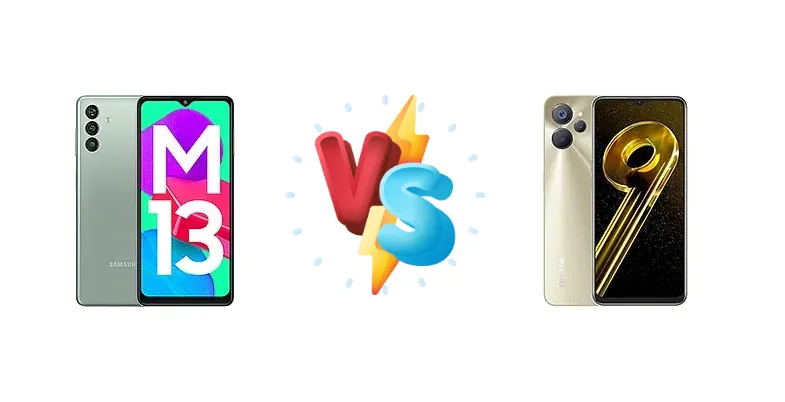
The sub-$200 5G smartphone market is fiercely competitive. Both the Samsung Galaxy M13 (India variant) and the Realme 9i 5G aim to deliver 5G connectivity and a usable smartphone experience without breaking the bank. This comparison dissects their key differences, focusing on chipset performance, charging speeds, and overall value to help you make the right choice.
🏆 Quick Verdict
For most users, the Realme 9i 5G emerges as the stronger contender. Its Mediatek Dimensity 810, fabricated on a more efficient 6nm process, provides a noticeable performance edge over the Samsung Galaxy M13’s Exynos 850. While the M13 benefits from Samsung’s software ecosystem, the 9i 5G’s faster charging and superior processing power make it the better all-rounder.
| Network |
|---|
| 2G bands | GSM 850 / 900 / 1800 / 1900 | GSM 850 / 900 / 1800 / 1900 |
| 3G bands | HSDPA 850 / 900 / 2100 | HSDPA 850 / 900 / 1700(AWS) / 1900 / 2100 |
| 4G bands | 1, 3, 5, 7, 8, 20, 28, 38, 40, 41 | 1, 2, 3, 4, 5, 7, 8, 19, 20, 28, 34, 38, 39, 40, 41 |
| 5G bands | - | 1, 5, 7, 8, 28, 41, 77, 78 SA/NSA |
| Speed | HSPA, LTE | HSPA, LTE, 5G |
| Technology | GSM / HSPA / LTE | GSM / HSPA / LTE / 5G |
| Launch |
|---|
| Announced | 2022, July 14 | 2022, August 18 |
| Status | Available. Released 2022, July 23 | Available. Released 2022, August 24 |
| Body |
|---|
| Build | Glass front (Gorilla Glass 5), plastic back, plastic frame | - |
| Dimensions | 165.4 x 76.9 x 9.3 mm (6.51 x 3.03 x 0.37 in) | 164.4 x 75.1 x 8.1 mm (6.47 x 2.96 x 0.32 in) |
| SIM | Nano-SIM + Nano-SIM | Nano-SIM + Nano-SIM |
| Weight | 207 g (7.30 oz) | 187 g (6.60 oz) |
| Display |
|---|
| Protection | Corning Gorilla Glass 5 | Panda Glass |
| Resolution | 1080 x 2408 pixels, 20:9 ratio (~400 ppi density) | 1080 x 2408 pixels, 20:9 ratio (~400 ppi density) |
| Size | 6.6 inches, 104.9 cm2 (~82.5% screen-to-body ratio) | 6.6 inches, 104.9 cm2 (~85.0% screen-to-body ratio) |
| Type | PLS LCD | IPS LCD, 90Hz, 400 nits (typ) |
| Platform |
|---|
| CPU | Octa-core (4x2.0 GHz Cortex-A55 & 4x2.0 GHz Cortex-A55) | Octa-core (2x2.4 GHz Cortex-A76 & 6x2.0 GHz Cortex-A55) |
| Chipset | Exynos 850 (8 nm) | Mediatek Dimensity 810 (6 nm) |
| GPU | Mali-G52 | Mali-G57 MC2 |
| OS | Android 12, One UI Core 4 | Android 12, upgradable to Android 13, Realme UI 4.0 |
| Memory |
|---|
| Card slot | microSDXC (dedicated slot) | microSDXC (dedicated slot) |
| Internal | 64GB 4GB RAM, 128GB 6GB RAM | 64GB 4GB RAM, 128GB 4GB RAM, 128GB 6GB RAM |
| | eMMC 5.1 | UFS 2.2 |
| Main Camera |
|---|
| Features | LED flash, panorama, HDR | LED flash, HDR, panorama |
| Single | - | 8 MP, f/2.0, 27mm (wide) |
| Triple | 50 MP, f/1.8, (wide), PDAF
5 MP, f/2.2, 123˚ (ultrawide)
Auxiliary lens | 50 MP, f/1.8, 26mm (wide), 1/2.76", 0.64µm, PDAF
Unspecified MP, 46mm (telephoto)
2 MP (macro) |
| Video | 1080p@30fps | 1080p@30fps |
| Selfie camera |
|---|
| Features | HDR | HDR, panorama |
| Single | 8 MP, f/2.2, (wide) | 8 MP, f/2.0, 27mm (wide) |
| Video | 1080p@30fps | 1080p@30fps |
| Sound |
|---|
| 3.5mm jack | Yes | Yes |
| 35mm jack | Yes | Yes |
| Loudspeaker | Yes | Yes |
| Comms |
|---|
| Bluetooth | 5.0, A2DP, LE | 5.2, A2DP, LE |
| NFC | No | No |
| Positioning | GPS, GLONASS, BDS, GALILEO, QZSS | GPS, GLONASS, GALILEO, BDS |
| Radio | No | No |
| USB | USB Type-C 2.0 | USB Type-C 2.0, OTG |
| WLAN | Wi-Fi 802.11 a/b/g/n/ac, dual-band, Wi-Fi Direct | Wi-Fi 802.11 a/b/g/n/ac, dual-band |
| Features |
|---|
| Sensors | Fingerprint (side-mounted), accelerometer, compass | Fingerprint (side-mounted), accelerometer, proximity, compass |
| | Virtual proximity sensing | - |
| Battery |
|---|
| Charging | 15W wired | 18W wired |
| Type | Li-Po 6000 mAh | 5000 mAh |
| Misc |
|---|
| Colors | Midnight Blue, Aqua Green, Stardust Brown | Soulful Blue, Rocking Black, Gold |
| Models | SM-M135FU, SM-M135FU/DS | RMX3612 |
| Price | About 150 EUR | About 180 EUR |
| SAR | 0.56 W/kg (head) | - |
Samsung Galaxy M13 (India)
- Familiar Samsung One UI experience
- Established brand reputation
- Potentially longer software support
- Less powerful Exynos 850 chipset
- Slower 15W charging
- 8nm fabrication process less efficient
Realme 9i 5G
- More powerful Mediatek Dimensity 810 chipset
- Faster 18W charging
- 6nm fabrication process for better efficiency
- Realme UI may not appeal to all users
- Potentially shorter software support compared to Samsung
- Brand recognition lower than Samsung
Display Comparison
Neither device boasts a standout display. Both likely utilize LCD panels, a common cost-saving measure in this segment. However, details like peak brightness and color gamut coverage are missing. The Realme 9i 5G’s advantage lies in its potential for a slightly more responsive experience due to the more powerful chipset driving the UI. Bezels are expected to be similar on both, reflecting their budget positioning.
Camera Comparison
Camera performance is likely to be similar, with both phones relying on budget sensors. Without specific sensor details, it’s difficult to make a definitive judgment. However, the Realme 9i 5G’s image signal processor (ISP), integrated within the Dimensity 810, may offer slightly better image processing capabilities. The inclusion of a 2MP macro camera on both devices is largely a marketing tactic, offering limited real-world benefit due to the small sensor size and lack of optical image stabilization (OIS).
Performance
The core difference lies in the chipsets. The Realme 9i 5G’s Mediatek Dimensity 810 (6nm) is architecturally superior to the Samsung Galaxy M13’s Exynos 850 (8nm). The Dimensity 810 features two Cortex-A76 cores clocked at 2.4 GHz, offering significantly better single-core performance than the M13’s four Cortex-A55 cores at 2.0 GHz. This translates to snappier app launches and smoother multitasking. The 6nm fabrication process also contributes to better thermal efficiency, potentially reducing throttling during sustained loads. While both have 6x Cortex-A55 cores at 2.0 GHz, the overall CPU architecture favors the Realme.
Battery Life
The Realme 9i 5G’s 18W charging is a clear advantage over the Samsung Galaxy M13’s 15W charging. While battery capacity isn’t specified, the faster charging will significantly reduce the time spent tethered to a wall outlet. The Dimensity 810’s 6nm process also contributes to better power efficiency, potentially offsetting any capacity differences. Expect roughly 2-3 hours to fully charge the Realme 9i 5G, compared to a longer duration for the Galaxy M13.
Buying Guide
Buy the Samsung Galaxy M13 (India) if you prioritize brand recognition and a familiar Samsung One UI experience, and are willing to trade some processing power for it. Buy the Realme 9i 5G if you prioritize performance for gaming and multitasking, and want faster charging speeds, making it ideal for users who are constantly on the go.
Frequently Asked Questions
❓ Does the Exynos 850 in the Galaxy M13 overheat during prolonged gaming sessions?
The Exynos 850, being fabricated on an 8nm process, is more prone to thermal throttling than the 6nm Dimensity 810. While it won't necessarily overheat to the point of being unusable, expect performance to dip after extended gaming sessions, particularly with graphically demanding titles. The Realme 9i 5G will likely maintain higher sustained performance.
❓ Is the 2MP macro camera on either phone worth using?
Generally, no. The 2MP macro cameras on both the Samsung Galaxy M13 and Realme 9i 5G are included primarily for marketing purposes. The small sensor size and lack of autofocus result in images with limited detail and sharpness. You're better off using the main camera and cropping in for close-up shots.
❓ Can the Realme 9i 5G handle demanding games like PUBG Mobile at high settings?
The Realme 9i 5G, with its Dimensity 810 chipset, should be capable of running PUBG Mobile at high settings with reasonably stable frame rates. However, achieving a consistent 60fps may require adjusting graphics settings depending on the specific device configuration and thermal conditions. The Exynos 850 in the Galaxy M13 will likely struggle to maintain high frame rates at the same settings.
❓ How long will it take to fully charge each phone from 0%?
With its 18W charging, the Realme 9i 5G should fully charge in approximately 2 to 2.5 hours. The Samsung Galaxy M13, with its slower 15W charging, will likely take closer to 3 hours or more to reach 100%.