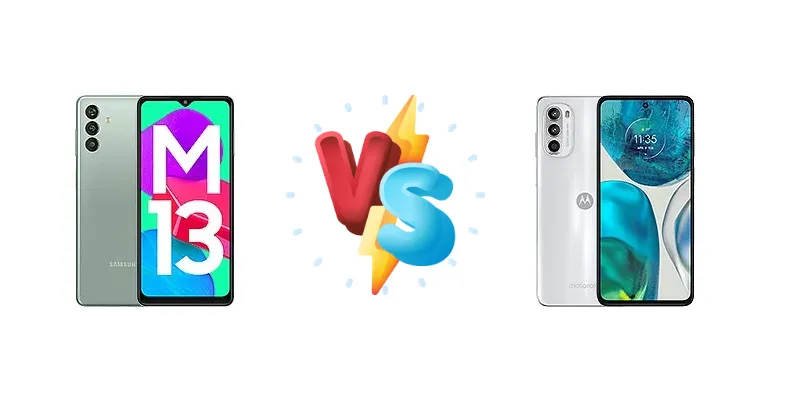
The Motorola Moto G52 and Samsung Galaxy M13 (India) represent compelling options in the fiercely competitive budget smartphone market. Both aim to deliver essential features at an accessible price point, but they take different approaches to achieving this. The G52 leverages Qualcomm’s efficiency-focused Snapdragon 680, while the M13 relies on Samsung’s in-house Exynos 850. This comparison dissects their key differences to determine which device offers the best value.
🏆 Quick Verdict
For the average user prioritizing sustained performance and faster charging, the Motorola Moto G52 emerges as the stronger contender. Its Snapdragon 680, built on a more efficient 6nm process, offers a noticeable advantage in real-world responsiveness and thermal management, complemented by 30W charging. While the M13 offers Samsung’s brand recognition, it falls behind in processing power and charging speed.
| Network |
|---|
| 2G bands | GSM 850 / 900 / 1800 / 1900 | GSM 850 / 900 / 1800 / 1900 |
| 3G bands | HSDPA 850 / 900 / 2100 | HSDPA 850 / 900 / 1700(AWS) / 1900 / 2100 |
| 4G bands | 1, 3, 5, 7, 8, 20, 28, 38, 40, 41 | LTE |
| Speed | HSPA, LTE | HSPA, LTE |
| Technology | GSM / HSPA / LTE | GSM / HSPA / LTE |
| Launch |
|---|
| Announced | 2022, July 14 | 2022, April 12 |
| Status | Available. Released 2022, July 23 | Available. Released 2022, April 20 |
| Body |
|---|
| Build | Glass front (Gorilla Glass 5), plastic back, plastic frame | - |
| Dimensions | 165.4 x 76.9 x 9.3 mm (6.51 x 3.03 x 0.37 in) | 160.1 x 74.5 x 8 mm (6.30 x 2.93 x 0.31 in) |
| SIM | Nano-SIM + Nano-SIM | Nano-SIM + Nano-SIM |
| Weight | 207 g (7.30 oz) | 169 g (5.96 oz) |
| | - | Water-repellent design |
| Display |
|---|
| Protection | Corning Gorilla Glass 5 | - |
| Resolution | 1080 x 2408 pixels, 20:9 ratio (~400 ppi density) | 1080 x 2400 pixels, 20:9 ratio (~402 ppi density) |
| Size | 6.6 inches, 104.9 cm2 (~82.5% screen-to-body ratio) | 6.6 inches, 103.6 cm2 (~86.9% screen-to-body ratio) |
| Type | PLS LCD | AMOLED, 90Hz |
| Platform |
|---|
| CPU | Octa-core (4x2.0 GHz Cortex-A55 & 4x2.0 GHz Cortex-A55) | Octa-core (4x2.4 GHz Kryo 265 Gold & 4x1.9 GHz Kryo 265 Silver) |
| Chipset | Exynos 850 (8 nm) | Qualcomm SM6225 Snapdragon 680 4G (6 nm) |
| GPU | Mali-G52 | Adreno 610 |
| OS | Android 12, One UI Core 4 | Android 12, planned upgrade to Android 13 |
| Memory |
|---|
| Card slot | microSDXC (dedicated slot) | microSDXC (uses shared SIM slot) |
| Internal | 64GB 4GB RAM, 128GB 6GB RAM | 64GB 4GB RAM, 128GB 4GB RAM, 128GB 6GB RAM, 256GB 6GB RAM |
| | eMMC 5.1 | - |
| Main Camera |
|---|
| Features | LED flash, panorama, HDR | LED flash, HDR, panorama |
| Triple | 50 MP, f/1.8, (wide), PDAF
5 MP, f/2.2, 123˚ (ultrawide)
Auxiliary lens | 50 MP, f/1.8 (wide), 1/2.76", 0.64µm, PDAF
8 MP, f/2.2, 118˚ (ultrawide), 1/4.0", 1.12µm
2 MP (macro) |
| Video | 1080p@30fps | 1080p@30fps |
| Selfie camera |
|---|
| Features | HDR | - |
| Single | 8 MP, f/2.2, (wide) | 16 MP, f/2.5, (wide), 1.0µm |
| Video | 1080p@30fps | 1080p@30fps |
| Sound |
|---|
| 3.5mm jack | Yes | Yes |
| 35mm jack | Yes | Yes |
| Loudspeaker | Yes | Yes, with stereo speakers |
| Comms |
|---|
| Bluetooth | 5.0, A2DP, LE | 5.0, A2DP, LE |
| NFC | No | Yes (market/region dependent) |
| Positioning | GPS, GLONASS, BDS, GALILEO, QZSS | GPS, GLONASS, GALILEO |
| Radio | No | Unspecified |
| USB | USB Type-C 2.0 | USB Type-C 2.0 |
| WLAN | Wi-Fi 802.11 a/b/g/n/ac, dual-band, Wi-Fi Direct | Wi-Fi 802.11 a/b/g/n/ac, dual-band, Wi-Fi Direct |
| Features |
|---|
| Sensors | Fingerprint (side-mounted), accelerometer, compass | Fingerprint (side-mounted), accelerometer, gyro, proximity, compass |
| | Virtual proximity sensing | - |
| Battery |
|---|
| Charging | 15W wired | 30W wired |
| Type | Li-Po 6000 mAh | Li-Po 5000 mAh |
| Misc |
|---|
| Colors | Midnight Blue, Aqua Green, Stardust Brown | Charcoal Gray, Porcelain White |
| Models | SM-M135FU, SM-M135FU/DS | XT2221-1, XT2221-2 |
| Price | About 150 EUR | About 470 EUR |
| SAR | 0.56 W/kg (head) | - |
Samsung Galaxy M13 (India)
- Samsung Brand Recognition
- Potentially wider service network
- Likely vibrant image processing
- Less efficient Exynos 850 chipset
- Slower 15W charging
- Potentially lower sustained performance
Motorola Moto G52
- More efficient Snapdragon 680 chipset
- Faster 30W charging
- Smoother multitasking and app launches
- Better thermal management
- Less brand recognition than Samsung
- Potentially less vibrant image processing
Display Comparison
Neither device boasts a standout display. While specific panel details (like peak brightness or color gamut coverage) are absent, the focus here is on efficiency. Both likely utilize LCD panels given the price bracket. The absence of high refresh rates is standard. The key difference lies elsewhere, as display quality is not a primary differentiator.
Camera Comparison
Camera performance is likely to be similar, with both phones targeting the budget segment. Without detailed sensor information, it’s safe to assume both rely on primary sensors around the 13-50MP range. The inclusion of 2MP macro lenses on both devices is largely a marketing tactic, offering limited practical benefit. Image processing will likely lean towards Samsung’s typically vibrant style on the M13, while Motorola often aims for a more natural look. The Snapdragon 680’s ISP (Image Signal Processor) is generally capable, but the Exynos 850’s ISP is also adequate for basic photography.
Performance
The core battleground is the chipset. The Motorola Moto G52’s Qualcomm Snapdragon 680 (6nm) holds a clear architectural advantage over the Samsung Galaxy M13’s Exynos 850 (8nm). The 6nm process inherently provides better power efficiency, translating to less heat generation under load. The Snapdragon 680’s CPU configuration – 4x2.4 GHz Kryo 265 Gold & 4x1.9 GHz Kryo 265 Silver – also offers a higher peak clock speed compared to the M13’s 4x2.0 GHz Cortex-A55 & 4x2.0 GHz Cortex-A55. This means the G52 will likely exhibit snappier app launches and smoother multitasking. While both utilize an octa-core configuration, the Snapdragon’s architecture is more modern and efficient.
Battery Life
The Galaxy M13’s battery capacity is not specified, but typical for this segment is around 5000mAh. The Moto G52 also likely features a 5000mAh battery. However, the critical difference is charging speed. The M13 is limited to 15W wired charging, while the G52 supports 30W wired charging. This translates to a significantly faster 0-100% charge time for the G52, a crucial advantage for users who value convenience. The Snapdragon 680’s efficiency also contributes to potentially better battery life during typical usage.
Buying Guide
Buy the Samsung Galaxy M13 (India) if you prioritize brand familiarity and a potentially wider service network, and your usage is primarily focused on basic tasks like calls, messaging, and light social media. Buy the Motorola Moto G52 if you prefer a smoother, more responsive experience for multitasking, moderate gaming, and appreciate the convenience of significantly faster 30W charging, making it ideal for users on the go.
Frequently Asked Questions
❓ Does the Exynos 850 chip in the Galaxy M13 tend to overheat during prolonged gaming sessions?
The Exynos 850, built on an 8nm process, is more prone to thermal throttling compared to the Snapdragon 680 (6nm). While it can handle casual gaming, extended sessions with graphically demanding titles may result in noticeable performance drops as the chip heats up. The Moto G52’s Snapdragon 680 is better equipped to maintain sustained performance.
❓ Is the 30W charging on the Moto G52 a significant improvement over the 15W charging on the Galaxy M13 in real-world use?
Yes, the difference is substantial. 30W charging on the Moto G52 can reduce charging times by 40-50% compared to the Galaxy M13’s 15W charging. This means you can quickly top up your phone during short breaks, making it ideal for users who are frequently on the move.
❓ Are the 2MP macro cameras on either phone worth using?
Generally, no. 2MP macro cameras on budget phones typically lack the resolution and detail to produce truly impressive macro shots. They are often included as a marketing feature but offer limited practical benefit compared to using the main camera in standard photo mode.
❓ Which phone is better for running multiple apps simultaneously?
The Motorola Moto G52 is better suited for multitasking. The Snapdragon 680’s more efficient architecture and potentially higher RAM bandwidth (depending on the specific configuration) allow it to handle multiple apps running in the background more smoothly than the Galaxy M13’s Exynos 850.