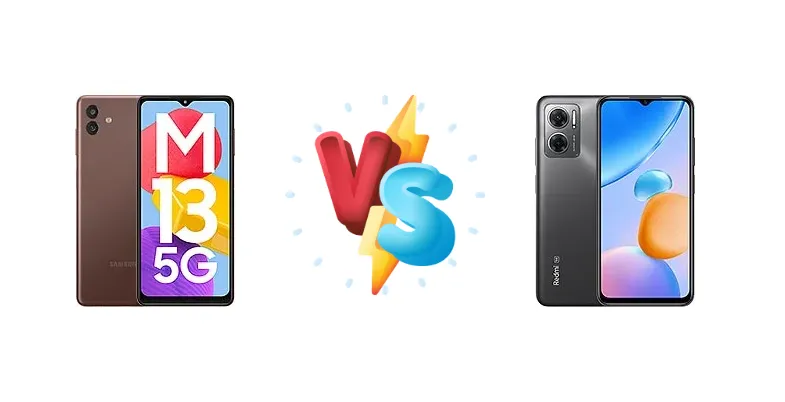
The budget 5G smartphone market is heating up, and two contenders are battling for your attention: the Samsung Galaxy M13 5G and the Xiaomi Redmi 11 Prime 5G. Both offer 5G connectivity at an affordable price, but which one delivers the best overall experience? Let's dive into a detailed comparison.
🏆 Quick Verdict
The Redmi 11 Prime 5G edges out the M13 5G thanks to its slightly faster charging and potentially better software support. However, Samsung's brand recognition and potentially superior display quality make it a close contest. Ultimately, the best choice depends on your priorities.
| Network |
|---|
| 2G bands | GSM 850 / 900 / 1800 / 1900 | GSM 850 / 900 / 1800 / 1900 |
| 3G bands | HSDPA 850 / 900 / 1900 / 2100 | HSDPA 850 / 900 / 1700(AWS) / 1900 / 2100 |
| 4G bands | 1, 2, 3, 4, 5, 7, 8, 12, 17, 20, 26, 28, 38, 40, 41, 66 | 1, 2, 3, 4, 5, 7, 8, 20, 28, 38, 40, 41 |
| 5G bands | 1, 3, 5, 7, 8, 20, 28, 38, 40, 41, 78 SA/NSA/Sub6 | 1, 3, 5, 7, 8, 20, 28, 38, 40, 41, 77, 78 SA/NSA |
| Speed | HSPA, LTE, 5G | HSPA, LTE, 5G |
| Technology | GSM / HSPA / LTE / 5G | GSM / HSPA / LTE / 5G |
| Launch |
|---|
| Announced | 2022, July 14 | 2022, September 06 |
| Status | Available. Released 2022, July 23 | Available. Released 2022, September 09 |
| Body |
|---|
| Build | Glass front (Gorilla Glass 3), plastic back, plastic frame | - |
| Dimensions | 164.5 x 76.5 x 8.8 mm (6.48 x 3.01 x 0.35 in) | 164 x 76.1 x 8.9 mm (6.46 x 3.00 x 0.35 in) |
| SIM | Nano-SIM + Nano-SIM | Nano-SIM + Nano-SIM |
| Weight | 195 g (6.88 oz) | 200 g (7.05 oz) |
| Display |
|---|
| Protection | Corning Gorilla Glass 3 | Corning Gorilla Glass 3 |
| Resolution | 720 x 1600 pixels, 20:9 ratio (~270 ppi density) | 1080 x 2408 pixels, 20:9 ratio (~401 ppi density) |
| Size | 6.5 inches, 102.0 cm2 (~81.1% screen-to-body ratio) | 6.58 inches, 104.3 cm2 (~83.6% screen-to-body ratio) |
| Type | PLS LCD, 90Hz, 400 nits (typ) | IPS LCD, 90Hz |
| Platform |
|---|
| CPU | Octa-core (2x2.2 GHz Cortex-A76 & 6x2.0 GHz Cortex-A55) | Octa-core (2x2.2 GHz Cortex-A76 & 6x2.0 GHz Cortex-A55) |
| Chipset | Mediatek Dimensity 700 (7 nm) | Mediatek Dimensity 700 (7 nm) |
| GPU | Mali-G57 MC2 | Mali-G57 MC2 |
| OS | Android 12, One UI Core 4 | Android 12, MIUI 13 |
| Memory |
|---|
| Card slot | microSDXC (dedicated slot) | microSDXC (dedicated slot) |
| Internal | 64GB 4GB RAM, 128GB 6GB RAM | 64GB 4GB RAM, 128GB 4GB RAM, 128GB 6GB RAM |
| | - | UFS 2.2 |
| Main Camera |
|---|
| Dual | 50 MP, f/1.8, (wide), PDAF
Auxiliary lens | 50 MP, f/1.8, (wide), PDAF
Auxiliary lens |
| Features | LED flash, panorama, HDR | LED flash, HDR, panorama |
| Video | 1080p@30fps | 1080p@30fps |
| Selfie camera |
|---|
| Features | HDR | HDR |
| Single | 5 MP, f/2.0, (wide) | 5 MP, f/2.2 |
| Video | - | 1080p@30fps |
| Sound |
|---|
| 3.5mm jack | Yes | Yes |
| 35mm jack | Yes | Yes |
| Loudspeaker | Yes | Yes |
| | - | 24-bit/192kHz audio |
| Comms |
|---|
| Bluetooth | 5.0, A2DP, LE | 5.1, A2DP, LE |
| Infrared port | - | Yes |
| NFC | No | Yes |
| Positioning | GPS, GLONASS, BDS, GALILEO, QZSS | GPS, GLONASS, BDS, GALILEO |
| Radio | Unspecified | FM radio |
| USB | USB Type-C 2.0 | USB Type-C 2.0, OTG |
| WLAN | Wi-Fi 802.11 a/b/g/n/ac, dual-band | Wi-Fi 802.11 a/b/g/n/ac, dual-band, Wi-Fi Direct |
| Features |
|---|
| Sensors | Fingerprint (side-mounted), accelerometer, gyro, compass | Fingerprint (side-mounted), accelerometer, proximity, compass |
| | Virtual proximity sensing | - |
| Battery |
|---|
| Charging | 15W wired | 18W wired |
| Type | Li-Po 5000 mAh | Li-Po 5000 mAh |
| Misc |
|---|
| Colors | Midnight Blue, Aqua Green, Stardust Brown | Thunder Black, Chrome Silver, Meadow Green |
| Models | SM-M136B, SM-M136B/DS | - |
| Price | About 180 EUR | About 180 EUR |
| SAR | 0.73 W/kg (head) | - |
| SAR EU | 0.84 W/kg (head) 1.33 W/kg (body) | - |
Samsung Galaxy M13 5G
- Established brand reputation
- Potentially better display quality
- Familiar Samsung One UI
- Good software support (typically)
- Slower 15W charging
- Potentially more bloatware
- Camera performance may not be class-leading
Xiaomi Redmi 11 Prime 5G
- Faster 18W charging
- Potentially cleaner MIUI software
- Competitive price
- Modern design
- Xiaomi's software update track record can be inconsistent
- Brand recognition less than Samsung
- Display quality may be slightly inferior
Display Comparison
Both phones feature a 6.6-inch display, likely with a Full HD+ resolution. While specific panel types aren't explicitly stated, the Samsung might offer slightly better color accuracy and viewing angles due to Samsung's display expertise. Expect similar brightness levels.
Camera Comparison
The M13 5G likely features a triple camera setup with a 50MP main sensor, while the Redmi 11 Prime 5G also boasts a 50MP main sensor. Image quality will depend on software processing and sensor performance. Expect decent results in good lighting conditions, but low-light performance might be a weakness for both.
Performance
Powered by the same Mediatek Dimensity 700 chipset, performance should be largely comparable in everyday tasks and light gaming. Software optimization could be a differentiating factor, with Xiaomi potentially offering a cleaner, less bloated experience. However, Samsung's One UI is generally well-regarded.
Battery Life
Both phones are expected to have a 5000mAh battery, providing all-day battery life for moderate users. The Redmi 11 Prime 5G's 18W charging offers a slight advantage over the M13 5G's 15W charging, allowing for quicker top-ups.
Buying Guide
The Samsung Galaxy M13 5G is ideal for users who prioritize brand reputation, a potentially better display, and a familiar Samsung UI. The Xiaomi Redmi 11 Prime 5G is a great pick for those seeking faster charging, a slightly more modern design, and a competitive price point.
Frequently Asked Questions
❓ Which phone has better 5G connectivity?
Both phones utilize the Mediatek Dimensity 700 chipset, which supports 5G. Real-world 5G performance will depend on network availability and carrier support, and should be similar on both devices.
❓ Is the Samsung Galaxy M13 5G worth the extra money?
That depends on your priorities. If you value brand recognition and potentially a slightly better display, the M13 5G might be worth the premium. However, if you're primarily focused on charging speed and value, the Redmi 11 Prime 5G is a compelling alternative.