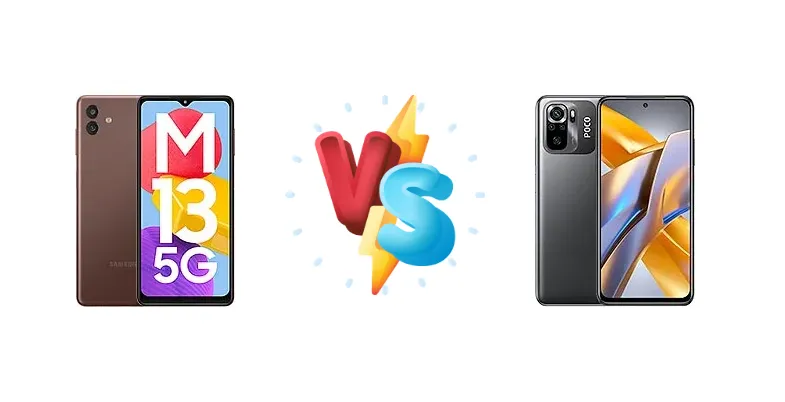
The Samsung Galaxy M13 5G and Xiaomi Poco M5s represent compelling options in the crowded sub-$200 smartphone market. While both aim to deliver essential features at an accessible price, they take different approaches. The M13 5G prioritizes 5G connectivity with a newer chipset, while the Poco M5s focuses on a brighter display and significantly faster charging speeds. This comparison dissects their strengths and weaknesses to determine which device offers the best value.
🏆 Quick Verdict
For the average user prioritizing fast charging and a brighter viewing experience, the Xiaomi Poco M5s is the better choice. Its 33W charging dramatically reduces downtime, and the 756 nit display offers superior visibility. However, users heavily reliant on 5G and seeking a slightly more efficient processor may find the Galaxy M13 5G appealing.
| Network |
|---|
| 2G bands | GSM 850 / 900 / 1800 / 1900 | GSM 850 / 900 / 1800 / 1900 |
| 3G bands | HSDPA 850 / 900 / 1900 / 2100 | HSDPA 850 / 900 / 1700(AWS) / 1900 / 2100 |
| 4G bands | 1, 2, 3, 4, 5, 7, 8, 12, 17, 20, 26, 28, 38, 40, 41, 66 | 1, 2, 3, 4, 5, 7, 8, 20, 28, 38, 40, 41 |
| 5G bands | 1, 3, 5, 7, 8, 20, 28, 38, 40, 41, 78 SA/NSA/Sub6 | - |
| Speed | HSPA, LTE, 5G | HSPA, LTE |
| Technology | GSM / HSPA / LTE / 5G | GSM / HSPA / LTE |
| Launch |
|---|
| Announced | 2022, July 14 | 2022, September 05 |
| Status | Available. Released 2022, July 23 | Available. Released 2022, September 06 |
| Body |
|---|
| Build | Glass front (Gorilla Glass 3), plastic back, plastic frame | Glass front (Gorilla Glass 3), plastic frame, plastic back |
| Dimensions | 164.5 x 76.5 x 8.8 mm (6.48 x 3.01 x 0.35 in) | 160.5 x 74.5 x 8.3 mm (6.32 x 2.93 x 0.33 in) |
| SIM | Nano-SIM + Nano-SIM | Nano-SIM + Nano-SIM |
| Weight | 195 g (6.88 oz) | 178.8 g (6.31 oz) |
| | - | IP53, dust and splash resistant |
| Display |
|---|
| Protection | Corning Gorilla Glass 3 | Corning Gorilla Glass 3 |
| Resolution | 720 x 1600 pixels, 20:9 ratio (~270 ppi density) | 1080 x 2400 pixels, 20:9 ratio (~409 ppi density) |
| Size | 6.5 inches, 102.0 cm2 (~81.1% screen-to-body ratio) | 6.43 inches, 99.8 cm2 (~83.5% screen-to-body ratio) |
| Type | PLS LCD, 90Hz, 400 nits (typ) | AMOLED, 450 nits (typ), 700 nits (HBM), 1100 nits (peak) |
| Platform |
|---|
| CPU | Octa-core (2x2.2 GHz Cortex-A76 & 6x2.0 GHz Cortex-A55) | Octa-core (2x2.05 GHz Cortex-A76 & 6x2.0 GHz Cortex-A55) |
| Chipset | Mediatek Dimensity 700 (7 nm) | Mediatek MT6785V/CD Helio G95 (12 nm) |
| GPU | Mali-G57 MC2 | Mali-G76 MC4 |
| OS | Android 12, One UI Core 4 | Android 12, MIUI 13 |
| Memory |
|---|
| Card slot | microSDXC (dedicated slot) | microSDXC (dedicated slot) |
| Internal | 64GB 4GB RAM, 128GB 6GB RAM | 64GB 4GB RAM, 128GB 4GB RAM, 128GB 6GB RAM, 256GB 8GB RAM |
| | - | UFS 2.2 |
| Main Camera |
|---|
| Dual | 50 MP, f/1.8, (wide), PDAF
Auxiliary lens | - |
| Features | LED flash, panorama, HDR | LED flash, HDR, panorama |
| Quad | - | 64 MP, f/1.8, 26mm (wide), 1/1.97", 0.7µm, PDAF
8 MP, f/2.2, 118˚ (ultrawide), 1/4.0", 1.12µm
2 MP (macro)
Auxiliary lens |
| Video | 1080p@30fps | 4K@30fps, 1080p@30/60/120fps, 720p@960fps |
| Selfie camera |
|---|
| Features | HDR | HDR |
| Single | 5 MP, f/2.0, (wide) | 13 MP, f/2.4, (wide), 1/3.06", 1.12µm |
| Video | - | 1080p@30fps |
| Sound |
|---|
| 3.5mm jack | Yes | Yes |
| 35mm jack | Yes | Yes |
| Loudspeaker | Yes | Yes, with stereo speakers |
| Comms |
|---|
| Bluetooth | 5.0, A2DP, LE | 5.0, A2DP, LE |
| Infrared port | - | Yes |
| NFC | No | Yes |
| Positioning | GPS, GLONASS, BDS, GALILEO, QZSS | GPS, GLONASS, GALILEO, BDS |
| Radio | Unspecified | FM radio |
| USB | USB Type-C 2.0 | USB Type-C 2.0 |
| WLAN | Wi-Fi 802.11 a/b/g/n/ac, dual-band | Wi-Fi 802.11 a/b/g/n/ac, dual-band, Wi-Fi Direct |
| Features |
|---|
| Sensors | Fingerprint (side-mounted), accelerometer, gyro, compass | Fingerprint (side-mounted), accelerometer, gyro, compass |
| | Virtual proximity sensing | Virtual proximity sensing |
| Battery |
|---|
| Charging | 15W wired | 33W wired, 64% in 30 min |
| Type | Li-Po 5000 mAh | Li-Po 5000 mAh |
| Misc |
|---|
| Colors | Midnight Blue, Aqua Green, Stardust Brown | Gray, Blue, White |
| Models | SM-M136B, SM-M136B/DS | 2207117BPG |
| Price | About 180 EUR | About 120 EUR |
| SAR | 0.73 W/kg (head) | 1.00 W/kg (head) 0.65 W/kg (body) |
| SAR EU | 0.84 W/kg (head) 1.33 W/kg (body) | 0.60 W/kg (head) 0.87 W/kg (body) |
| Tests |
|---|
| Battery life | - |
Endurance rating 132h
|
| Camera | - |
Photo / Video |
| Display | - |
Contrast ratio: Infinite (nominal) |
| Loudspeaker | - |
-25.4 LUFS (Very good)
|
| Performance | - |
AnTuTu: 360681 (v9)
GeekBench: 1831 (v5.1)
GFXBench: 18fps (ES 3.1 onscreen) |
Samsung Galaxy M13 5G
- Potentially better power efficiency with the Dimensity 700 (7nm)
- 5G connectivity for faster data speeds
- Samsung's established software ecosystem
- Slow 15W charging
- Display brightness likely lower than the Poco M5s
- Limited camera details available
Xiaomi Poco M5s
- Significantly faster 33W charging
- Brighter 756 nit display for better outdoor visibility
- Potentially better value for money
- Helio G95 may run warmer under load
- 12nm process less efficient than 7nm
- Xiaomi's MIUI software can be polarizing
Display Comparison
The Poco M5s boasts a significantly brighter display, reaching a measured 756 nits, compared to the Galaxy M13 5G’s unspecified brightness. This difference translates to much better outdoor visibility for the Poco M5s. While both displays have an 'infinite' contrast ratio (nominal), the higher peak brightness of the Poco M5s is a tangible benefit. The M13 5G’s display specifications are less detailed, suggesting a more basic LCD panel, while the Poco M5s likely utilizes a more advanced IPS LCD. Bezels are assumed to be comparable given the price bracket, and color accuracy data is unavailable for either device.
Camera Comparison
Both phones feature 'Photo / Video' capabilities, but detailed camera specifications are lacking. Without sensor size or aperture information, a direct comparison is difficult. The presence of a 2MP macro camera on both devices suggests limited utility, as these sensors typically produce low-quality images. Image processing styles will likely differ – Samsung often favors vibrant, saturated colors, while Xiaomi tends towards a more natural look. The absence of Optical Image Stabilization (OIS) on either device indicates a reliance on software stabilization, which may struggle in low-light conditions.
Performance
The Samsung Galaxy M13 5G utilizes the Mediatek Dimensity 700 (7nm), while the Poco M5s features the Helio G95 (12nm). The Dimensity 700, built on a smaller 7nm process, generally offers better power efficiency and potentially sustained performance. However, the Helio G95’s CPU clock speeds (2x2.05 GHz Cortex-A76) are slightly higher than the M13 5G’s (2x2.2 GHz Cortex-A76), though the difference is unlikely to be dramatically noticeable in everyday tasks. Both CPUs share the same 6x2.0 GHz Cortex-A55 efficiency cores. The larger process node of the Helio G95 suggests it may run warmer under sustained load, potentially leading to thermal throttling during extended gaming sessions. RAM specifications are not provided, but both likely utilize LPDDR4X to keep costs down.
Battery Life
Both the Samsung Galaxy M13 5G and Xiaomi Poco M5s achieve an endurance rating of 132 hours, indicating similar overall battery life. However, the charging capabilities are vastly different. The Poco M5s supports 33W wired charging, achieving 64% charge in just 30 minutes, while the Galaxy M13 5G is limited to a slow 15W charging rate. This means the Poco M5s can significantly reduce downtime, making it ideal for users who frequently need to top up their battery. While the M13 5G’s Dimensity 700 chipset may be slightly more power-efficient, the Poco M5s’ faster charging effectively mitigates any potential battery life advantage.
Buying Guide
Buy the Samsung Galaxy M13 5G if you need reliable 5G connectivity for streaming or remote work, and value the Mediatek Dimensity 700's potentially better power efficiency for extended usage. Buy the Xiaomi Poco M5s if you prefer a vibrant, easily viewable display, and prioritize minimizing charging time – its 33W fast charging is a significant advantage for users who are constantly on the go.
Frequently Asked Questions
❓ Does the Mediatek Helio G95 in the Poco M5s tend to overheat during prolonged gaming sessions?
The Helio G95, built on a 12nm process, is more prone to thermal throttling than the 7nm Dimensity 700 in the Galaxy M13 5G. While it can handle moderate gaming, extended sessions with demanding titles may lead to reduced performance as the chip heats up. The Poco M5s' thermal management will be crucial in mitigating this.
❓ Is the 64% charge in 30 minutes claim for the Poco M5s accurate in real-world usage?
Xiaomi's 33W fast charging is generally reliable, and the 64% in 30 minutes claim is likely achievable under optimal conditions (using the included charger and cable). However, factors like battery temperature and background app activity can slightly affect charging speeds. It still represents a substantial improvement over the Galaxy M13 5G’s 15W charging.
❓ How does the 5G performance of the Galaxy M13 5G compare to 4G on the Poco M5s?
The Galaxy M13 5G’s Dimensity 700 offers access to 5G networks, providing potentially faster download and upload speeds where 5G coverage is available. However, the real-world benefit depends heavily on network availability and your carrier’s 5G infrastructure. In areas with limited 5G coverage, the Poco M5s’ 4G performance will likely be comparable, and the difference may be negligible.