
Samsung Galaxy M13 5G vs Galaxy F14: The Ultimate Budget Showdown
| Phones Images | |||||
|---|---|---|---|---|---|
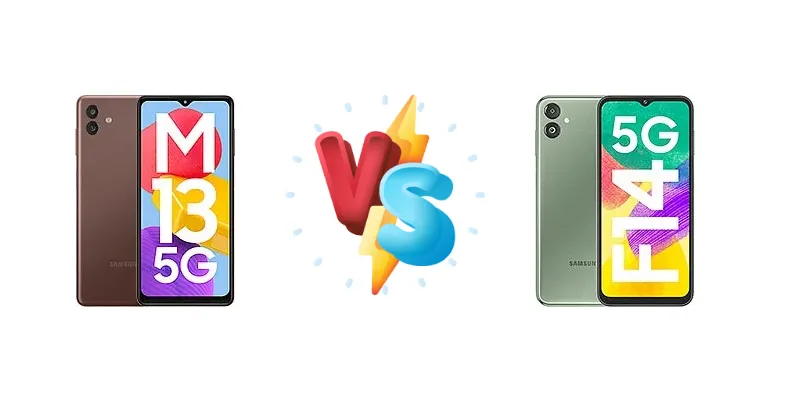
|
🏆 Quick Verdict
The Samsung Galaxy F14 emerges as the winner thanks to its superior chipset (Exynos 1330), faster charging (25W), and generally improved performance. While the M13 5G offers 5G connectivity, the F14's overall package is more appealing.
| PHONES | ||
|---|---|---|
| Phone Names | Samsung Galaxy M13 5G | Samsung Galaxy F14 |
| Network | ||
|---|---|---|
| 2G bands | GSM 850 / 900 / 1800 / 1900 | GSM 850 / 900 / 1800 / 1900 |
| 3G bands | HSDPA 850 / 900 / 1900 / 2100 | HSDPA 850 / 900 / 1700(AWS) / 1900 / 2100 |
| 4G bands | 1, 2, 3, 4, 5, 7, 8, 12, 17, 20, 26, 28, 38, 40, 41, 66 | 1, 2, 3, 4, 5, 7, 8, 12, 17, 20, 26, 28, 38, 40, 41, 66 |
| 5G bands | 1, 3, 5, 7, 8, 20, 28, 38, 40, 41, 78 SA/NSA/Sub6 | 1, 3, 5, 7, 8, 20, 28, 38, 40, 41, 66, 77, 78 SA/NSA/Sub6 |
| Speed | HSPA, LTE, 5G | HSPA, LTE-А, 5G |
| Technology | GSM / HSPA / LTE / 5G | GSM / HSPA / LTE / 5G |
| Launch | ||
|---|---|---|
| Announced | 2022, July 14 | 2023, March 24 |
| Status | Available. Released 2022, July 23 | Available. Released 2023, March 30 |
| Body | ||
|---|---|---|
| Build | Glass front (Gorilla Glass 3), plastic back, plastic frame | Glass front (Gorilla Glass 5), plastic back, plastic frame |
| Dimensions | 164.5 x 76.5 x 8.8 mm (6.48 x 3.01 x 0.35 in) | 166.8 x 77.2 x 9.4 mm (6.57 x 3.04 x 0.37 in) |
| SIM | Nano-SIM + Nano-SIM | Nano-SIM + Nano-SIM |
| Weight | 195 g (6.88 oz) | 206 g (7.27 oz) |
| Display | ||
|---|---|---|
| Protection | Corning Gorilla Glass 3 | Corning Gorilla Glass 5 |
| Resolution | 720 x 1600 pixels, 20:9 ratio (~270 ppi density) | 1080 x 2408 pixels, 20:9 ratio (~400 ppi density) |
| Size | 6.5 inches, 102.0 cm2 (~81.1% screen-to-body ratio) | 6.6 inches, 104.9 cm2 (~81.5% screen-to-body ratio) |
| Type | PLS LCD, 90Hz, 400 nits (typ) | PLS LCD, 90Hz |
| Platform | ||
|---|---|---|
| CPU | Octa-core (2x2.2 GHz Cortex-A76 & 6x2.0 GHz Cortex-A55) | Octa-core (2x2.4 GHz Cortex-A78 & 6x2.0 GHz Cortex-A55) |
| Chipset | Mediatek Dimensity 700 (7 nm) | Exynos 1330 (5 nm) |
| GPU | Mali-G57 MC2 | Mali-G68 MP2 |
| OS | Android 12, One UI Core 4 | Android 13, One UI Core 5.1 |
| Memory | ||
|---|---|---|
| Card slot | microSDXC (dedicated slot) | microSDXC (dedicated slot) |
| Internal | 64GB 4GB RAM, 128GB 6GB RAM | 64GB 4GB RAM, 128GB 4GB RAM, 128GB 6GB RAM |
| Main Camera | ||
|---|---|---|
| Dual | 50 MP, f/1.8, (wide), PDAF Auxiliary lens | 50 MP, f/1.8, (wide), PDAF 2 MP (macro) |
| Features | LED flash, panorama, HDR | LED flash, panorama, HDR |
| Video | 1080p@30fps | 1080p@30fps |
| Selfie camera | ||
|---|---|---|
| Features | HDR | - |
| Single | 5 MP, f/2.0, (wide) | 13 MP, f/2.0, (wide) |
| Video | - | 1080p@30fps |
| Sound | ||
|---|---|---|
| 3.5mm jack | Yes | Yes |
| 35mm jack | Yes | Yes |
| Loudspeaker | Yes | Yes |
| Comms | ||
|---|---|---|
| Bluetooth | 5.0, A2DP, LE | 5.2, A2DP, LE |
| NFC | No | No |
| Positioning | GPS, GLONASS, BDS, GALILEO, QZSS | GPS, GLONASS, GALILEO, BDS, QZSS, NavIC |
| Radio | Unspecified | FM radio, recording |
| USB | USB Type-C 2.0 | USB Type-C 2.0 |
| WLAN | Wi-Fi 802.11 a/b/g/n/ac, dual-band | Wi-Fi 802.11 a/b/g/n/ac, dual-band, Wi-Fi Direct |
| Features | ||
|---|---|---|
| Sensors | Fingerprint (side-mounted), accelerometer, gyro, compass | Fingerprint (side-mounted), accelerometer, gyro, proximity, compass |
| Virtual proximity sensing | - | |
| Battery | ||
|---|---|---|
| Charging | 15W wired | 25W wired |
| Type | Li-Po 5000 mAh | Li-Po 6000 mAh |
| Misc | ||
|---|---|---|
| Colors | Midnight Blue, Aqua Green, Stardust Brown | Black, Green, Purple |
| Models | SM-M136B, SM-M136B/DS | SM-E146B, SM-E146B/DS |
| Price | About 180 EUR | About 150 EUR |
| SAR | 0.73 W/kg (head) | 0.69 W/kg (head) |
| SAR EU | 0.84 W/kg (head) 1.33 W/kg (body) | - |
Samsung Galaxy M13 5G
- 5G Connectivity
- Large 6000mAh Battery
- Affordable Price
- Older Chipset
- Slower Charging (15W)
- Potentially Less Powerful Performance
Samsung Galaxy F14
- More Powerful Exynos 1330 Chipset
- Faster 25W Charging
- Improved Performance
- Likely Better Display
- No 5G Connectivity
- Similar Battery Capacity (but slower charging speed)
- Potentially Slightly Higher Price
Display Comparison
Both phones feature a 6.6-inch FHD+ display, likely with a 90Hz refresh rate. While panel technology (AMOLED vs LCD) isn't explicitly stated, the F14 is expected to have a slightly better display due to the newer Exynos chipset allowing for better display drivers. Expect similar brightness and color accuracy, but the F14 might offer marginally improved viewing angles.
Camera Comparison
Both phones likely feature a triple-camera setup, with a 50MP main sensor. The F14's newer chipset should provide better image processing capabilities, resulting in slightly better photos, especially in low light. Expect similar video recording capabilities, likely up to 1080p at 30fps. The F14 may have slightly improved stabilization.
Performance
This is where the F14 shines. The Exynos 1330 (5nm) is significantly more powerful than the Mediatek Dimensity 700 (7nm). Expect smoother multitasking, faster app loading times, and better gaming performance on the F14. The Cortex-A78 cores in the Exynos 1330 offer a substantial performance boost over the Cortex-A76 cores in the Dimensity 700.
Battery Life
Both phones are expected to have a 6000mAh battery, offering excellent battery life. However, the F14's 25W charging is a significant advantage over the M13 5G's 15W charging, allowing for much faster top-ups.
Buying Guide
The Samsung Galaxy M13 5G is a good choice for users prioritizing 5G connectivity on a tight budget and are less concerned about raw performance. The Samsung Galaxy F14 is ideal for those seeking a smoother experience, faster charging, and a more modern chipset, even if it means sacrificing 5G.