
Realme 9i 5G vs Samsung Galaxy M13 5G: A Deep Dive into Budget 5G Contenders
| Phones Images | |||||
|---|---|---|---|---|---|
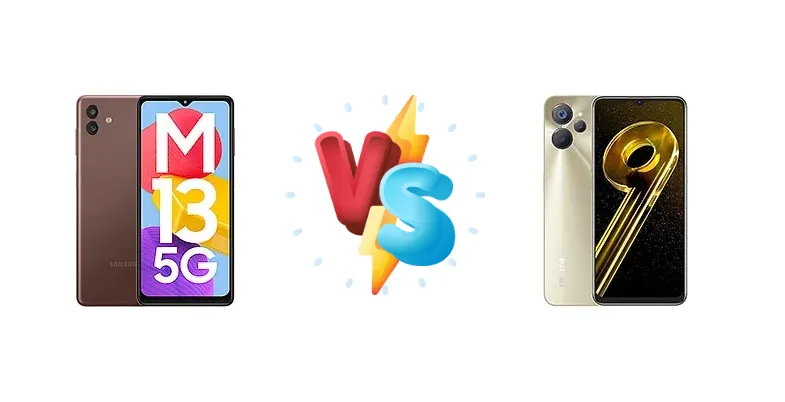
|
🏆 Quick Verdict
For most users, the Realme 9i 5G emerges as the better choice. Its Mediatek Dimensity 810, fabricated on a more efficient 6nm process, provides a noticeable performance edge over the Galaxy M13 5G’s Dimensity 700. While the Samsung offers brand recognition, the Realme delivers superior processing power and faster charging for a similar price.
| PHONES | ||
|---|---|---|
| Phone Names | Samsung Galaxy M13 5G | Realme 9i 5G |
| Network | ||
|---|---|---|
| 2G bands | GSM 850 / 900 / 1800 / 1900 | GSM 850 / 900 / 1800 / 1900 |
| 3G bands | HSDPA 850 / 900 / 1900 / 2100 | HSDPA 850 / 900 / 1700(AWS) / 1900 / 2100 |
| 4G bands | 1, 2, 3, 4, 5, 7, 8, 12, 17, 20, 26, 28, 38, 40, 41, 66 | 1, 2, 3, 4, 5, 7, 8, 19, 20, 28, 34, 38, 39, 40, 41 |
| 5G bands | 1, 3, 5, 7, 8, 20, 28, 38, 40, 41, 78 SA/NSA/Sub6 | 1, 5, 7, 8, 28, 41, 77, 78 SA/NSA |
| Speed | HSPA, LTE, 5G | HSPA, LTE, 5G |
| Technology | GSM / HSPA / LTE / 5G | GSM / HSPA / LTE / 5G |
| Launch | ||
|---|---|---|
| Announced | 2022, July 14 | 2022, August 18 |
| Status | Available. Released 2022, July 23 | Available. Released 2022, August 24 |
| Body | ||
|---|---|---|
| Build | Glass front (Gorilla Glass 3), plastic back, plastic frame | - |
| Dimensions | 164.5 x 76.5 x 8.8 mm (6.48 x 3.01 x 0.35 in) | 164.4 x 75.1 x 8.1 mm (6.47 x 2.96 x 0.32 in) |
| SIM | Nano-SIM + Nano-SIM | Nano-SIM + Nano-SIM |
| Weight | 195 g (6.88 oz) | 187 g (6.60 oz) |
| Display | ||
|---|---|---|
| Protection | Corning Gorilla Glass 3 | Panda Glass |
| Resolution | 720 x 1600 pixels, 20:9 ratio (~270 ppi density) | 1080 x 2408 pixels, 20:9 ratio (~400 ppi density) |
| Size | 6.5 inches, 102.0 cm2 (~81.1% screen-to-body ratio) | 6.6 inches, 104.9 cm2 (~85.0% screen-to-body ratio) |
| Type | PLS LCD, 90Hz, 400 nits (typ) | IPS LCD, 90Hz, 400 nits (typ) |
| Platform | ||
|---|---|---|
| CPU | Octa-core (2x2.2 GHz Cortex-A76 & 6x2.0 GHz Cortex-A55) | Octa-core (2x2.4 GHz Cortex-A76 & 6x2.0 GHz Cortex-A55) |
| Chipset | Mediatek Dimensity 700 (7 nm) | Mediatek Dimensity 810 (6 nm) |
| GPU | Mali-G57 MC2 | Mali-G57 MC2 |
| OS | Android 12, One UI Core 4 | Android 12, upgradable to Android 13, Realme UI 4.0 |
| Memory | ||
|---|---|---|
| Card slot | microSDXC (dedicated slot) | microSDXC (dedicated slot) |
| Internal | 64GB 4GB RAM, 128GB 6GB RAM | 64GB 4GB RAM, 128GB 4GB RAM, 128GB 6GB RAM |
| - | UFS 2.2 | |
| Main Camera | ||
|---|---|---|
| Dual | 50 MP, f/1.8, (wide), PDAF Auxiliary lens | - |
| Features | LED flash, panorama, HDR | LED flash, HDR, panorama |
| Single | - | 8 MP, f/2.0, 27mm (wide) |
| Triple | - | 50 MP, f/1.8, 26mm (wide), 1/2.76", 0.64µm, PDAF Unspecified MP, 46mm (telephoto) 2 MP (macro) |
| Video | 1080p@30fps | 1080p@30fps |
| Selfie camera | ||
|---|---|---|
| Features | HDR | HDR, panorama |
| Single | 5 MP, f/2.0, (wide) | 8 MP, f/2.0, 27mm (wide) |
| Video | - | 1080p@30fps |
| Sound | ||
|---|---|---|
| 3.5mm jack | Yes | Yes |
| 35mm jack | Yes | Yes |
| Loudspeaker | Yes | Yes |
| Comms | ||
|---|---|---|
| Bluetooth | 5.0, A2DP, LE | 5.2, A2DP, LE |
| NFC | No | No |
| Positioning | GPS, GLONASS, BDS, GALILEO, QZSS | GPS, GLONASS, GALILEO, BDS |
| Radio | Unspecified | No |
| USB | USB Type-C 2.0 | USB Type-C 2.0, OTG |
| WLAN | Wi-Fi 802.11 a/b/g/n/ac, dual-band | Wi-Fi 802.11 a/b/g/n/ac, dual-band |
| Features | ||
|---|---|---|
| Sensors | Fingerprint (side-mounted), accelerometer, gyro, compass | Fingerprint (side-mounted), accelerometer, proximity, compass |
| Virtual proximity sensing | - | |
| Battery | ||
|---|---|---|
| Charging | 15W wired | 18W wired |
| Type | Li-Po 5000 mAh | 5000 mAh |
| Misc | ||
|---|---|---|
| Colors | Midnight Blue, Aqua Green, Stardust Brown | Soulful Blue, Rocking Black, Gold |
| Models | SM-M136B, SM-M136B/DS | RMX3612 |
| Price | About 180 EUR | About 180 EUR |
| SAR | 0.73 W/kg (head) | - |
| SAR EU | 0.84 W/kg (head) 1.33 W/kg (body) | - |
Samsung Galaxy M13 5G
- Familiar Samsung One UI experience
- Strong brand recognition
- Reliable software updates (potentially)
- Less powerful chipset (Dimensity 700)
- Slower 15W charging
- Potentially lower sustained performance
Realme 9i 5G
- More powerful chipset (Dimensity 810)
- Faster 18W charging
- More efficient 6nm process
- Realme UI may not appeal to all users
- Less established brand reputation
- Potentially less frequent software updates
Display Comparison
Neither device boasts a standout display. Both likely utilize LCD panels, a common cost-saving measure in this segment. The key difference lies under the hood: the Realme 9i 5G’s Dimensity 810 benefits from a 6nm process, potentially leading to slightly better power efficiency when driving the display. While specific brightness nits aren't provided, the Realme's more efficient chipset could translate to marginally longer battery life during video playback.
Camera Comparison
Without detailed sensor information, a direct camera comparison is difficult. However, it’s safe to assume both phones feature a primary sensor paired with depth and macro lenses. Given the price point, image processing will likely be the differentiating factor. Samsung’s image processing tends to favor vibrant, saturated colors, while Realme often aims for a more natural look. The Realme 9i 5G’s more powerful chipset could potentially enable faster image processing and better low-light performance, but this is speculative without detailed camera specs.
Performance
The core difference between these two phones is the chipset. The Realme 9i 5G’s Mediatek Dimensity 810 (6nm) has a clock speed advantage with its 2x2.4 GHz Cortex-A76 cores compared to the Samsung Galaxy M13 5G’s Dimensity 700 (7nm) 2x2.2 GHz Cortex-A76 cores. The 6nm fabrication process of the Dimensity 810 is more efficient, meaning it generates less heat for the same level of performance. This translates to sustained performance during demanding tasks like gaming. While both use the same Cortex-A55 efficiency cores, the Realme’s higher-clocked performance cores will provide a smoother experience in everyday use and a more responsive gaming experience.
Battery Life
Both phones offer adequate battery capacity for all-day use, but the Realme 9i 5G has a clear advantage in charging speed. Its 18W wired charging is significantly faster than the Samsung Galaxy M13 5G’s 15W charging. This means less time tethered to a wall outlet and quicker top-ups when needed. While the actual battery capacity isn't specified, the faster charging of the Realme 9i 5G is a tangible benefit for users who are frequently on the go.
Buying Guide
Buy the Samsung Galaxy M13 5G if you prioritize the Samsung ecosystem and a familiar user interface, and are willing to trade some performance for brand loyalty. Buy the Realme 9i 5G if you prioritize raw processing power for gaming and multitasking, and want faster 18W charging to minimize downtime. The Realme is the better option for users who want the most performance for their money.