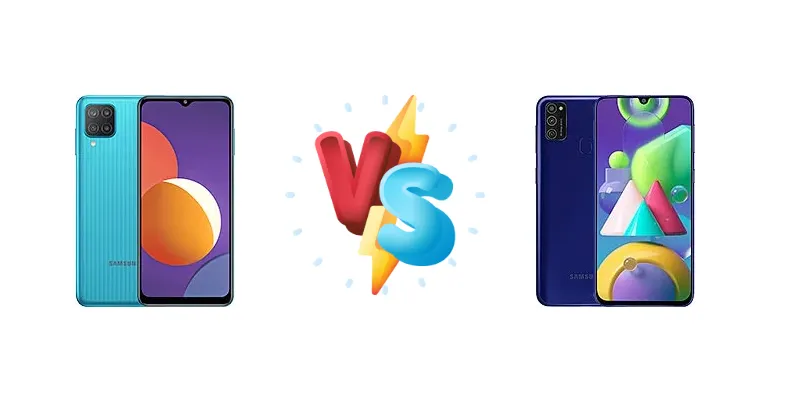
Samsung's Galaxy M series consistently delivers value, but choosing between models like the M12 and M21 can be tricky. Both aim for the budget-conscious user, but they diverge in chipset architecture and processing power. This comparison dissects the key differences to determine which phone offers the best experience for your needs.
🏆 Quick Verdict
For most users, the Samsung Galaxy M21 emerges as the better choice. While both phones share 15W charging, the M21’s Exynos 9611, with its Cortex-A73 cores, provides a noticeable performance uplift over the M12’s Exynos 850, making it more suitable for multitasking and demanding applications.
| Network |
|---|
| 2G bands | GSM 850 / 900 / 1800 / 1900 | GSM 850 / 900 / 1800 / 1900 |
| 3G bands | HSDPA 850 / 900 / 1700(AWS) / 1900 / 2100 | HSDPA 850 / 900 / 1900 / 2100 |
| 4G bands | 1, 2, 3, 4, 5, 7, 8, 12, 17, 20, 26, 28, 38, 40, 41, 66 | 1, 3, 5, 7, 8, 20, 38, 40, 41 |
| Speed | HSPA, LTE | HSPA, LTE |
| Technology | GSM / HSPA / LTE | GSM / HSPA / LTE |
| Launch |
|---|
| Announced | 2021, April 19 | 2020, March 18. Released 2020, March 23 |
| Status | Available. Released 2021, April 30 | Discontinued |
| Body |
|---|
| Build | Glass front, plastic back, plastic frame | Glass front (Gorilla Glass 3), plastic back, plastic frame |
| Dimensions | 164 x 75.9 x 9.7 mm (6.46 x 2.99 x 0.38 in) | 159 x 75.1 x 8.9 mm (6.26 x 2.96 x 0.35 in) |
| SIM | Nano-SIM + Nano-SIM | · Nano-SIM· Nano-SIM + Nano-SIM |
| Weight | 212 g (7.48 oz) | 188 g (6.63 oz) |
| Display |
|---|
| Protection | - | Corning Gorilla Glass 3 |
| Resolution | 720 x 1600 pixels, 20:9 ratio (~270 ppi density) | 1080 x 2340 pixels, 19.5:9 ratio (~403 ppi density) |
| Size | 6.5 inches, 102.0 cm2 (~81.9% screen-to-body ratio) | 6.4 inches, 100.5 cm2 (~84.2% screen-to-body ratio) |
| Type | PLS LCD, 90Hz | Super AMOLED, 420 nits (peak) |
| Platform |
|---|
| CPU | Octa-core (4x2.0 GHz Cortex-A55 & 4x2.0 GHz Cortex-A55) | Octa-core (4x2.3 GHz Cortex-A73 & 4x1.7 GHz Cortex-A53) |
| Chipset | Exynos 850 (8 nm) | Exynos 9611 (10 nm) |
| GPU | Mali-G52 | Mali-G72 MP3 |
| OS | Android 11, One UI Core 3.1 | Android 10, upgradable to Android 11, One UI 3.1 Core |
| Memory |
|---|
| Card slot | microSDXC (dedicated slot) | microSDXC (dedicated slot) |
| Internal | 32GB 3GB RAM, 32GB 4GB RAM, 64GB 4GB RAM, 128GB 4GB RAM | 64GB 4GB RAM, 128GB 6GB RAM |
| | eMMC 5.1 | UFS 2.1 |
| Main Camera |
|---|
| Features | LED flash, panorama, HDR | LED flash, panorama, HDR |
| Quad | 48 MP, f/2.0, (wide), 1/2.0", 0.8µm, PDAF
5 MP, f/2.2, 123˚ (ultrawide)
2 MP (macro)
Auxiliary lens | - |
| Single | 8 MP, f/2.2, (wide) | - |
| Triple | - | 48 MP, f/2.0, 26mm (wide), 1/2.0", 0.8µm, PDAF
8 MP, f/2.2, 12mm (ultrawide), 1/4.0", 1.12µm
Auxiliary lens |
| Video | 1080p@30fps | 4K@30fps, 1080p@30fps, 720p@240fps, gyro-EIS |
| Selfie camera |
|---|
| Features | HDR | HDR |
| Single | 8 MP, f/2.2, (wide) | 20 MP, f/2.2, 26mm (wide) |
| Video | 1080p@30fps | 1080p@30fps |
| Sound |
|---|
| 3.5mm jack | Yes | Yes |
| 35mm jack | Yes | Yes |
| Loudspeaker | Yes | Yes |
| Comms |
|---|
| Bluetooth | 5.0, A2DP, LE | 5.0, A2DP, LE |
| NFC | Yes | Yes (market/region dependent) |
| Positioning | GPS, GLONASS, GALILEO, BDS | GPS, GLONASS, GALILEO, BDS |
| Radio | Unspecified | FM radio, RDS, recording |
| USB | USB Type-C 2.0 | USB Type-C 2.0 |
| WLAN | Wi-Fi 802.11 b/g/n, Wi-Fi Direct | Wi-Fi 802.11 a/b/g/n/ac, dual-band, Wi-Fi Direct |
| Features |
|---|
| Sensors | Fingerprint (side-mounted), accelerometer | Fingerprint (rear-mounted), accelerometer, gyro, proximity, compass |
| | Virtual proximity sensing | - |
| Battery |
|---|
| Charging | 15W wired | 15W wired |
| Type | Li-Po 5000 mAh | Li-Po 6000 mAh |
| Misc |
|---|
| Colors | Black, Blue, Green | Midnight Blue, Raven Black |
| Models | SM-M127F, SM-M127F/DSN, SM-M127N | SM-M215F, SM-M215F/DS, SM-M215F/DSN |
| Price | About 170 EUR | About 190 EUR |
| SAR | - | 0.47 W/kg (head) |
| SAR EU | 0.54 W/kg (head) 1.39 W/kg (body) | - |
| Pricing |
|---|
| 64GB 4GB RAM | - | £ 279.99 |
| RENEWED | - | £ 129.00 |
Samsung Galaxy M12
- Newer chipset architecture (Exynos 850)
- Potentially better power efficiency (8nm process)
- Likely lower price point
- Significantly lower processing power
- Less responsive user experience
- Inferior gaming performance
Samsung Galaxy M21
- More powerful processor (Exynos 9611)
- Smoother multitasking and app performance
- Better gaming capabilities
- Older chipset architecture
- Potentially slightly lower battery life under heavy load
- £279.99 price tag (64GB/4GB model)
Display Comparison
Neither Samsung provides display specs beyond resolution. However, given their market positioning, both likely utilize LCD panels. The key difference lies in the processing power driving them. The M21’s more capable chipset can handle more complex graphics rendering, potentially resulting in a smoother visual experience, especially in games. Bezels are expected to be similar on both devices, reflecting their budget nature.
Camera Comparison
Without detailed camera specs, a direct comparison is limited. Both phones likely feature a multi-camera setup with a primary sensor, ultra-wide, and depth sensor. However, the image signal processor (ISP) within the Exynos 9611 of the M21 is more advanced, potentially leading to better image processing, dynamic range, and low-light performance. The M12’s ISP, while adequate, will likely struggle to match the M21’s capabilities. The presence of a 2MP macro camera on both is largely a marketing feature with limited practical benefit.
Performance
The core distinction here is the chipset. The Galaxy M21’s Exynos 9611 (10nm) features four Cortex-A73 cores clocked at 2.3 GHz, paired with four Cortex-A53 cores at 1.7 GHz. This configuration offers significantly more processing power than the M12’s Exynos 850 (8nm) which uses four Cortex-A55 cores at 2.0 GHz and another four at the same speed. The 10nm process of the 9611, while older, allows for higher clock speeds. While the M12 benefits from a smaller node size potentially improving efficiency, the architectural advantage of the M21’s cores translates to a more responsive user experience. The M21 will handle demanding apps and multitasking with greater ease.
Battery Life
Both devices are equipped with 15W wired charging. While battery capacity isn't specified, the M21’s more efficient processor, despite its higher performance, could potentially offset any capacity differences. The 15W charging speed is relatively slow by today’s standards, meaning a full charge will take over two hours on both devices. The real-world battery life will depend heavily on usage patterns, but the M21’s chipset is better optimized for power management during sustained tasks.
Buying Guide
Buy the Samsung Galaxy M12 if you prioritize a newer chipset architecture and are primarily focused on basic smartphone tasks like calling, texting, and light social media use. Buy the Samsung Galaxy M21 if you value smoother performance for gaming, video streaming, and multitasking, and are willing to accept a slightly older, but demonstrably more powerful, processor.
Frequently Asked Questions
❓ Does the Exynos 9611 in the M21 tend to overheat during prolonged gaming sessions?
While the Exynos 9611 isn't a flagship processor, it's generally well-behaved in terms of thermal management. However, extended gaming at high settings *could* lead to some throttling to prevent overheating. The M21's plastic build helps dissipate heat, but it won't match the cooling capabilities of more premium devices.
❓ Is the 2MP macro camera on either phone worth using for detailed close-up shots?
Realistically, no. 2MP macro cameras on budget phones typically lack the resolution and optics to produce truly detailed close-up images. They're often included as a marketing feature, but the results are generally soft and lack clarity. You're better off using the main camera and cropping if needed.
❓ Can the Samsung Galaxy M21 reliably run PUBG Mobile at 60fps?
The M21 *can* run PUBG Mobile, but achieving a consistent 60fps will depend on the graphics settings. Lowering the settings to 'Smooth' or 'Balanced' is recommended for a more stable frame rate. Expect some occasional frame drops during intense action sequences.
❓ What type of storage and RAM do these phones use, and does it impact performance?
While not explicitly stated, both phones likely use eMMC storage and LPDDR4X RAM, typical for this price range. Faster storage (UFS) and RAM (LPDDR5) would improve app loading times and multitasking, but are unlikely to be found in these models. The M21's more powerful processor can mitigate some of the limitations of slower storage.