
Samsung Galaxy A34 vs M12: A Detailed Comparison of Samsung's Budget Lineup
| Phones Images | |||||
|---|---|---|---|---|---|
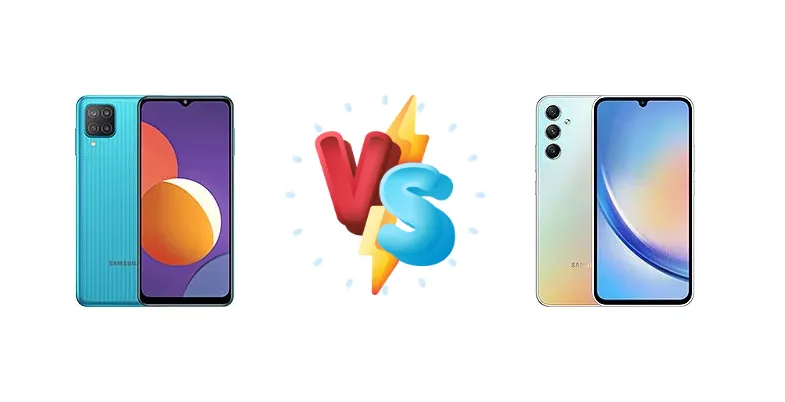
|
🏆 Quick Verdict
For most users, the Samsung Galaxy A34 is the superior choice. Its Mediatek Dimensity 1080 chipset delivers significantly better performance, and the brighter 1009 nit display enhances the viewing experience. While the M12 remains a viable option for extremely budget-conscious buyers, the A34 offers a more future-proof and enjoyable user experience.
| PHONES | ||
|---|---|---|
| Phone Names | Samsung Galaxy M12 | Samsung Galaxy A34 |
| Network | ||
|---|---|---|
| 2G bands | GSM 850 / 900 / 1800 / 1900 | GSM 850 / 900 / 1800 / 1900 |
| 3G bands | HSDPA 850 / 900 / 1700(AWS) / 1900 / 2100 | HSDPA 850 / 900 / 1700(AWS) / 1900 / 2100 |
| 4G bands | 1, 2, 3, 4, 5, 7, 8, 12, 17, 20, 26, 28, 38, 40, 41, 66 | 1, 2, 3, 4, 5, 7, 8, 12, 17, 20, 26, 28, 32, 38, 40, 41, 66 |
| 5G bands | - | 1, 3, 7, 8, 20, 28, 38, 40, 41, 77, 78 SA/NSA/Sub6 |
| Speed | HSPA, LTE | HSPA, LTE, 5G |
| Technology | GSM / HSPA / LTE | GSM / HSPA / LTE / 5G |
| Launch | ||
|---|---|---|
| Announced | 2021, April 19 | 2023, March 14 |
| Status | Available. Released 2021, April 30 | Available. Released 2023, March 24 |
| Body | ||
|---|---|---|
| Build | Glass front, plastic back, plastic frame | Glass front (Gorilla Glass 5), plastic frame, plastic back |
| Dimensions | 164 x 75.9 x 9.7 mm (6.46 x 2.99 x 0.38 in) | 161.3 x 78.1 x 8.2 mm (6.35 x 3.07 x 0.32 in) |
| SIM | Nano-SIM + Nano-SIM | · Nano-SIM· Nano-SIM + Nano-SIM |
| Weight | 212 g (7.48 oz) | 199 g (7.02 oz) |
| - | IP67 dust/water resistant (up to 1m for 30 min) | |
| Display | ||
|---|---|---|
| Protection | - | Corning Gorilla Glass 5 |
| Resolution | 720 x 1600 pixels, 20:9 ratio (~270 ppi density) | 1080 x 2340 pixels, 19.5:9 ratio (~390 ppi density) |
| Size | 6.5 inches, 102.0 cm2 (~81.9% screen-to-body ratio) | 6.6 inches, 106.9 cm2 (~84.9% screen-to-body ratio) |
| Type | PLS LCD, 90Hz | Super AMOLED, 120Hz, 1000 nits (HBM) |
| Platform | ||
|---|---|---|
| CPU | Octa-core (4x2.0 GHz Cortex-A55 & 4x2.0 GHz Cortex-A55) | Octa-core (2x2.6 GHz Cortex-A78 & 6x2.0 GHz Cortex-A55) |
| Chipset | Exynos 850 (8 nm) | Mediatek Dimensity 1080 (6 nm) |
| GPU | Mali-G52 | Mali-G68 MC4 |
| OS | Android 11, One UI Core 3.1 | Android 13, up to 4 major Android upgrades, One UI 6.1 |
| Memory | ||
|---|---|---|
| Card slot | microSDXC (dedicated slot) | microSDXC (uses shared SIM slot) |
| Internal | 32GB 3GB RAM, 32GB 4GB RAM, 64GB 4GB RAM, 128GB 4GB RAM | 128GB 4GB RAM, 128GB 6GB RAM, 128GB 8GB RAM, 256GB 6GB RAM, 256GB 8GB RAM |
| eMMC 5.1 | - | |
| Main Camera | ||
|---|---|---|
| Features | LED flash, panorama, HDR | LED flash, panorama, HDR |
| Quad | 48 MP, f/2.0, (wide), 1/2.0", 0.8µm, PDAF 5 MP, f/2.2, 123˚ (ultrawide) 2 MP (macro) Auxiliary lens | - |
| Single | 8 MP, f/2.2, (wide) | - |
| Triple | - | 48 MP, f/1.8, 26mm (wide), 1/2.0", 0.8µm, PDAF, OIS 8 MP, f/2.2, 123˚, (ultrawide), 1/4.0", 1.12µm 5 MP (macro) |
| Video | 1080p@30fps | 4K@30fps, 1080p@30/60fps, 720p@480fps |
| Selfie camera | ||
|---|---|---|
| Features | HDR | - |
| Single | 8 MP, f/2.2, (wide) | 13 MP, f/2.2, 26mm (wide), 1/3.1", 1.12µm |
| Video | 1080p@30fps | 4K@30fps, 1080p@30fps |
| Sound | ||
|---|---|---|
| 3.5mm jack | Yes | No |
| 35mm jack | Yes | No |
| Loudspeaker | Yes | Yes, with stereo speakers |
| Comms | ||
|---|---|---|
| Bluetooth | 5.0, A2DP, LE | 5.3, A2DP, LE |
| NFC | Yes | Yes (market/region dependent) |
| Positioning | GPS, GLONASS, GALILEO, BDS | GPS, GLONASS, GALILEO, BDS |
| Radio | Unspecified | No |
| USB | USB Type-C 2.0 | USB Type-C 2.0, OTG |
| WLAN | Wi-Fi 802.11 b/g/n, Wi-Fi Direct | Wi-Fi 802.11 a/b/g/n/ac, dual-band, Wi-Fi Direct |
| Features | ||
|---|---|---|
| Sensors | Fingerprint (side-mounted), accelerometer | Fingerprint (under display, optical), accelerometer, gyro, compass |
| Virtual proximity sensing | Virtual proximity sensing | |
| Battery | ||
|---|---|---|
| Charging | 15W wired | 25W wired |
| Type | Li-Po 5000 mAh | Li-Ion 5000 mAh |
| Misc | ||
|---|---|---|
| Colors | Black, Blue, Green | Lime, Graphite, Violet, Silver |
| Models | SM-M127F, SM-M127F/DSN, SM-M127N | SM-A346E, SM-A346B, SM-A346B/DS, SM-A346B/DSN, SM-A346E/DS, SM-A346E/DSN, SM-A346M, SM-A346M/N, SM-A346M/DSN, SM-A3460 |
| Price | About 170 EUR | € 169.99 / $ 175.00 / £ 164.99 / ₹ 23,999 |
| SAR EU | 0.54 W/kg (head) 1.39 W/kg (body) | 0.55 W/kg (head) 1.49 W/kg (body) |
| Tests | ||
|---|---|---|
| Battery life | - | Endurance rating 133h |
| Camera | - | Photo / Video |
| Display | - | Contrast ratio: Infinite (nominal) |
| Loudspeaker | - | -26.1 LUFS (Good) |
| Performance | - | AnTuTu: 472126 (v9) GeekBench: 2316 (v5.5), 2518 (v6) GFXBench: 23fps (ES 3.1 onscreen) |
Samsung Galaxy M12
- Significantly faster processor (Dimensity 1080)
- Brighter and more vibrant display (1009 nits)
- Faster charging (25W)
- Likely higher price point
- May lack a headphone jack (depending on region)
Samsung Galaxy A34
- More affordable price
- Decent battery life (133h endurance)
- Acceptable performance for basic tasks
- Slower processor (Exynos 850)
- Dimmer display
- Slower charging (15W)
Display Comparison
The Galaxy A34 boasts a significantly brighter display, reaching a measured peak brightness of 1009 nits, compared to an unspecified brightness for the M12. This makes the A34 far more usable outdoors in direct sunlight. While both displays are described as having an 'infinite' contrast ratio (typical for AMOLED panels), the A34’s higher brightness translates to a more vivid and punchy image. The M12’s display technology is not specified, suggesting a potentially lower-quality panel. The A34’s superior display is a clear advantage for media consumers and gamers.
Camera Comparison
Both phones feature photo and video capabilities, but detailed camera specifications are limited. Without sensor size or aperture information, a direct comparison is difficult. However, the A34’s positioning in Samsung’s lineup suggests a more advanced camera system. The inclusion of features like Optical Image Stabilization (OIS) – common in A-series phones – is likely, providing sharper images and smoother videos. The M12 likely relies on software processing to compensate for a less capable sensor. The presence of a 2MP macro camera on the M12 is a common budget phone tactic, offering limited real-world benefit due to its low resolution.
Performance
The core difference lies in the chipsets. The Galaxy A34’s Mediatek Dimensity 1080, fabricated on a 6nm process, offers a substantial performance leap over the Galaxy M12’s Exynos 850 (8nm). The Dimensity 1080’s octa-core configuration, featuring 2x2.6 GHz Cortex-A78 cores and 6x2.0 GHz Cortex-A55 cores, provides a more responsive experience for demanding applications and gaming. The Exynos 850, with its 4x2.0 GHz Cortex-A55 and 4x2.0 GHz Cortex-A55 cores, is adequate for basic tasks but will struggle with heavier workloads. The 6nm process of the Dimensity 1080 also contributes to better thermal efficiency, reducing the likelihood of performance throttling during extended use.
Battery Life
Both devices share an endurance rating of 133 hours, suggesting comparable battery life under similar usage conditions. However, the A34’s 25W wired charging is a significant advantage over the M12’s 15W charging. This translates to faster top-ups, reducing downtime. While battery capacity isn’t specified, the faster charging speed of the A34 mitigates any potential disadvantage from a slightly smaller battery size. A full charge on the A34 will be noticeably quicker than on the M12.
Buying Guide
Buy the Samsung Galaxy M12 if you prioritize absolute affordability and basic smartphone functionality. It's ideal for users who primarily need a phone for calls, texts, and light social media use. Buy the Samsung Galaxy A34 if you value performance for gaming and multitasking, a brighter and more vibrant display for media consumption, and faster charging speeds. It's the better choice for users who want a phone that can handle more demanding tasks and last longer in the long run.