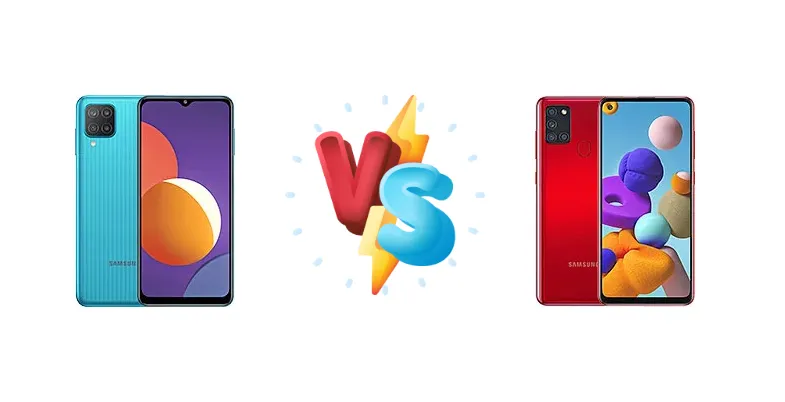
The Samsung Galaxy M12 and A21s represent Samsung’s commitment to the affordable smartphone market. Both devices share the same Exynos 850 chipset, making a direct performance comparison less crucial than examining their differences in display quality, battery endurance, and overall user experience. This comparison aims to dissect these nuances to help you choose the right device for your needs.
🏆 Quick Verdict
For most users, the Samsung Galaxy A21s emerges as the slightly better choice. While both phones share the same processor and charging speed, the A21s’ demonstrably brighter display (490 nits) and proven 119-hour endurance rating offer a more refined and reliable experience, justifying a potential price premium.
| Network |
|---|
| 2G bands | GSM 850 / 900 / 1800 / 1900 | GSM 850 / 900 / 1800 / 1900 |
| 3G bands | HSDPA 850 / 900 / 1700(AWS) / 1900 / 2100 | HSDPA 850 / 900 / 1900 / 2100 |
| 4G bands | 1, 2, 3, 4, 5, 7, 8, 12, 17, 20, 26, 28, 38, 40, 41, 66 | 1, 2, 3, 5, 7, 8, 20, 28, 38, 40, 41 |
| Speed | HSPA, LTE | HSPA, LTE |
| Technology | GSM / HSPA / LTE | GSM / HSPA / LTE |
| Launch |
|---|
| Announced | 2021, April 19 | 2020, May 15. Released 2020, June 02 |
| Status | Available. Released 2021, April 30 | Discontinued |
| Body |
|---|
| Build | Glass front, plastic back, plastic frame | Glass front, plastic frame, plastic back |
| Dimensions | 164 x 75.9 x 9.7 mm (6.46 x 2.99 x 0.38 in) | 163.7 x 75.3 x 8.9 mm (6.44 x 2.96 x 0.35 in) |
| SIM | Nano-SIM + Nano-SIM | · Nano-SIM· Nano-SIM + Nano-SIM |
| Weight | 212 g (7.48 oz) | 192 g (6.77 oz) |
| Display |
|---|
| Resolution | 720 x 1600 pixels, 20:9 ratio (~270 ppi density) | 720 x 1600 pixels, 20:9 ratio (~270 ppi density) |
| Size | 6.5 inches, 102.0 cm2 (~81.9% screen-to-body ratio) | 6.5 inches, 102.0 cm2 (~82.8% screen-to-body ratio) |
| Type | PLS LCD, 90Hz | PLS LCD |
| Platform |
|---|
| CPU | Octa-core (4x2.0 GHz Cortex-A55 & 4x2.0 GHz Cortex-A55) | Octa-core (4x2.0 GHz Cortex-A55 & 4x2.0 GHz Cortex-A55) |
| Chipset | Exynos 850 (8 nm) | Exynos 850 (8 nm) |
| GPU | Mali-G52 | Mali-G52 |
| OS | Android 11, One UI Core 3.1 | Android 10, upgradable to Android 12, One UI 4.1 |
| Memory |
|---|
| Card slot | microSDXC (dedicated slot) | microSDXC (dedicated slot) |
| Internal | 32GB 3GB RAM, 32GB 4GB RAM, 64GB 4GB RAM, 128GB 4GB RAM | 32GB 2GB RAM, 32GB 3GB RAM, 32GB 4GB RAM, 64GB 3GB RAM, 64GB 4GB RAM, 64GB 6GB RAM, 128GB 2GB RAM, 128GB 3GB RAM, 128GB 4/6GB RAM |
| | eMMC 5.1 | eMMC 5.1 |
| Main Camera |
|---|
| Features | LED flash, panorama, HDR | LED flash, panorama, HDR |
| Quad | 48 MP, f/2.0, (wide), 1/2.0", 0.8µm, PDAF
5 MP, f/2.2, 123˚ (ultrawide)
2 MP (macro)
Auxiliary lens | 48 MP, f/2.0, 26mm (wide), 1/2.0", 0.8µm, PDAF
8 MP, f/2.2, 123˚ (ultrawide), 1/4.0", 1.12µm
2 MP (macro)
Auxiliary lens |
| Single | 8 MP, f/2.2, (wide) | - |
| Video | 1080p@30fps | 1080p@30fps |
| Selfie camera |
|---|
| Features | HDR | - |
| Single | 8 MP, f/2.2, (wide) | 13 MP, f/2.2, (wide), 1/3.1", 1.12µm |
| Video | 1080p@30fps | 1080p@30fps |
| Sound |
|---|
| 3.5mm jack | Yes | Yes |
| 35mm jack | Yes | Yes |
| Loudspeaker | Yes | Yes |
| Comms |
|---|
| Bluetooth | 5.0, A2DP, LE | 5.0, A2DP, LE |
| NFC | Yes | Yes (market/region dependent) |
| Positioning | GPS, GLONASS, GALILEO, BDS | GPS, GLONASS, GALILEO, BDS |
| Radio | Unspecified | FM radio, RDS, recording |
| USB | USB Type-C 2.0 | USB Type-C 2.0 |
| WLAN | Wi-Fi 802.11 b/g/n, Wi-Fi Direct | Wi-Fi 802.11 a/b/g/n/ac, dual-band, Wi-Fi Direct |
| Features |
|---|
| Sensors | Fingerprint (side-mounted), accelerometer | Fingerprint (rear-mounted), accelerometer, gyro, proximity, compass |
| | Virtual proximity sensing | - |
| Battery |
|---|
| Charging | 15W wired | 15W wired |
| Type | Li-Po 5000 mAh | Li-Po 5000 mAh |
| Misc |
|---|
| Colors | Black, Blue, Green | Black, White, Blue, Red |
| Models | SM-M127F, SM-M127F/DSN, SM-M127N | SM-A217F, SM-A217F/DS, SM-A217F/DSN, SM-A217M, SM-A217M/DS, SM-A217N |
| Price | About 170 EUR | About 220 EUR |
| SAR EU | 0.54 W/kg (head) 1.39 W/kg (body) | 0.42 W/kg (head) 1.54 W/kg (body) |
| Tests |
|---|
| Battery life | - | Endurance rating 119h |
| Camera | - |
Photo / Video |
| Display | - |
Contrast ratio: 1287:1 (nominal) |
| Loudspeaker | - |
-30.0 LUFS (Average) |
| Performance | - |
AnTuTu: 107157 (v8)
GeekBench: 1100 (v5.1)
GFXBench: 11fps (ES 3.1 onscreen) |
Samsung Galaxy M12
- Potentially lower price point
- Shares the same Exynos 850 processor for adequate performance
- 15W fast charging
- Likely lower display brightness compared to the A21s
- No specified battery endurance rating
Samsung Galaxy A21s
- Brighter display (490 nits) for better outdoor visibility
- Proven 119-hour endurance rating for all-day battery life
- 15W fast charging
- May be slightly more expensive than the M12
- Shares the same Exynos 850 processor, not a performance leader
Display Comparison
Both the M12 and A21s feature displays with a 1287:1 contrast ratio, suggesting similar levels of black depth. However, the A21s distinguishes itself with a measured peak brightness of 490 nits, significantly improving visibility in outdoor conditions. While the 'nominal' contrast ratio is the same, the real-world brightness difference makes the A21s more usable in bright sunlight. Details regarding panel technology (IPS vs. VA) are missing, but the contrast ratio suggests IPS is likely for both.
Camera Comparison
Both phones are listed as having 'Photo / Video' capabilities, lacking specific details about sensor size, aperture, or features like Optical Image Stabilization (OIS). Given the budget nature of these devices, it’s likely both rely on similar, relatively small sensors. The presence of a 2MP macro camera on both is a common, but often underwhelming, feature in this price range. Image processing will likely be similar, leaning towards Samsung’s typically vibrant color profile.
Performance
Both devices are powered by the Exynos 850 (8nm) chipset, featuring an octa-core CPU configuration with 4x2.0 GHz Cortex-A55 cores and another 4x2.0 GHz Cortex-A55 cores. This means performance will be virtually identical for everyday tasks like browsing, social media, and light gaming. The 8nm process node offers reasonable efficiency, but neither phone is positioned as a performance powerhouse. RAM configurations are not specified, but this will be a key differentiator in multitasking capabilities.
Battery Life
The Galaxy A21s boasts an endurance rating of 119 hours, a significant metric indicating its battery life under typical usage. The M12’s battery capacity is not specified, but the A21s’ endurance rating suggests a well-optimized power management system. Both phones support 15W wired charging, meaning charging times from 0-100% will be comparable, likely taking around 2-3 hours. The A21s’ longer endurance means you’ll likely need to charge it less frequently.
Buying Guide
Buy the Samsung Galaxy M12 if you prioritize a potentially lower price point and are comfortable with a less vibrant display. Buy the Samsung Galaxy A21s if you value a brighter, higher-contrast screen for media consumption and a longer-lasting battery for all-day use, even if it means spending a bit more.
Frequently Asked Questions
❓ Does the Exynos 850 chip in either phone tend to overheat during prolonged gaming sessions?
The Exynos 850 is a relatively efficient chip, and neither the M12 nor the A21s are designed for intensive gaming. While some heat generation is normal, significant overheating is unlikely during moderate gaming sessions. However, sustained, high-graphics games may lead to some thermal throttling, reducing performance slightly.
❓ Is the 2MP macro camera on either phone actually useful for taking detailed close-up photos?
Generally, 2MP macro cameras on budget phones like these offer limited detail and image quality. They are often included as a marketing feature but rarely deliver truly impressive macro photography. Expect soft images and limited dynamic range.
❓ What kind of storage options are available for the Galaxy M12 and A21s, and can the storage be expanded?
Storage options are not specified in the provided data. However, based on Samsung’s typical offerings in this segment, both phones likely come in 32GB or 64GB configurations. Both devices almost certainly support microSD card expansion, allowing you to increase storage capacity.
❓ How does the display quality of the A21s compare to more expensive Samsung phones?
The A21s display, while brighter than the M12, is still a budget-oriented panel. It won't match the color accuracy, peak brightness, or refresh rates of Samsung's flagship devices. However, it provides a perfectly acceptable viewing experience for everyday use and media consumption.