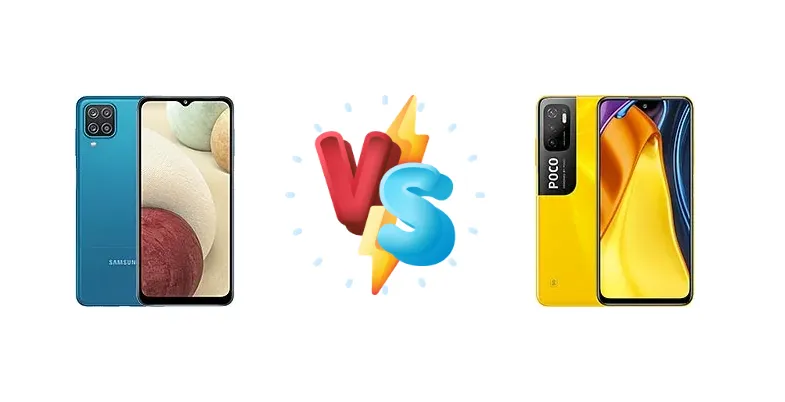
Both the Samsung Galaxy M12 (India) and the Xiaomi Poco M3 Pro 5G target the budget-conscious 5G smartphone user. However, they approach this segment with different strategies. The M12 relies on Samsung’s established brand and a focus on efficiency, while the Poco M3 Pro 5G prioritizes raw performance with a more modern chipset. This comparison dissects their key differences to determine which offers the best value.
🏆 Quick Verdict
For most users, the Xiaomi Poco M3 Pro 5G emerges as the stronger contender. Its Mediatek Dimensity 700 chipset, built on a 7nm process, delivers noticeably better CPU and GPU performance than the Samsung Galaxy M12’s Exynos 850. While both offer similar battery endurance, the Poco’s faster 18W charging provides a slight convenience advantage.
| Network |
|---|
| 2G bands | GSM 850 / 900 / 1800 / 1900 | GSM 850 / 900 / 1800 / 1900 |
| 3G bands | HSDPA 850 / 900 / 2100 | HSDPA 850 / 900 / 1700(AWS) / 1900 / 2100 |
| 4G bands | 1, 3, 5, 7, 8, 38, 40, 41 | 1, 2, 3, 4, 5, 7, 8, 12, 17, 20, 28, 32, 38, 40, 41, 66 |
| 5G bands | - | 1, 3, 7, 8, 20, 28, 38, 40, 41, 66, 77, 78 SA/NSA |
| Speed | HSPA, LTE | HSPA, LTE, 5G |
| Technology | GSM / HSPA / LTE | GSM / HSPA / LTE / 5G |
| Launch |
|---|
| Announced | 2021, February 05 | 2021, May 19 |
| Status | Available. Released 2021, March 18 | Available. Released 2021, May 22 |
| Body |
|---|
| Build | Glass front, plastic back, plastic frame | Glass front (Gorilla Glass 3), plastic frame, plastic back |
| Dimensions | 164 x 75.9 x 9.7 mm (6.46 x 2.99 x 0.38 in) | 161.8 x 75.3 x 8.9 mm (6.37 x 2.96 x 0.35 in) |
| SIM | Nano-SIM + Nano-SIM | Nano-SIM + Nano-SIM |
| Weight | 221 g (7.80 oz) | 190 g (6.70 oz) |
| Display |
|---|
| Protection | - | Corning Gorilla Glass 3 |
| Resolution | 720 x 1600 pixels, 20:9 ratio (~270 ppi density) | 1080 x 2400 pixels, 20:9 ratio (~405 ppi density) |
| Size | 6.5 inches, 102.0 cm2 (~81.9% screen-to-body ratio) | 6.5 inches, 102.0 cm2 (~83.7% screen-to-body ratio) |
| Type | PLS LCD, 90Hz | IPS LCD, 90Hz, 400 nits (typ), 500 nits (HBM) |
| Platform |
|---|
| CPU | Octa-core (4x2.0 GHz Cortex-A55 & 4x2.0 GHz Cortex-A55) | Octa-core (2x2.2 GHz Cortex-A76 & 6x2.0 GHz Cortex-A55) |
| Chipset | Exynos 850 (8 nm) | Mediatek Dimensity 700 (7 nm) |
| GPU | Mali-G52 | Mali-G57 MC2 |
| OS | Android 11, One UI 3.1 | Android 11, MIUI 12 |
| Memory |
|---|
| Card slot | microSDXC (dedicated slot) | microSDXC (uses shared SIM slot) |
| Internal | 64GB 4GB RAM, 128GB 6GB RAM | 64GB 4GB RAM, 128GB 6GB RAM |
| | eMMC 5.1 | UFS 2.2 |
| Main Camera |
|---|
| Features | LED flash, panorama, HDR | Dual-LED dual-tone flash, HDR, panorama |
| Quad | 48 MP, f/2.0, (wide), 1/2.0", 0.8µm, PDAF
5 MP, f/2.2, 123˚ (ultrawide)
2 MP (macro)
Auxiliary lens | - |
| Single | - | 8 MP, f/2.0, (wide) |
| Triple | - | 48 MP, f/1.8, 26mm (wide), 1/2.0", 0.8µm, PDAF
2 MP (macro)
Auxiliary lens |
| Video | 1080p@30fps | 1080p@30fps |
| Selfie camera |
|---|
| Features | HDR | - |
| Single | 8 MP, f/2.2, (wide) | 8 MP, f/2.0, (wide) |
| Video | 1080p@30fps | 1080p@30fps |
| Sound |
|---|
| 3.5mm jack | Yes | Yes |
| 35mm jack | Yes | Yes |
| Loudspeaker | Yes | Yes |
| | - | 24-bit/192kHz audio |
| Comms |
|---|
| Bluetooth | 5.0, A2DP, LE | 5.1, A2DP, LE |
| Infrared port | - | Yes |
| NFC | No | Yes (market/region dependent) |
| Positioning | GPS, GLONASS, GALILEO, BDS | GPS, GLONASS, GALILEO, BDS |
| Radio | Unspecified | FM radio |
| USB | USB Type-C 2.0, OTG | USB Type-C 2.0 |
| WLAN | Wi-Fi 802.11 b/g/n, Wi-Fi Direct | Wi-Fi 802.11 a/b/g/n/ac, dual-band, Wi-Fi Direct |
| Features |
|---|
| Sensors | Fingerprint (side-mounted), accelerometer | Fingerprint (side-mounted), accelerometer, gyro, proximity, compass |
| | Virtual proximity sensing | - |
| Battery |
|---|
| Charging | 15W wired | 18W wired |
| Type | Li-Po 6000 mAh | Li-Po 5000 mAh |
| Misc |
|---|
| Colors | Attractive Black, Elegant Blue, Trendy Emerald Green | Poco Yellow, Power Black, Cool Blue |
| Models | SM-M127F, SM-M127F/DS, SM-F127G, SM-F127G/DS, SM-M127G, SM-M127G/DS | M2103K19PG, M2103K19PI, M2103K19PY |
| Price | About 130 EUR | About 140 EUR |
| SAR | 1.19 W/kg (head) | 0.94 W/kg (head) 1.06 W/kg (body) |
| SAR EU | 0.54 W/kg (head) 1.39 W/kg (body) | 0.54 W/kg (head) 0.90 W/kg (body) |
| Pricing |
|---|
| 128GB 6GB RAM | ₹ 13,999 | - |
| Tests |
|---|
| Battery life | - |
Endurance rating 121h
|
| Camera | - |
Photo / Video |
| Display | - |
Contrast ratio: 1475:1 (nominal) |
| Loudspeaker | - |
-27.9 LUFS (Good)
|
Samsung Galaxy M12 (India)
- Established Samsung brand reputation
- Potentially more refined software experience
- Similar battery endurance to Poco M3 Pro 5G
- Less powerful Exynos 850 chipset
- Slower 15W charging
- Display specifications are less impressive
Xiaomi Poco M3 Pro 5G
- More powerful Mediatek Dimensity 700 chipset
- Faster 18W charging
- Higher peak display brightness
- Xiaomi’s MIUI software can be polarizing
- Brand recognition is lower than Samsung in some markets
Display Comparison
The Poco M3 Pro 5G boasts a measured peak brightness of 536 nits, a significant advantage over the Galaxy M12’s unspecified brightness. Both displays share a 1475:1 contrast ratio, suggesting similar color reproduction quality. However, the lack of detailed display specifications for the M12 – such as panel type (IPS vs AMOLED) and color gamut coverage – leaves the Poco with a clear edge in terms of visual experience, particularly in outdoor conditions. The M12’s display is likely to be less vibrant and harder to see in direct sunlight.
Camera Comparison
Both devices list 'Photo / Video' capabilities, but lack specific details. Without sensor size or aperture information, a direct comparison is difficult. However, given the market positioning, it’s reasonable to assume both utilize budget-friendly sensors. The presence of a 2MP macro camera on both devices suggests limited utility, as image quality from such sensors is typically subpar. Real-world image processing will likely be the differentiating factor, and Samsung generally offers more refined image processing, but the Poco’s potentially superior ISP within the Dimensity 700 could close the gap.
Performance
The core difference lies in the chipsets. The Poco M3 Pro 5G’s Mediatek Dimensity 700 (7nm) features a more powerful CPU configuration with 2x2.2 GHz Cortex-A76 cores alongside 6x2.0 GHz Cortex-A55 cores, compared to the Galaxy M12’s Exynos 850 (8nm) which utilizes 4x2.0 GHz Cortex-A55 cores paired with another 4x2.0 GHz Cortex-A55 cores. This architectural difference translates to a tangible performance boost for the Poco, especially in CPU-intensive tasks and gaming. The 7nm fabrication process of the Dimensity 700 also contributes to better power efficiency. While both phones have 6GB of RAM in the specified configuration, the superior chipset will allow the Poco to handle multitasking and demanding applications more smoothly.
Battery Life
Both the Samsung Galaxy M12 and the Xiaomi Poco M3 Pro 5G achieve an endurance rating of 121 hours, indicating comparable battery life under similar usage conditions. However, the Poco M3 Pro 5G offers 18W wired charging, while the M12 is limited to 15W. This translates to faster charging times for the Poco, reducing downtime. While the difference isn’t massive, it’s a noticeable convenience factor for users who frequently need to top up their battery.
Buying Guide
Buy the Samsung Galaxy M12 (India) if you prioritize a well-established brand with a focus on software stability and a potentially wider service network. Buy the Xiaomi Poco M3 Pro 5G if you value performance for gaming and demanding apps, and want a faster processor and quicker charging at a similar price point. The Poco is the better choice for users who actively utilize 5G connectivity.
Frequently Asked Questions
❓ Does the Exynos 850 in the Galaxy M12 tend to overheat during prolonged gaming sessions?
The Exynos 850 is generally an efficient chip, but its lower performance ceiling compared to the Dimensity 700 means it will likely work harder during gaming. While it shouldn't overheat severely, users may experience some throttling and reduced frame rates in demanding titles over extended periods.
❓ Is the 2MP macro camera on either phone worth using for detailed close-up shots?
Unfortunately, the 2MP macro cameras on both the Galaxy M12 and Poco M3 Pro 5G are largely marketing features. The low resolution and lack of autofocus result in images that are often soft, noisy, and lack detail. They are best avoided in favor of the main camera.
❓ Can the Poco M3 Pro 5G reliably maintain 60fps in popular games like PUBG Mobile?
The Poco M3 Pro 5G, with its Dimensity 700 chipset, should be able to maintain 60fps in PUBG Mobile at medium graphics settings. However, achieving consistently high frame rates at higher settings may require some optimization and could lead to occasional frame drops.
❓ What type of charging protocol does the Samsung Galaxy M12 support, and is a faster charger compatible?
The Samsung Galaxy M12 supports 15W charging via USB-C. While it may technically charge with a faster PD (Power Delivery) charger, it won't draw more than 15W, so there's no practical benefit to using a higher wattage charger.