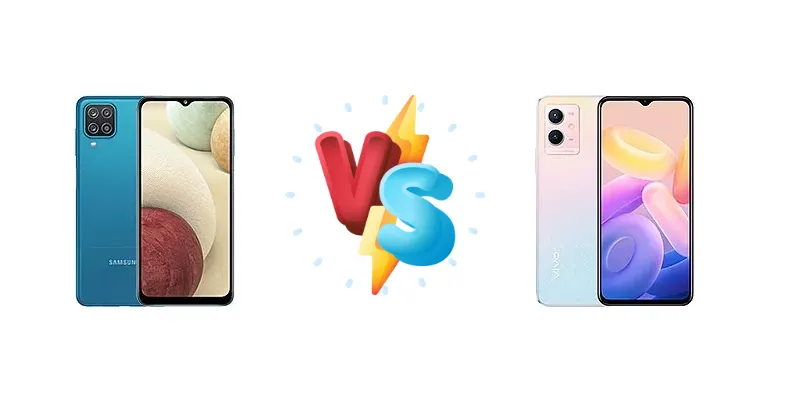
Both the Samsung Galaxy M12 (India) and the vivo Y33s 5G target the increasingly competitive sub-₹15,000 (approximately $180 USD) Indian smartphone market, offering 5G connectivity at an accessible price point. However, they take different approaches to achieving this, with Samsung relying on its Exynos 850 chipset and vivo opting for the MediaTek Dimensity 700. This comparison will dissect the key differences to determine which device delivers the best value.
🏆 Quick Verdict
For the average user prioritizing 5G connectivity and slightly better performance, the vivo Y33s 5G is the stronger choice. Its Dimensity 700, built on a more efficient 7nm process, offers a noticeable advantage in sustained performance and potentially better power efficiency compared to the Samsung Galaxy M12’s 8nm Exynos 850. However, Samsung’s brand recognition and software experience remain compelling factors.
| Network |
|---|
| 2G bands | GSM 850 / 900 / 1800 / 1900 | GSM 850 / 900 / 1800 / 1900 |
| 3G bands | HSDPA 850 / 900 / 2100 | HSDPA 850 / 900 / 2100 |
| 4G bands | 1, 3, 5, 7, 8, 38, 40, 41 | 1, 3, 5, 8, 28, 34, 38, 39, 40, 41 |
| 5G bands | - | 1, 28, 41, 77, 78 SA/NSA |
| Speed | HSPA, LTE | HSPA, LTE, 5G |
| Technology | GSM / HSPA / LTE | GSM / CDMA / HSPA / CDMA2000 / LTE / 5G |
| | - | CDMA2000 1x |
| Launch |
|---|
| Announced | 2021, February 05 | 2022, March 01 |
| Status | Available. Released 2021, March 18 | Available. Released 2022, March 01 |
| Body |
|---|
| Build | Glass front, plastic back, plastic frame | Glass front, plastic frame, plastic back |
| Dimensions | 164 x 75.9 x 9.7 mm (6.46 x 2.99 x 0.38 in) | 164 x 75.9 x 8.3 mm (6.46 x 2.99 x 0.33 in) |
| SIM | Nano-SIM + Nano-SIM | Nano-SIM + Nano-SIM |
| Weight | 221 g (7.80 oz) | 185 g (6.53 oz) |
| Display |
|---|
| Resolution | 720 x 1600 pixels, 20:9 ratio (~270 ppi density) | 720 x 1600 pixels, 20:9 ratio (~269 ppi density) |
| Size | 6.5 inches, 102.0 cm2 (~81.9% screen-to-body ratio) | 6.51 inches, 103.1 cm2 (~82.8% screen-to-body ratio) |
| Type | PLS LCD, 90Hz | IPS LCD |
| Platform |
|---|
| CPU | Octa-core (4x2.0 GHz Cortex-A55 & 4x2.0 GHz Cortex-A55) | Octa-core (2x2.2 GHz Cortex-A76 & 6x2.0 GHz Cortex-A55) |
| Chipset | Exynos 850 (8 nm) | Mediatek Dimensity 700 (7 nm) |
| GPU | Mali-G52 | Mali-G57 MC2 |
| OS | Android 11, One UI 3.1 | Android 12, OriginOS Ocean |
| Memory |
|---|
| Card slot | microSDXC (dedicated slot) | microSDXC |
| Internal | 64GB 4GB RAM, 128GB 6GB RAM | 128GB 4GB RAM, 128GB 6GB RAM, 128GB 8GB RAM |
| | eMMC 5.1 | UFS 2.1 |
| Main Camera |
|---|
| Dual | - | 13 MP, f/2.2, 26mm (wide), AF
2 MP (macro) |
| Features | LED flash, panorama, HDR | LED flash, HDR, panorama |
| Quad | 48 MP, f/2.0, (wide), 1/2.0", 0.8µm, PDAF
5 MP, f/2.2, 123˚ (ultrawide)
2 MP (macro)
Auxiliary lens | - |
| Single | - | 8 MP, f/1.8, (wide) |
| Video | 1080p@30fps | 1080p@30fps, gyro-EIS |
| Selfie camera |
|---|
| Features | HDR | - |
| Single | 8 MP, f/2.2, (wide) | 8 MP, f/1.8, (wide) |
| Video | 1080p@30fps | 1080p@30fps |
| Sound |
|---|
| 3.5mm jack | Yes | Yes |
| 35mm jack | Yes | Yes |
| Loudspeaker | Yes | Yes |
| Comms |
|---|
| Bluetooth | 5.0, A2DP, LE | 5.1, A2DP, LE, aptX HD |
| NFC | No | - |
| Positioning | GPS, GLONASS, GALILEO, BDS | GPS, GLONASS, GALILEO, BDS, QZSS |
| Radio | Unspecified | Unspecified |
| USB | USB Type-C 2.0, OTG | USB Type-C, OTG |
| WLAN | Wi-Fi 802.11 b/g/n, Wi-Fi Direct | Wi-Fi 802.11 a/b/g/n/ac, dual-band, Wi-Fi Direct |
| Features |
|---|
| Sensors | Fingerprint (side-mounted), accelerometer | Fingerprint (side-mounted), accelerometer, proximity, compass |
| | Virtual proximity sensing | - |
| Battery |
|---|
| Charging | 15W wired | 18W wired |
| Type | Li-Po 6000 mAh | 5000 mAh |
| Misc |
|---|
| Colors | Attractive Black, Elegant Blue, Trendy Emerald Green | Black, Blue, Gradient |
| Models | SM-M127F, SM-M127F/DS, SM-F127G, SM-F127G/DS, SM-M127G, SM-M127G/DS | - |
| Price | About 130 EUR | About 180 EUR |
| SAR | 1.19 W/kg (head) | - |
| SAR EU | 0.54 W/kg (head) 1.39 W/kg (body) | - |
| Pricing |
|---|
| 128GB 6GB RAM | ₹ 13,999 | - |
Samsung Galaxy M12 (India)
- Established Brand Reputation (Samsung)
- Mature Software Experience (One UI)
- Potentially more readily available service network
- Less Efficient Chipset (Exynos 850)
- Slower Charging (15W)
- Potentially more throttling under load
vivo Y33s 5G
- More Efficient Chipset (Dimensity 700)
- Faster Charging (18W)
- Better CPU Performance for multitasking
- Less Brand Recognition (vivo)
- Software experience may not appeal to all users
Display Comparison
Neither device boasts a particularly standout display. Both likely utilize LCD panels, a common cost-saving measure in this segment. The focus here isn't on premium features like high refresh rates or OLED technology. While specific display specs (brightness, color accuracy) are unavailable, the real-world difference will likely be minimal for typical usage. Bezels are expected to be moderate on both, prioritizing affordability over an immersive edge-to-edge experience.
Camera Comparison
Camera performance is likely to be similar, with both devices focusing on providing acceptable image quality in good lighting conditions. Both will likely feature a primary camera alongside depth and macro sensors, but the quality of the latter two will be limited. Without specific sensor size information, it’s difficult to definitively declare a winner. However, the image processing algorithms employed by vivo often prioritize vibrant colors, while Samsung tends towards a more natural look. The 2MP macro cameras on both devices are largely marketing features and offer limited practical utility.
Performance
The core difference lies in the chipsets. The vivo Y33s 5G’s MediaTek Dimensity 700, fabricated on a 7nm process, offers a clear architectural advantage over the Samsung Galaxy M12’s Exynos 850 (8nm). The Dimensity 700 features a more powerful CPU configuration – 2x2.2 GHz Cortex-A76 cores alongside 6x2.0 GHz Cortex-A55 cores – compared to the M12’s all-Cortex-A55 setup. This translates to faster application loading times and a smoother experience with demanding apps. While both have 6GB of RAM in the 128GB variant, the more efficient chipset in the Y33s will likely manage memory more effectively, reducing lag. The Exynos 850, while capable, will likely exhibit more throttling under sustained load.
Battery Life
The Samsung Galaxy M12 offers 15W charging, while the vivo Y33s 5G steps it up to 18W. While the difference isn’t massive, the faster charging on the Y33s will result in quicker top-ups. Battery capacity is not specified for the Y33s, but given the segment, it's likely comparable to the M12. The Dimensity 700’s superior power efficiency could offset any potential capacity difference, potentially leading to similar real-world battery life despite the slower charging of the M12.
Buying Guide
Buy the Samsung Galaxy M12 (India) if you prioritize a well-established brand with a mature software ecosystem and are primarily focused on basic smartphone tasks like calling, messaging, and light social media use. Buy the vivo Y33s 5G if you prioritize 5G performance, slightly better gaming capabilities, and a more modern chipset architecture for future-proofing, even if it means sacrificing some brand familiarity.
Frequently Asked Questions
❓ Does the Exynos 850 in the Samsung Galaxy M12 overheat during prolonged gaming sessions?
The Exynos 850 is known to throttle under sustained load, meaning it will reduce performance to manage heat. While it won't necessarily 'overheat' to the point of being unusable, you may experience frame drops and stuttering during extended gaming sessions, especially with graphically demanding titles. The Dimensity 700 in the vivo Y33s 5G is more efficient and will likely maintain higher sustained performance.
❓ Is the 5G connectivity on the vivo Y33s 5G reliable and compatible with all 5G bands in India?
The vivo Y33s 5G supports 5G connectivity, but specific band compatibility varies. It's crucial to check the official specifications on vivo's India website to ensure it supports the 5G bands used by your carrier. Generally, the Dimensity 700 supports a wide range of 5G bands, making it likely to be compatible with most Indian 5G networks, but verification is essential.
❓ How does the software experience differ between Samsung's One UI and vivo's Funtouch OS?
Samsung's One UI is known for its feature-richness and relatively clean interface, though it can be pre-loaded with some Samsung apps. vivo's Funtouch OS has historically been more heavily customized, but recent versions have become more streamlined. Personal preference plays a large role here; some users prefer the more polished look of One UI, while others may find Funtouch OS's customization options appealing.