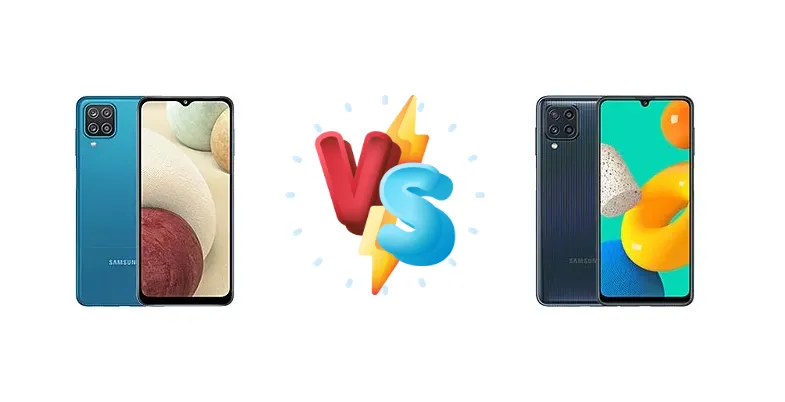
Samsung's M series consistently targets the value-conscious buyer, but navigating the options can be tricky. The Galaxy M12 (India) and M32 represent distinct approaches within this segment. The M12 prioritizes efficiency with its Exynos 850, while the M32 attempts to offer a performance boost with the MediaTek Helio G80, alongside potentially faster charging. This comparison dissects the key differences to determine which phone best suits your needs.
🏆 Quick Verdict
For most users, the Samsung Galaxy M32 is the better choice. While both phones target a similar price point, the M32’s Helio G80 chipset offers a noticeable performance advantage in demanding tasks, and the availability of 25W charging (though often implemented as 15W in India) provides a faster top-up experience. The M12 remains a viable option for those prioritizing efficiency and a slightly lower initial cost.
| Network |
|---|
| 2G bands | GSM 850 / 900 / 1800 / 1900 | GSM 850 / 900 / 1800 / 1900 |
| 3G bands | HSDPA 850 / 900 / 2100 | HSDPA 850 / 900 / 1700(AWS) / 1900 / 2100 - International |
| 4G bands | 1, 3, 5, 7, 8, 38, 40, 41 | 1, 2, 3, 4, 5, 7, 8, 12, 17, 20, 26, 28, 38, 40, 41, 66 - International |
| Speed | HSPA, LTE | HSPA, LTE |
| Technology | GSM / HSPA / LTE | GSM / HSPA / LTE |
| | - | 1, 3, 5, 8, 20, 38, 40, 41 - India |
| Launch |
|---|
| Announced | 2021, February 05 | 2021, June 21 |
| Status | Available. Released 2021, March 18 | Available. Released 2021, June 28 |
| Body |
|---|
| Build | Glass front, plastic back, plastic frame | Glass front (Gorilla Glass 5), plastic frame, plastic back |
| Dimensions | 164 x 75.9 x 9.7 mm (6.46 x 2.99 x 0.38 in) | 159.3 x 74 x 8.4 mm (Global) or 9.3 mm (India) |
| SIM | Nano-SIM + Nano-SIM | · Nano-SIM· Nano-SIM + Nano-SIM |
| Weight | 221 g (7.80 oz) | 180 g (Global) / 196 g (India) (6.35 oz) |
| Display |
|---|
| Protection | - | Corning Gorilla Glass 5 |
| Resolution | 720 x 1600 pixels, 20:9 ratio (~270 ppi density) | 1080 x 2400 pixels, 20:9 ratio (~411 ppi density) |
| Size | 6.5 inches, 102.0 cm2 (~81.9% screen-to-body ratio) | 6.4 inches, 98.9 cm2 (~83.9% screen-to-body ratio) |
| Type | PLS LCD, 90Hz | Super AMOLED, 90Hz, 800 nits (HBM) |
| Platform |
|---|
| CPU | Octa-core (4x2.0 GHz Cortex-A55 & 4x2.0 GHz Cortex-A55) | Octa-core (2x2.0 GHz Cortex-A75 & 6x1.8 GHz Cortex-A55) |
| Chipset | Exynos 850 (8 nm) | Mediatek MT6769V/CU Helio G80 (12 nm) |
| GPU | Mali-G52 | Mali-G52 MC2 |
| OS | Android 11, One UI 3.1 | Android 11, upgradable to Android 13, One UI 5 |
| Memory |
|---|
| Card slot | microSDXC (dedicated slot) | microSDXC (dedicated slot) |
| Internal | 64GB 4GB RAM, 128GB 6GB RAM | 64GB 4GB RAM, 128GB 6GB RAM, 128GB 8GB RAM |
| | eMMC 5.1 | eMMC 5.1 |
| Main Camera |
|---|
| Features | LED flash, panorama, HDR | LED flash, panorama, HDR |
| Quad | 48 MP, f/2.0, (wide), 1/2.0", 0.8µm, PDAF
5 MP, f/2.2, 123˚ (ultrawide)
2 MP (macro)
Auxiliary lens | 64 MP, f/1.8, 26mm (wide), 1/1.97", 0.7µm, PDAF
8 MP, f/2.2, 123˚, (ultrawide), 1/4.0", 1.12µm
2 MP (macro)
Auxiliary lens |
| Video | 1080p@30fps | 1080p@30fps |
| Selfie camera |
|---|
| Features | HDR | - |
| Single | 8 MP, f/2.2, (wide) | 20 MP, f/2.2, (wide) |
| Video | 1080p@30fps | 1080p@30fps |
| Sound |
|---|
| 3.5mm jack | Yes | Yes |
| 35mm jack | Yes | Yes |
| Loudspeaker | Yes | Yes |
| Comms |
|---|
| Bluetooth | 5.0, A2DP, LE | 5.0, A2DP, LE |
| NFC | No | Yes (market/region dependent) |
| Positioning | GPS, GLONASS, GALILEO, BDS | GPS, GLONASS, BDS, GALILEO |
| Radio | Unspecified | No |
| USB | USB Type-C 2.0, OTG | USB Type-C 2.0, OTG |
| WLAN | Wi-Fi 802.11 b/g/n, Wi-Fi Direct | Wi-Fi 802.11 a/b/g/n/ac, dual-band, Wi-Fi Direct |
| Features |
|---|
| Sensors | Fingerprint (side-mounted), accelerometer | Fingerprint (side-mounted), accelerometer, gyro, compass |
| | Virtual proximity sensing | Virtual proximity sensing |
| Battery |
|---|
| Charging | 15W wired | 25W wired (International)
15W wired (India) |
| Type | Li-Po 6000 mAh | Market-dependent versions:· Li-Ion 5000 mAh (Global)· Li-Ion 6000 mAh (India only) |
| Misc |
|---|
| Colors | Attractive Black, Elegant Blue, Trendy Emerald Green | Black, Light Blue |
| Models | SM-M127F, SM-M127F/DS, SM-F127G, SM-F127G/DS, SM-M127G, SM-M127G/DS | SM-M325FV, SM-M325FV/DS, SM-M325F/DS, SM-M325F |
| Price | About 130 EUR | About 180 EUR |
| SAR | 1.19 W/kg (head) | 0.64 W/kg (head) |
| SAR EU | 0.54 W/kg (head) 1.39 W/kg (body) | 0.56 W/kg (head) 1.57 W/kg (body) |
| Pricing |
|---|
| 128GB 6GB RAM | ₹ 13,999 | - |
Samsung Galaxy M12 (India)
- More power-efficient chipset (Exynos 850)
- Potentially slightly longer battery life during light use
- Lower initial cost (potentially)
- Noticeably slower performance in demanding tasks
- Slower charging speed (15W)
- Less capable GPU for gaming
Samsung Galaxy M32
- Faster processor (Helio G80) with Cortex-A75 cores
- Potentially faster charging (25W, often 15W in India)
- Better GPU performance for gaming
- Less power-efficient chipset (Helio G80)
- May run slightly warmer under load
- Potentially higher price
Display Comparison
Both devices likely feature similar LCD panels, typical for this price bracket. However, detailed display specs (resolution, brightness, color gamut) are missing. The focus here is on the internal hardware. The difference lies in the processing power driving the display. The M32’s Helio G80 will provide a smoother experience when scrolling through content or playing games, as the GPU is more capable than the one integrated with the Exynos 850.
Camera Comparison
Without detailed camera specs beyond the presence of a 2MP macro lens on both (which is largely irrelevant), it’s difficult to make a definitive judgment. We can assume both phones feature a similar primary camera setup targeting the budget segment. The image processing algorithms will likely differ, but the chipset’s ISP (Image Signal Processor) plays a crucial role. The Helio G80’s ISP is generally more capable, potentially resulting in better dynamic range and noise reduction, especially in challenging lighting conditions. However, the real-world difference will likely be subtle.
Performance
The core difference lies in the chipsets. The Samsung Galaxy M12’s Exynos 850 (8nm) utilizes a homogenous octa-core configuration with eight Cortex-A55 cores clocked at 2.0 GHz. This prioritizes efficiency. Conversely, the M32’s MediaTek Helio G80 (12nm) employs a more powerful, but less efficient, configuration: two Cortex-A75 cores at 2.0 GHz and six Cortex-A55 cores at 1.8 GHz. The A75 cores offer significantly higher single-core performance, translating to snappier app launches and better responsiveness. The 12nm process node of the Helio G80 is less efficient than the 8nm Exynos 850, potentially leading to more heat generation under sustained load. However, the performance gains are likely to outweigh this drawback for most users.
Battery Life
Both phones offer adequate battery capacity for all-day use. The M32’s potential for 25W charging (though often limited to 15W in India) is a significant advantage over the M12’s fixed 15W charging. While both will likely take over two hours for a full charge, the M32 can top up more quickly when a compatible charger is used. The Exynos 850’s efficiency may contribute to slightly longer battery life during light usage, but the difference will be minimal.
Buying Guide
Buy the Samsung Galaxy M12 (India) if you need a phone primarily for basic tasks like calling, messaging, and light social media use, and value long battery life over raw performance. Buy the Samsung Galaxy M32 if you prefer a smoother experience with more demanding apps, enjoy occasional gaming, and appreciate the convenience of faster charging, even if it's not consistently utilized at its maximum potential.
Frequently Asked Questions
❓ Does the Exynos 850 in the M12 overheat during prolonged gaming sessions?
The Exynos 850 is designed for efficiency, so overheating isn't a major concern. However, it will throttle performance under sustained load, leading to frame drops in demanding games. It's suitable for casual gaming, but not ideal for extended, high-graphics sessions.
❓ Is the 2MP macro camera on either phone actually useful for taking detailed close-up photos?
Generally, 2MP macro cameras on budget phones are of limited utility. The low resolution results in images lacking detail and sharpness. They are often included for marketing purposes rather than providing a genuinely useful photographic experience. Expect soft, noisy results.
❓ Does the Samsung Galaxy M32 support 90fps gameplay in PUBG Mobile?
While the Helio G80 is capable, achieving a consistent 90fps in PUBG Mobile will depend on the graphics settings and the specific device configuration. You'll likely need to use balanced or low graphics settings to maintain a stable frame rate. The M12 will struggle to reach even 60fps consistently.
❓ Is the 25W charging on the M32 actually available in India, or is it limited to 15W like the M12?
Unfortunately, Samsung often limits the charging wattage on devices sold in India compared to international models. While the M32 is advertised with 25W charging, many users report it only charges at 15W with the included charger. You may need to purchase a separate 25W charger to utilize the faster charging speed.