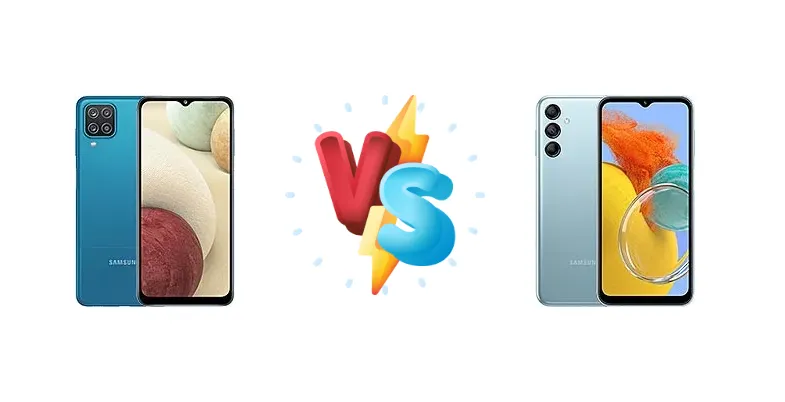
The Samsung Galaxy M series consistently delivers value-focused smartphones, but the jump from the M12 to the M14 represents a significant internal upgrade. While both cater to the budget-conscious consumer, the M14 introduces the newer Exynos 1330 chipset and faster charging, prompting the question: is the upgrade worthwhile, especially for existing M12 owners in India?
🏆 Quick Verdict
For most users, the Samsung Galaxy M14 is the superior choice. The Exynos 1330 offers a noticeable performance boost over the M12’s Exynos 850, and the inclusion of 25W charging (in India) significantly improves usability. While the M12 remains a capable device, the M14 provides a more future-proof experience.
| Network |
|---|
| 2G bands | GSM 850 / 900 / 1800 / 1900 | GSM 850 / 900 / 1800 / 1900 |
| 3G bands | HSDPA 850 / 900 / 2100 | HSDPA 850 / 900 / 1700(AWS) / 1900 / 2100 |
| 4G bands | 1, 3, 5, 7, 8, 38, 40, 41 | 1, 2, 3, 4, 5, 7, 8, 12, 17, 20, 26, 28, 38, 40, 41, 66 |
| 5G bands | - | 1, 3, 5, 7, 8, 20, 28, 38, 40, 41, 66, 77, 78 SA/NSA |
| Speed | HSPA, LTE | HSPA, LTE, 5G |
| Technology | GSM / HSPA / LTE | GSM / HSPA / LTE / 5G |
| Launch |
|---|
| Announced | 2021, February 05 | 2023, March 08 |
| Status | Available. Released 2021, March 18 | Available. Released 2023, March 08 |
| Body |
|---|
| Build | Glass front, plastic back, plastic frame | Glass front (Gorilla Glass 5), plastic back, plastic frame |
| Dimensions | 164 x 75.9 x 9.7 mm (6.46 x 2.99 x 0.38 in) | 166.8 x 77.2 x 9.4 mm (6.57 x 3.04 x 0.37 in) |
| SIM | Nano-SIM + Nano-SIM | · Nano-SIM· Nano-SIM + Nano-SIM |
| Weight | 221 g (7.80 oz) | 206 g (7.27 oz) |
| Display |
|---|
| Protection | - | Corning Gorilla Glass 5 |
| Resolution | 720 x 1600 pixels, 20:9 ratio (~270 ppi density) | 1080 x 2408 pixels, 20:9 ratio (~400 ppi density) |
| Size | 6.5 inches, 102.0 cm2 (~81.9% screen-to-body ratio) | 6.6 inches, 104.9 cm2 (~81.5% screen-to-body ratio) |
| Type | PLS LCD, 90Hz | PLS LCD, 90Hz |
| Platform |
|---|
| CPU | Octa-core (4x2.0 GHz Cortex-A55 & 4x2.0 GHz Cortex-A55) | Octa-core (2x2.4 GHz Cortex-A78 & 6x2.0 GHz Cortex-A55) |
| Chipset | Exynos 850 (8 nm) | Exynos 1330 (5 nm) |
| GPU | Mali-G52 | Mali-G68 MP2 |
| OS | Android 11, One UI 3.1 | Android 13, One UI core 5.1 |
| Memory |
|---|
| Card slot | microSDXC (dedicated slot) | microSDHC (dedicated slot) |
| Internal | 64GB 4GB RAM, 128GB 6GB RAM | 64GB 4GB RAM, 128GB 4GB RAM, 128GB 6GB RAM |
| | eMMC 5.1 | - |
| Main Camera |
|---|
| Features | LED flash, panorama, HDR | LED flash, panorama, HDR |
| Quad | 48 MP, f/2.0, (wide), 1/2.0", 0.8µm, PDAF
5 MP, f/2.2, 123˚ (ultrawide)
2 MP (macro)
Auxiliary lens | - |
| Single | - | 13 MP, f/2.0, (wide) |
| Triple | - | 50 MP, f/1.8, (wide), PDAF
2 MP (macro)
Auxiliary lens |
| Video | 1080p@30fps | 1080p@30fps |
| Selfie camera |
|---|
| Features | HDR | - |
| Single | 8 MP, f/2.2, (wide) | 13 MP, f/2.0, (wide) |
| Video | 1080p@30fps | 1080p@30fps |
| Sound |
|---|
| 3.5mm jack | Yes | Yes |
| 35mm jack | Yes | Yes |
| Loudspeaker | Yes | Yes |
| Comms |
|---|
| Bluetooth | 5.0, A2DP, LE | 5.2, A2DP, LE |
| NFC | No | Yes |
| Positioning | GPS, GLONASS, GALILEO, BDS | GPS, GLONASS, GALILEO, BDS, QZSS, NavIC |
| Radio | Unspecified | Unspecified |
| USB | USB Type-C 2.0, OTG | USB Type-C 2.0 |
| WLAN | Wi-Fi 802.11 b/g/n, Wi-Fi Direct | Wi-Fi 802.11 a/b/g/n/ac, dual-band, Wi-Fi Direct |
| Features |
|---|
| Sensors | Fingerprint (side-mounted), accelerometer | Fingerprint (side-mounted), accelerometer, gyro, proximity, compass |
| | Virtual proximity sensing | - |
| Battery |
|---|
| Charging | 15W wired | 15W wired - international
25W wired - India |
| Type | Li-Po 6000 mAh | Li-Po 6000 mAh |
| Misc |
|---|
| Colors | Attractive Black, Elegant Blue, Trendy Emerald Green | Navy Blue, Light Blue, Silver |
| Models | SM-M127F, SM-M127F/DS, SM-F127G, SM-F127G/DS, SM-M127G, SM-M127G/DS | SM-M146B, SM-M146B/DS, SM-M146B/DSN |
| Price | About 130 EUR | ₹ 10,990 |
| SAR | 1.19 W/kg (head) | - |
| SAR EU | 0.54 W/kg (head) 1.39 W/kg (body) | 0.48 W/kg (head) 1.53 W/kg (body) |
| Pricing |
|---|
| 128GB 6GB RAM | ₹ 13,999 | - |
Samsung Galaxy M12 (India)
- Lower price point (potentially)
- Functional for basic tasks
- Established user base
- Older, less efficient chipset
- Slower charging speed
- Limited performance headroom
Samsung Galaxy M14
- Faster and more efficient Exynos 1330
- 25W fast charging (India)
- Improved multitasking and gaming
- Higher price point
- May not represent a massive leap in display quality
- Similar camera hardware (potentially)
Display Comparison
Both devices lack detailed display specifications in the provided data, but given their market positioning, we can assume both utilize LCD panels. The key difference lies in the processing power driving them. The Exynos 1330 in the M14 will likely deliver smoother animations and faster app loading times, enhancing the overall visual experience, even on a similar panel. Bezels are expected to be comparable, typical of this price segment. Color accuracy is likely similar, leaning towards Samsung’s typically vibrant, but not necessarily color-accurate, profile.
Camera Comparison
Detailed camera specifications are absent, but the M14 likely benefits from the improved image signal processor (ISP) within the Exynos 1330. This translates to better image processing, particularly in low-light conditions. While both phones likely feature a multi-camera setup, the M14’s ISP will likely deliver more detailed and dynamic range-rich photos. The presence of a 2MP macro camera on both is largely a marketing feature and offers limited practical benefit. The primary sensor’s performance, driven by the chipset, will be the key differentiator.
Performance
The core of the upgrade lies in the chipset. The Galaxy M14’s Exynos 1330, fabricated on a 5nm process, is a substantial improvement over the M12’s 8nm Exynos 850. The 1330’s octa-core configuration, featuring 2x2.4 GHz Cortex-A78 cores alongside 6x2.0 GHz Cortex-A55 cores, provides a significant uplift in CPU performance compared to the M12’s 4x2.0 GHz Cortex-A55 and 4x2.0 GHz Cortex-A55 setup. This translates to faster app launches, smoother multitasking, and improved gaming performance. The 5nm process also contributes to better thermal efficiency, potentially reducing throttling during sustained workloads. While both use similar RAM configurations (6GB in the provided data), the M14’s chipset will be able to utilize it more effectively.
Battery Life
Both devices feature a 15W wired charging capability, however, the M14 offers a 25W option in India. This faster charging significantly reduces the time to fully charge the device, a crucial convenience factor. While the battery capacity isn’t specified, the Exynos 1330’s improved power efficiency could offset a potentially smaller battery size in the M14, resulting in comparable real-world battery life. The 25W charging in India is a significant advantage for M14 buyers, reducing downtime.
Buying Guide
Buy the Samsung Galaxy M12 (India) if you prioritize absolute affordability and already own it – it remains a functional device for basic tasks. Buy the Samsung Galaxy M14 if you value smoother multitasking, improved gaming performance, and faster charging, particularly if you're coming from an older device or are a power user who demands more from their smartphone.
Frequently Asked Questions
❓ Does the Exynos 1330 in the Galaxy M14 tend to overheat during prolonged gaming sessions?
The Exynos 1330, built on a 5nm process, is significantly more thermally efficient than the Exynos 850. While some heat generation is inevitable during intensive gaming, the M14 is less likely to experience significant throttling compared to the M12, allowing for more sustained performance.
❓ Is the 2MP macro camera on either phone actually useful for taking detailed close-up photos?
Generally, 2MP macro cameras on budget smartphones offer limited practical benefit. The low resolution results in images lacking detail and sharpness. They are primarily a marketing feature and are unlikely to produce high-quality macro photographs.
❓ Can the Galaxy M14 reliably run PUBG Mobile at 60fps with smooth graphics?
The Exynos 1330 should be capable of running PUBG Mobile at 60fps with smooth graphics settings, though performance may vary depending on the specific game version and background processes. It represents a significant improvement over the M12’s capabilities in this regard.
❓ What is the real-world difference in charging time between the 15W and 25W charging options on the Galaxy M14?
The 25W charging (available in India) will significantly reduce charging time. While exact figures depend on battery capacity, expect a 0-100% charge to take approximately 1.5-2 hours with 25W, compared to 2.5-3 hours with 15W.