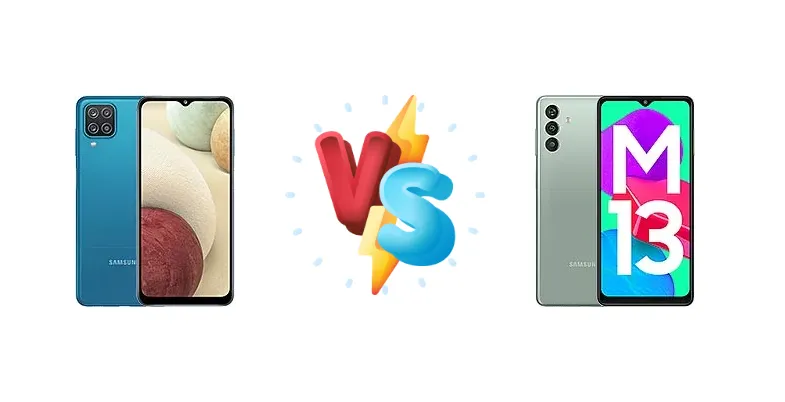
Samsung's Galaxy M series consistently targets the value-conscious Indian smartphone market. The M12 and M13 represent incremental updates within this segment. While both devices share a core chipset, subtle differences in features and pricing necessitate a detailed comparison to determine which offers the best bang for your buck.
🏆 Quick Verdict
For most users, the Samsung Galaxy M12 remains the more compelling choice. Despite the M13 being the newer model, the identical Exynos 850 chipset and 15W charging, coupled with potentially higher pricing, don't justify a significant upgrade. The M12 offers excellent value at its current price point.
| Network |
|---|
| 2G bands | GSM 850 / 900 / 1800 / 1900 | GSM 850 / 900 / 1800 / 1900 |
| 3G bands | HSDPA 850 / 900 / 2100 | HSDPA 850 / 900 / 2100 |
| 4G bands | 1, 3, 5, 7, 8, 38, 40, 41 | 1, 3, 5, 7, 8, 20, 28, 38, 40, 41 |
| Speed | HSPA, LTE | HSPA, LTE |
| Technology | GSM / HSPA / LTE | GSM / HSPA / LTE |
| Launch |
|---|
| Announced | 2021, February 05 | 2022, July 14 |
| Status | Available. Released 2021, March 18 | Available. Released 2022, July 23 |
| Body |
|---|
| Build | Glass front, plastic back, plastic frame | Glass front (Gorilla Glass 5), plastic back, plastic frame |
| Dimensions | 164 x 75.9 x 9.7 mm (6.46 x 2.99 x 0.38 in) | 165.4 x 76.9 x 9.3 mm (6.51 x 3.03 x 0.37 in) |
| SIM | Nano-SIM + Nano-SIM | Nano-SIM + Nano-SIM |
| Weight | 221 g (7.80 oz) | 207 g (7.30 oz) |
| Display |
|---|
| Protection | - | Corning Gorilla Glass 5 |
| Resolution | 720 x 1600 pixels, 20:9 ratio (~270 ppi density) | 1080 x 2408 pixels, 20:9 ratio (~400 ppi density) |
| Size | 6.5 inches, 102.0 cm2 (~81.9% screen-to-body ratio) | 6.6 inches, 104.9 cm2 (~82.5% screen-to-body ratio) |
| Type | PLS LCD, 90Hz | PLS LCD |
| Platform |
|---|
| CPU | Octa-core (4x2.0 GHz Cortex-A55 & 4x2.0 GHz Cortex-A55) | Octa-core (4x2.0 GHz Cortex-A55 & 4x2.0 GHz Cortex-A55) |
| Chipset | Exynos 850 (8 nm) | Exynos 850 (8 nm) |
| GPU | Mali-G52 | Mali-G52 |
| OS | Android 11, One UI 3.1 | Android 12, One UI Core 4 |
| Memory |
|---|
| Card slot | microSDXC (dedicated slot) | microSDXC (dedicated slot) |
| Internal | 64GB 4GB RAM, 128GB 6GB RAM | 64GB 4GB RAM, 128GB 6GB RAM |
| | eMMC 5.1 | eMMC 5.1 |
| Main Camera |
|---|
| Features | LED flash, panorama, HDR | LED flash, panorama, HDR |
| Quad | 48 MP, f/2.0, (wide), 1/2.0", 0.8µm, PDAF
5 MP, f/2.2, 123˚ (ultrawide)
2 MP (macro)
Auxiliary lens | - |
| Triple | - | 50 MP, f/1.8, (wide), PDAF
5 MP, f/2.2, 123˚ (ultrawide)
Auxiliary lens |
| Video | 1080p@30fps | 1080p@30fps |
| Selfie camera |
|---|
| Features | HDR | HDR |
| Single | 8 MP, f/2.2, (wide) | 8 MP, f/2.2, (wide) |
| Video | 1080p@30fps | 1080p@30fps |
| Sound |
|---|
| 3.5mm jack | Yes | Yes |
| 35mm jack | Yes | Yes |
| Loudspeaker | Yes | Yes |
| Comms |
|---|
| Bluetooth | 5.0, A2DP, LE | 5.0, A2DP, LE |
| NFC | No | No |
| Positioning | GPS, GLONASS, GALILEO, BDS | GPS, GLONASS, BDS, GALILEO, QZSS |
| Radio | Unspecified | No |
| USB | USB Type-C 2.0, OTG | USB Type-C 2.0 |
| WLAN | Wi-Fi 802.11 b/g/n, Wi-Fi Direct | Wi-Fi 802.11 a/b/g/n/ac, dual-band, Wi-Fi Direct |
| Features |
|---|
| Sensors | Fingerprint (side-mounted), accelerometer | Fingerprint (side-mounted), accelerometer, compass |
| | Virtual proximity sensing | Virtual proximity sensing |
| Battery |
|---|
| Charging | 15W wired | 15W wired |
| Type | Li-Po 6000 mAh | Li-Po 6000 mAh |
| Misc |
|---|
| Colors | Attractive Black, Elegant Blue, Trendy Emerald Green | Midnight Blue, Aqua Green, Stardust Brown |
| Models | SM-M127F, SM-M127F/DS, SM-F127G, SM-F127G/DS, SM-M127G, SM-M127G/DS | SM-M135FU, SM-M135FU/DS |
| Price | About 130 EUR | About 150 EUR |
| SAR | 1.19 W/kg (head) | 0.56 W/kg (head) |
| SAR EU | 0.54 W/kg (head) 1.39 W/kg (body) | - |
| Pricing |
|---|
| 128GB 6GB RAM | ₹ 13,999 | - |
Samsung Galaxy M12 (India)
- Excellent value for money (potentially lower price)
- Reliable Exynos 850 performance for everyday tasks
- Likely similar battery life to the M13
- Slow 15W charging
- Potentially outdated software (depending on updates)
Samsung Galaxy M13 (India)
- Latest software updates (initially)
- Potentially slightly refined design
- Exynos 850 performance for everyday tasks
- Slow 15W charging
- Minimal performance gains over the M12
- Potentially higher price
Display Comparison
Both the Galaxy M12 and M13 lack detailed display specifications in the provided data. However, given their positioning, we can infer both likely utilize PLS LCD panels. The absence of high refresh rates or AMOLED technology is typical for this price bracket. The user experience will likely be similar, with color accuracy and viewing angles being adequate for everyday use, but not exceptional. Bezels are expected to be noticeable, and peak brightness will likely be sufficient for indoor use but may struggle in direct sunlight.
Camera Comparison
Camera details are sparse. Both phones likely feature a multi-camera setup, but the provided data doesn't specify sensor sizes or lens apertures. It's reasonable to assume the primary sensor is a 13MP or 16MP unit. The inclusion of a 2MP macro camera on both devices is largely a marketing tactic, offering limited practical benefit due to its low resolution and fixed focus. Image processing will likely be similar, leaning towards Samsung's typically vibrant and saturated style. Expect decent performance in well-lit conditions, but image quality will degrade in low light.
Performance
The core of both devices is the Exynos 850 (8nm) chipset, paired with an identical CPU configuration – an octa-core setup with 4x2.0 GHz Cortex-A55 cores and another 4x2.0 GHz Cortex-A55 cores. This means performance will be virtually indistinguishable in most tasks, including app launching, web browsing, and social media. The 8nm process node offers reasonable efficiency, but the Exynos 850 isn't a powerhouse. Users engaging in demanding gaming or heavy multitasking may experience some slowdowns. The lack of information regarding RAM type (LPDDR4X is likely) prevents a deeper analysis of memory bandwidth.
Battery Life
Both the Galaxy M12 and M13 are equipped with 15W wired charging. This is relatively slow compared to the fast charging options available on competing devices. While battery capacity isn't specified, the M12 typically shipped with a 5000mAh battery, and the M13 likely maintains a similar capacity. Expect a full charge to take around 2-3 hours. Real-world battery life will depend on usage patterns, but both phones should comfortably last a full day with moderate use. The slow charging speed is a significant drawback for users who prioritize quick top-ups.
Buying Guide
Buy the Samsung Galaxy M12 (India) if you prioritize maximizing value and are looking for a reliable, everyday smartphone with a decent chipset at the lowest possible price. Buy the Samsung Galaxy M13 (India) if you specifically need the latest software updates and are willing to pay a premium for a marginally newer model, understanding that the core performance remains unchanged.
Frequently Asked Questions
❓ Does the Exynos 850 chip in either the M12 or M13 overheat during prolonged gaming sessions?
The Exynos 850 is a relatively efficient chip, but it's not designed for sustained, high-performance gaming. While it won't typically overheat to the point of shutting down, users may experience thermal throttling during extended gaming sessions, leading to reduced frame rates. The passive cooling solution in both devices isn't sufficient to dissipate heat effectively under heavy load.
❓ Is the 2MP macro camera on either phone actually useful for taking detailed close-up photos?
Unfortunately, the 2MP macro camera on both the M12 and M13 is largely a marketing gimmick. Its low resolution and fixed focus result in images that lack detail and sharpness. It's best to rely on the main camera for close-up shots, utilizing digital zoom instead.
❓ Can either the Galaxy M12 or M13 reliably run PUBG Mobile at 60fps?
While PUBG Mobile is playable on both devices, achieving a consistent 60fps experience is unlikely, even with graphics settings lowered. The Exynos 850 struggles to maintain a stable frame rate in demanding games like PUBG. Expect frame drops and occasional stuttering, especially during intense action sequences. Lowering the graphics settings to the minimum will improve performance, but at the cost of visual fidelity.