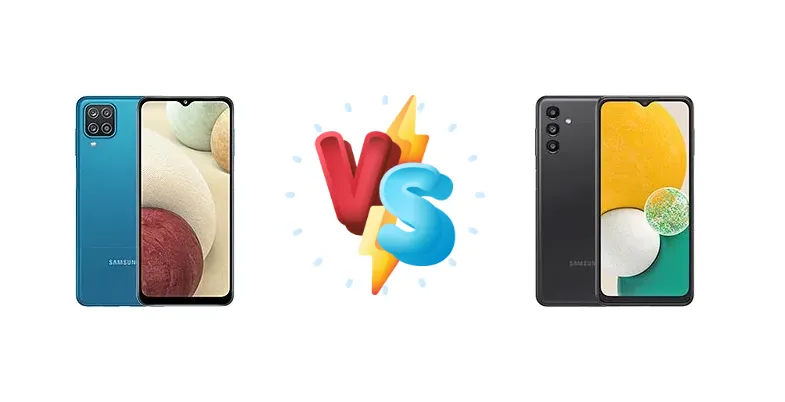
Samsung's budget lineup often presents a confusing array of choices. The Galaxy M12, popular in India, and the newer Galaxy A13 5G both aim for affordability, but diverge in their core components. This comparison dissects the differences between the Exynos 850-powered M12 and the Dimensity 700-equipped A13 5G, focusing on real-world impact for the budget-conscious user.
🏆 Quick Verdict
For most users, the Samsung Galaxy A13 5G is the better choice. While both phones share a 15W charging rate, the A13 5G’s Mediatek Dimensity 700, built on a more efficient 7nm process, delivers noticeably better performance and future-proofs with 5G connectivity, making it a more compelling overall package.
| Network |
|---|
| 2G bands | GSM 850 / 900 / 1800 / 1900 | GSM 850 / 900 / 1800 / 1900 |
| 3G bands | HSDPA 850 / 900 / 2100 | HSDPA 850 / 1700(AWS) / 1900 / 2100 |
| 4G bands | 1, 3, 5, 7, 8, 38, 40, 41 | 1, 2, 3, 4, 5, 7, 12, 14, 20, 29, 30, 38, 39, 40, 41, 66 |
| 5G bands | - | 2, 5, 66, 77 Sub6/mmWave |
| Speed | HSPA, LTE | HSPA, LTE, 5G |
| Technology | GSM / HSPA / LTE | GSM / HSPA / LTE / 5G |
| | - | 2, 5, 41, 48, 66, 71, 77 Sub6/mmWave - SM-A136U |
| Launch |
|---|
| Announced | 2021, February 05 | 2021, December 02 |
| Status | Available. Released 2021, March 18 | Available. Released 2021, December 03 |
| Body |
|---|
| Build | Glass front, plastic back, plastic frame | Glass front, plastic back, plastic frame |
| Dimensions | 164 x 75.9 x 9.7 mm (6.46 x 2.99 x 0.38 in) | 164.5 x 76.5 x 8.8 mm (6.48 x 3.01 x 0.35 in) |
| SIM | Nano-SIM + Nano-SIM | Nano-SIM |
| Weight | 221 g (7.80 oz) | 195 g (6.88 oz) |
| Display |
|---|
| Resolution | 720 x 1600 pixels, 20:9 ratio (~270 ppi density) | 720 x 1600 pixels, 20:9 ratio (~270 ppi density) |
| Size | 6.5 inches, 102.0 cm2 (~81.9% screen-to-body ratio) | 6.5 inches, 102.0 cm2 (~81.1% screen-to-body ratio) |
| Type | PLS LCD, 90Hz | PLS LCD, 90Hz |
| Platform |
|---|
| CPU | Octa-core (4x2.0 GHz Cortex-A55 & 4x2.0 GHz Cortex-A55) | Octa-core (2x2.2 GHz Cortex-A76 & 6x2.0 GHz Cortex-A55) |
| Chipset | Exynos 850 (8 nm) | Mediatek Dimensity 700 (7 nm) |
| GPU | Mali-G52 | Mali-G57 MC2 |
| OS | Android 11, One UI 3.1 | Android 11, upgradable to Android 14, One UI 6.1 |
| Memory |
|---|
| Card slot | microSDXC (dedicated slot) | microSDXC (dedicated slot) |
| Internal | 64GB 4GB RAM, 128GB 6GB RAM | 64GB 4GB RAM, 128GB 4GB RAM, 128GB 6GB RAM |
| | eMMC 5.1 | - |
| Main Camera |
|---|
| Features | LED flash, panorama, HDR | LED flash, panorama, HDR |
| Quad | 48 MP, f/2.0, (wide), 1/2.0", 0.8µm, PDAF
5 MP, f/2.2, 123˚ (ultrawide)
2 MP (macro)
Auxiliary lens | - |
| Single | - | 5 MP, f/2.0, (wide) |
| Triple | - | 50 MP, f/1.8, 26mm (wide), PDAF
2 MP (macro)
Auxiliary lens |
| Video | 1080p@30fps | 1080p@30fps |
| Selfie camera |
|---|
| Features | HDR | - |
| Single | 8 MP, f/2.2, (wide) | 5 MP, f/2.0, (wide) |
| Video | 1080p@30fps | 1080p@30fps |
| Sound |
|---|
| 3.5mm jack | Yes | Yes |
| 35mm jack | Yes | Yes |
| Loudspeaker | Yes | Yes |
| Comms |
|---|
| Bluetooth | 5.0, A2DP, LE | 5.0, A2DP, LE |
| NFC | No | Yes |
| Positioning | GPS, GLONASS, GALILEO, BDS | GPS, GLONASS, GALILEO |
| Radio | Unspecified | Unspecified |
| USB | USB Type-C 2.0, OTG | USB Type-C 2.0 |
| WLAN | Wi-Fi 802.11 b/g/n, Wi-Fi Direct | Wi-Fi 802.11 a/b/g/n/ac, dual-band, Wi-Fi Direct |
| Features |
|---|
| Sensors | Fingerprint (side-mounted), accelerometer | Fingerprint (side-mounted), accelerometer, gyro, compass, barometer |
| | Virtual proximity sensing | Virtual proximity sensing |
| Battery |
|---|
| Charging | 15W wired | 15W wired |
| Type | Li-Po 6000 mAh | Li-Po 5000 mAh |
| Misc |
|---|
| Colors | Attractive Black, Elegant Blue, Trendy Emerald Green | Black |
| Models | SM-M127F, SM-M127F/DS, SM-F127G, SM-F127G/DS, SM-M127G, SM-M127G/DS | SM-A136U, SM-A136U1, SM-A136W, SM-A136B, SM-S136DL |
| Price | About 130 EUR | € 178.00 / $ 64.00 / £ 72.54 |
| SAR | 1.19 W/kg (head) | 1.27 W/kg (head) 0.58 W/kg (body) |
| SAR EU | 0.54 W/kg (head) 1.39 W/kg (body) | - |
| Pricing |
|---|
| 128GB 6GB RAM | ₹ 13,999 | - |
Samsung Galaxy M12 (India)
- Potentially lower price point (depending on retailer)
- Large display size (assumed, based on M-series positioning)
- Familiar Samsung One UI experience
- Less powerful Exynos 850 chipset
- No 5G connectivity
- 8nm process less efficient than 7nm
Samsung Galaxy A13 5G
- More powerful Mediatek Dimensity 700 chipset
- 5G connectivity for faster data speeds
- 7nm process for improved efficiency
- Potentially slightly higher price
- May not have as large a display as the M12
- Samsung's software bloat
Display Comparison
Both devices likely feature similar LCD panels, given their price points. However, detailed display specs (resolution, brightness) are missing. The focus here is on the internal hardware. The A13 5G’s chipset will contribute to smoother scrolling and app transitions, indirectly improving the perceived display experience. Neither phone is expected to offer high refresh rates or advanced features like LTPO.
Camera Comparison
Without detailed camera sensor information, a direct comparison is difficult. Both phones likely feature a multi-camera setup with a primary sensor and supporting lenses. However, the image signal processor (ISP) within the Dimensity 700 is generally more advanced than that of the Exynos 850, potentially resulting in better image processing, dynamic range, and low-light performance on the A13 5G. The presence of a 2MP macro camera on both devices is largely a marketing feature with limited practical utility.
Performance
The core difference lies in the chipsets. The Mediatek Dimensity 700 (7nm) in the A13 5G boasts a more modern architecture with 2x 2.2 GHz Cortex-A76 cores alongside 6x 2.0 GHz Cortex-A55 cores. This contrasts with the Exynos 850 (8nm) in the M12, which uses 4x 2.0 GHz Cortex-A55 cores and another 4x 2.0 GHz Cortex-A55 cores. The A76 cores in the A13 5G provide a significant performance uplift in CPU-intensive tasks and gaming. The 7nm process also translates to better power efficiency, potentially leading to longer battery life under load. The A13 5G will handle multitasking and demanding apps with greater ease.
Battery Life
Both phones are equipped with 15W wired charging, meaning charging speeds will be comparable. While the M12’s battery capacity is not specified, the A13 5G’s efficiency gains from the 7nm Dimensity 700 could offset any potential capacity difference. The A13 5G’s more efficient chipset will likely result in longer screen-on time for similar usage patterns, despite the identical charging wattage.
Buying Guide
Buy the Samsung Galaxy M12 (India) if your primary need is a large-screen device for basic tasks like calling, messaging, and light social media, and 5G connectivity isn't a priority. Buy the Samsung Galaxy A13 5G if you prioritize smoother multitasking, occasional gaming, and the benefits of 5G network access, even if it means a slightly higher initial investment.
Frequently Asked Questions
❓ Does the Exynos 850 in the M12 struggle with demanding games like PUBG?
Yes, the Exynos 850 is a budget chipset and will likely exhibit noticeable frame drops and stuttering in graphically intensive games like PUBG, even on medium settings. The A13 5G’s Dimensity 700 offers a significantly smoother gaming experience.
❓ Is the 5G connectivity on the A13 5G actually useful in India?
5G availability in India is expanding rapidly. While coverage isn't universal, investing in a 5G-capable phone like the A13 5G future-proofs your device and allows you to take advantage of faster speeds as 5G networks become more widespread in your area.
❓ Will I notice a significant difference in app loading times between the two phones?
Yes, the A13 5G’s Dimensity 700 will result in noticeably faster app loading times and smoother multitasking compared to the M12’s Exynos 850, thanks to its more powerful CPU cores and efficient architecture.
❓ How does the 15W charging affect the overall user experience on both devices?
15W charging is relatively slow by today's standards. Expect a full charge to take around 2-3 hours on both devices. The A13 5G’s more efficient chipset may slightly mitigate the impact of slow charging by maximizing battery life during use.