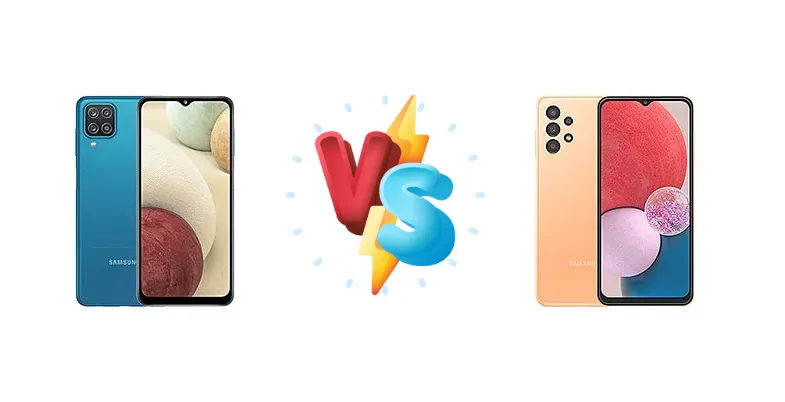
Samsung's budget lineup can be confusing. Both the Galaxy M12 (specifically the India variant) and the Galaxy A13 aim for affordability, but subtle differences in display quality and availability make choosing between them tricky. This comparison dives deep into the specs to determine which phone delivers the most bang for your buck.
🏆 Quick Verdict
For the average user prioritizing a slightly brighter and more vibrant display, the Galaxy A13 is the better choice. However, the Galaxy M12 (India) offers comparable performance at a potentially lower price point, making it a strong contender for budget-conscious buyers.
| Network |
|---|
| 2G bands | GSM 850 / 900 / 1800 / 1900 | GSM 850 / 900 / 1800 / 1900 |
| 3G bands | HSDPA 850 / 900 / 2100 | HSDPA 850 / 900 / 2100 |
| 4G bands | 1, 3, 5, 7, 8, 38, 40, 41 | 1, 3, 5, 7, 8, 20, 28, 38, 40, 41 |
| Speed | HSPA, LTE | HSPA, LTE |
| Technology | GSM / HSPA / LTE | GSM / HSPA / LTE |
| Launch |
|---|
| Announced | 2021, February 05 | 2022, March 04 |
| Status | Available. Released 2021, March 18 | Available. Released 2022, March 23 |
| Body |
|---|
| Build | Glass front, plastic back, plastic frame | Glass front (Gorilla Glass 5), plastic frame, plastic back |
| Dimensions | 164 x 75.9 x 9.7 mm (6.46 x 2.99 x 0.38 in) | 165.1 x 76.4 x 8.8 mm (6.5 x 3.01 x 0.35 in) |
| SIM | Nano-SIM + Nano-SIM | · Nano-SIM· Nano-SIM + Nano-SIM |
| Weight | 221 g (7.80 oz) | 195 g (6.88 oz) |
| Display |
|---|
| Protection | - | Corning Gorilla Glass 5 |
| Resolution | 720 x 1600 pixels, 20:9 ratio (~270 ppi density) | 1080 x 2408 pixels, 20:9 ratio (~400 ppi density) |
| Size | 6.5 inches, 102.0 cm2 (~81.9% screen-to-body ratio) | 6.6 inches, 104.9 cm2 (~83.2% screen-to-body ratio) |
| Type | PLS LCD, 90Hz | PLS LCD |
| Platform |
|---|
| CPU | Octa-core (4x2.0 GHz Cortex-A55 & 4x2.0 GHz Cortex-A55) | Octa-core (4x2.0 GHz Cortex-A55 & 4x2.0 GHz Cortex-A55) |
| Chipset | Exynos 850 (8 nm) | Exynos 850 (8 nm) |
| GPU | Mali-G52 | Mali-G52 |
| OS | Android 11, One UI 3.1 | Android 12, upgradable to Android 14, One UI 6.1 |
| Memory |
|---|
| Card slot | microSDXC (dedicated slot) | microSDXC (dedicated slot) |
| Internal | 64GB 4GB RAM, 128GB 6GB RAM | 32GB 3GB RAM, 32GB 4GB RAM, 64GB 4GB RAM, 128GB 3GB RAM, 128GB 4GB RAM, 128GB 6GB RAM |
| | eMMC 5.1 | eMMC 5.1 |
| Main Camera |
|---|
| Features | LED flash, panorama, HDR | LED flash, panorama, HDR |
| Quad | 48 MP, f/2.0, (wide), 1/2.0", 0.8µm, PDAF
5 MP, f/2.2, 123˚ (ultrawide)
2 MP (macro)
Auxiliary lens | 50 MP, f/1.8, (wide), PDAF
5 MP, f/2.2, 123˚ (ultrawide), 1/5.0", 1.12µm
2 MP (macro)
Auxiliary lens |
| Single | - | 8 MP, f/2.2, (wide) |
| Video | 1080p@30fps | 1080p@30fps |
| Selfie camera |
|---|
| Features | HDR | - |
| Single | 8 MP, f/2.2, (wide) | 8 MP, f/2.2, (wide) |
| Video | 1080p@30fps | 1080p@30fps |
| Sound |
|---|
| 3.5mm jack | Yes | Yes |
| 35mm jack | Yes | Yes |
| Loudspeaker | Yes | Yes |
| Comms |
|---|
| Bluetooth | 5.0, A2DP, LE | 5.0, A2DP, LE |
| NFC | No | Yes (market/region dependent) |
| Positioning | GPS, GLONASS, GALILEO, BDS | GPS, GLONASS, GALILEO, BDS |
| Radio | Unspecified | No |
| USB | USB Type-C 2.0, OTG | USB Type-C 2.0, OTG |
| WLAN | Wi-Fi 802.11 b/g/n, Wi-Fi Direct | Wi-Fi 802.11 a/b/g/n/ac, dual-band, Wi-Fi Direct |
| Features |
|---|
| Sensors | Fingerprint (side-mounted), accelerometer | Fingerprint (side-mounted), accelerometer, compass |
| | Virtual proximity sensing | Virtual proximity sensing |
| Battery |
|---|
| Charging | 15W wired | 15W wired |
| Type | Li-Po 6000 mAh | Li-Po 5000 mAh |
| Misc |
|---|
| Colors | Attractive Black, Elegant Blue, Trendy Emerald Green | Black, White, Peach, Blue |
| Models | SM-M127F, SM-M127F/DS, SM-F127G, SM-F127G/DS, SM-M127G, SM-M127G/DS | SM-A135F, SM-A135F/DS, SM-A135M, SM-A135U, SM-A135U1, SM-A135N |
| Price | About 130 EUR | € 94.99 / $ 129.99 / £ 89.00 |
| SAR | 1.19 W/kg (head) | 0.49 W/kg (head) |
| SAR EU | 0.54 W/kg (head) 1.39 W/kg (body) | 0.37 W/kg (head) 1.39 W/kg (body) |
| Pricing |
|---|
| 128GB 6GB RAM | ₹ 13,999 | - |
| Tests |
|---|
| Battery life | - |
Endurance rating 114h
|
| Camera | - |
Photo / Video |
| Display | - |
Contrast ratio: 1324:1 (nominal) |
| Loudspeaker | - |
-29.7 LUFS (Average)
|
| Performance | - |
AnTuTu: 122822 (v8), 136286 (v9)
GeekBench: 588 (v5.1)
GFXBench: 5.2fps (ES 3.1 onscreen) |
Samsung Galaxy M12 (India)
- Potentially lower price point (India variant)
- Solid performance for everyday tasks
- Excellent battery life (114h Endurance)
- Likely less vibrant display
- Limited display specifications available
Samsung Galaxy A13
- Brighter display with 587 nits peak brightness
- Higher contrast ratio (1324:1)
- More refined overall experience
- May be slightly more expensive
- 15W charging is relatively slow
Display Comparison
The Galaxy A13 boasts a measured peak brightness of 587 nits and a 1324:1 contrast ratio, providing a noticeably more vibrant viewing experience compared to the M12, which lacks published display specs. While both likely utilize PLS LCD panels, the A13's higher brightness translates to better outdoor visibility. The contrast ratio suggests deeper blacks and more dynamic colors on the A13. The M12's display, while functional, is likely more basic in its calibration and peak output.
Camera Comparison
Both devices feature a 'Photo / Video' camera system, but detailed sensor information is missing. Given their price points, expect similar camera performance – adequate for casual snapshots in good lighting conditions. The presence of a 2MP macro camera on both is largely a marketing gimmick, offering limited practical benefit. Image processing will likely be similar, leaning towards Samsung's typically vibrant and saturated style. Without specific sensor size or aperture details, it's difficult to definitively declare a camera winner.
Performance
Both the Galaxy M12 (India) and the Galaxy A13 are powered by the Exynos 850 (8nm) chipset, featuring an octa-core CPU configuration with 4x2.0 GHz Cortex-A55 cores and another 4x2.0 GHz Cortex-A55 cores. This means performance will be virtually identical for everyday tasks like browsing, social media, and light gaming. The 8nm process node offers reasonable efficiency, but neither phone is a powerhouse. Thermal throttling isn't a major concern given the chipset's modest power draw, but sustained heavy workloads will likely result in some performance reduction. RAM configurations are key; the M12's 6GB RAM option is competitive with the A13's available configurations.
Battery Life
Both the Galaxy M12 and A13 achieve an impressive Endurance rating of 114 hours, indicating excellent battery life. The M12's battery capacity is not specified, but the A13's is also not provided. Both phones support 15W wired charging, which is relatively slow by today's standards. Expect approximately 2.5-3 hours for a full charge from 0-100%. The similar Endurance ratings suggest comparable power efficiency despite potential differences in battery capacity.
Buying Guide
Buy the Samsung Galaxy M12 (India) if you need a reliable, everyday phone with solid performance and are primarily focused on value. It's ideal for users who prioritize functionality over premium features. Buy the Samsung Galaxy A13 if you prefer a more visually appealing display with higher peak brightness and a slightly more refined experience, and are willing to pay a small premium.
Frequently Asked Questions
❓ Does the Exynos 850 chip in either phone tend to overheat during prolonged gaming sessions?
The Exynos 850 is a relatively efficient chip. While it can get warm during extended gaming, it's unlikely to overheat significantly and cause performance throttling. Expect some frame rate drops after 30-45 minutes of demanding games, but it shouldn't be a showstopper.
❓ Is the 2MP macro camera on either the Galaxy M12 or A13 worth using?
Generally, no. 2MP macro cameras on budget phones typically produce low-resolution, soft images with limited detail. They are often included for marketing purposes but offer minimal practical benefit compared to using the main camera in close-up mode.
❓ Can either the Galaxy M12 or A13 reliably run PUBG Mobile at 60fps?
Both phones *can* run PUBG Mobile, but achieving a consistent 60fps will depend on the graphics settings. Lowering the graphics to 'Smooth' or 'Balanced' is recommended for a more stable frame rate. Expect occasional frame drops during intense action sequences.
❓ What is the difference in software support between the M12 and A13?
Samsung typically provides longer software support for the A-series compared to the M-series. The A13 is likely to receive more Android updates and security patches over its lifespan than the M12, making it a better long-term investment.