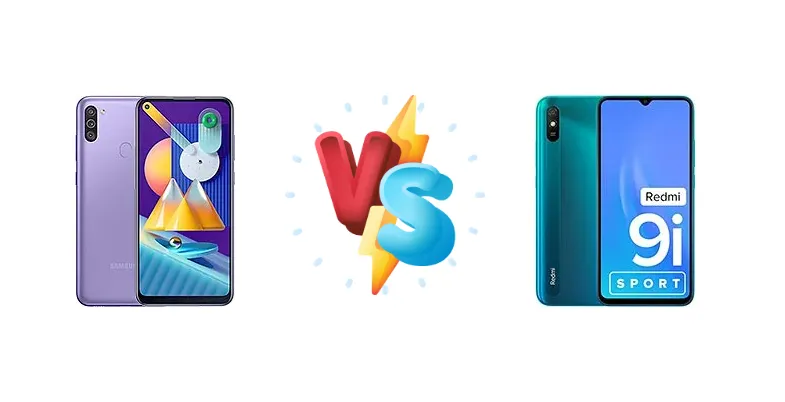
The Samsung Galaxy M11 and Xiaomi Redmi 9i Sport represent two compelling options in the ultra-budget smartphone segment. Both aim to deliver essential smartphone functionality at a price point that won't break the bank, but they achieve this with different approaches to chipset design and feature sets. This comparison will dissect their key differences to help you determine which device best suits your needs.
🏆 Quick Verdict
For the average user prioritizing sustained performance and a slightly more refined software experience, the Samsung Galaxy M11 edges out the Xiaomi Redmi 9i Sport. While the Redmi 9i Sport boasts a newer, nominally faster CPU core configuration, the Snapdragon 450's 14nm process and overall system optimization provide a smoother, more consistent experience.
| Network |
|---|
| 2G bands | GSM 850 / 900 / 1800 / 1900 | GSM 850 / 900 / 1800 / 1900 |
| 3G bands | HSDPA 850 / 900 / 1900 / 2100 | HSDPA 850 / 900 / 2100 |
| 4G bands | 1, 2, 3, 5, 7, 8, 20, 28, 38, 40, 41 | 1, 3, 5, 8, 40, 41 |
| Speed | HSPA, LTE | HSPA, LTE |
| Technology | GSM / HSPA / LTE | GSM / HSPA / LTE |
| Launch |
|---|
| Announced | 2020, March 30. Released 2020, May 4 | 2021, September 28 |
| Status | Discontinued | Available. Released 2021, September 28 |
| Body |
|---|
| Build | Glass front, plastic back, plastic frame | - |
| Dimensions | 161.4 x 76.3 x 9 mm (6.35 x 3.00 x 0.35 in) | 164.9 x 77.1 x 9 mm (6.49 x 3.04 x 0.35 in) |
| SIM | Nano-SIM + Nano-SIM | Nano-SIM + Nano-SIM |
| Weight | 197 g (6.95 oz) | 194 g (6.84 oz) |
| | - | Water-repellent coating |
| Display |
|---|
| Resolution | 720 x 1560 pixels, 19.5:9 ratio (~268 ppi density) | 720 x 1600 pixels, 20:9 ratio (~269 ppi density) |
| Size | 6.4 inches, 100.5 cm2 (~81.6% screen-to-body ratio) | 6.53 inches, 102.9 cm2 (~81.0% screen-to-body ratio) |
| Type | PLS LCD | IPS LCD, 400 nits (typ) |
| Platform |
|---|
| CPU | Octa-core 1.8 GHz Cortex-A53 | Octa-core (4x2.0 GHz Cortex-A53 & 4x1.5 GHz Cortex-A53) |
| Chipset | Qualcomm SDM450 Snapdragon 450 (14 nm) | Mediatek MT6762G Helio G25 (12 nm) |
| GPU | Adreno 506 | PowerVR GE8320 |
| OS | Android 10, upgradable to Android 12, One UI 4.1 | Android 10, MIUI 12 |
| Memory |
|---|
| Card slot | microSDXC (dedicated slot) | microSDXC (dedicated slot) |
| Internal | 32GB 3GB RAM, 64GB 4GB RAM | 64GB 4GB RAM, 128GB 4GB RAM |
| | eMMC 5.1 | eMMC 5.1 |
| Main Camera |
|---|
| Features | LED flash, panorama, HDR | LED flash, HDR |
| Single | - | 13 MP, f/2.2, 28mm (wide), 1.0µm, PDAF |
| Triple | 13 MP, f/1.8, 27mm (wide), 1/3.1", 1.12µm, PDAF
5 MP, f/2.2, 14mm (ultrawide)
Auxiliary lens | - |
| Video | 1080p@30fps | 1080p@30fps |
| Selfie camera |
|---|
| Features | HDR | HDR |
| Single | 8 MP, f/2.0, (wide) | 5 MP, f/2.2, (wide), 1.12µm |
| Video | 1080p@30fps | 1080p@30fps |
| Sound |
|---|
| 3.5mm jack | Yes | Yes |
| 35mm jack | Yes | Yes |
| Loudspeaker | Yes | Yes |
| Comms |
|---|
| Bluetooth | 4.2, A2DP | 5.0, A2DP, LE |
| NFC | No | No |
| Positioning | GPS, GLONASS, GALILEO, BDS | GPS, GLONASS, BDS |
| Radio | FM radio | FM radio |
| USB | USB Type-C 2.0 | microUSB 2.0, OTG |
| WLAN | Wi-Fi 802.11 b/g/n, Wi-Fi Direct | Wi-Fi 802.11 а/b/g/n, Wi-Fi Direct |
| Features |
|---|
| Sensors | Fingerprint (rear-mounted), accelerometer, proximity | Accelerometer, proximity, compass |
| Battery |
|---|
| Charging | 15W wired | 10W wired |
| Type | Li-Ion 5000 mAh | Li-Po 5000 mAh |
| Misc |
|---|
| Colors | Black, Metallic Blue, Violet | Carbon Black, Coral Green, Metallic Blue |
| Models | SM-M115F, SM-M115F/DSN, SM-M115M, SM-M115M/DS | - |
| Price | About 110 EUR | About 100 EUR |
| SAR EU | 0.52 W/kg (head) 0.89 W/kg (body) | - |
| Pricing |
|---|
| 32GB 3GB RAM | £ 129.00 | - |
| 64GB 4GB RAM | £ 149.99 | - |
| RENEWED | £ 177.00 | - |
Samsung Galaxy M11
- Faster 15W charging
- Potentially more refined software experience
- Snapdragon 450's thermal efficiency
- Older chipset architecture
- Lower peak CPU clock speeds
Xiaomi Redmi 9i Sport
- More modern CPU core configuration
- Helio G25's 12nm process
- Potentially lower power consumption
- Slower 10W charging
- Potential for thermal throttling
- Less refined software experience
Display Comparison
Neither device boasts a particularly impressive display. Both are likely to feature LCD panels, typical for this price bracket. However, detailed specifications regarding brightness and color accuracy are unavailable. The focus here is on functionality rather than visual fidelity. Bezels are expected to be substantial on both devices, maximizing screen real estate within their respective budgets.
Camera Comparison
Camera performance is likely to be similar on both devices, with both likely featuring a primary sensor and a suite of lower-resolution auxiliary lenses. Given the price point, image quality will be heavily reliant on software processing. Without specific sensor details, it's difficult to definitively declare a winner. However, Samsung's image processing algorithms are generally more refined, potentially leading to slightly more pleasing results in various lighting conditions. The Redmi 9i Sport's camera is unlikely to offer significant improvements over the M11's.
Performance
The core difference lies in the chipsets. The Xiaomi Redmi 9i Sport utilizes the Mediatek Helio G25, fabricated on a 12nm process, featuring an octa-core configuration split between 2.0 GHz and 1.5 GHz Cortex-A53 cores. The Samsung Galaxy M11, conversely, employs the Qualcomm Snapdragon 450 (14nm) with a uniform 1.8 GHz octa-core Cortex-A53 setup. While the G25's higher clock speeds *suggest* superior performance, the Snapdragon 450's more mature architecture and efficient 14nm process often translate to better thermal management and sustained performance. The G25's architecture may offer a slight edge in single-core tasks, but the M11 is likely to maintain performance longer during extended use. Both devices are paired with 3GB or 4GB of RAM, which will limit multitasking capabilities on both.
Battery Life
The Redmi 9i Sport features 10W charging, while the Galaxy M11 supports 15W charging. While battery capacity isn't specified, the faster charging on the M11 will likely result in quicker top-ups. The 12nm process of the Helio G25 *should* offer slightly better power efficiency, but the Snapdragon 450's optimization could offset this advantage. Real-world battery life will depend heavily on usage patterns, but the M11's faster charging is a tangible benefit.
Buying Guide
Buy the Samsung Galaxy M11 if you need a phone that handles everyday tasks reliably and offers a more stable software experience, even if it means sacrificing peak CPU clock speeds. It's ideal for users who prioritize consistent performance over occasional bursts of speed. Buy the Xiaomi Redmi 9i Sport if you prioritize a slightly more modern CPU architecture and are willing to accept potential trade-offs in sustained performance and software polish. This phone is best for users who primarily use social media and light apps.
Frequently Asked Questions
❓ Will the Redmi 9i Sport struggle with demanding games like PUBG Mobile?
The Helio G25 is a budget chipset, and while it can run PUBG Mobile, expect to play at lower graphics settings and potentially experience frame drops during intense moments. The Snapdragon 450 in the Galaxy M11 will offer a similar experience, but may maintain more consistent frame rates due to better thermal management.
❓ Is the difference in charging speed between the 10W and 15W chargers significant in real-world use?
Yes, the 15W charging on the Galaxy M11 will noticeably reduce charging times. While not a massive leap, it can shave off 30-60 minutes for a full charge compared to the Redmi 9i Sport's 10W charger, making it more convenient for users who need to quickly top up their battery.
❓ Which phone is better for someone who primarily uses social media and messaging apps?
Both phones are perfectly capable of handling social media and messaging apps. However, the Redmi 9i Sport's slightly newer CPU architecture might offer a marginally smoother experience when switching between apps, though the difference will likely be minimal.