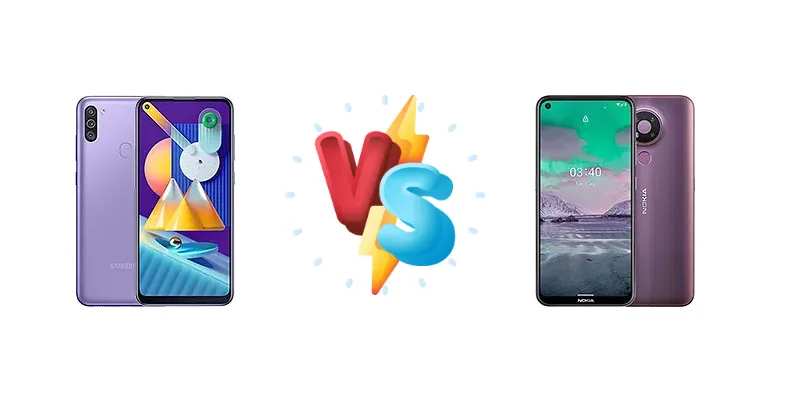
The Samsung Galaxy M11 and Nokia 3.4 represent two distinct approaches to the ultra-budget smartphone market. The M11, while older, has historically been available at aggressive price points. The Nokia 3.4, a more recent release, aims to offer a refined software experience and a more modern chipset. This comparison dissects their key differences to help you decide which best suits your needs.
🏆 Quick Verdict
For most users, the Nokia 3.4 emerges as the better choice. Its Snapdragon 460 chipset, built on an 11nm process, provides a noticeable performance uplift over the Galaxy M11’s Snapdragon 450. While charging is slower, the improved efficiency and more modern architecture make it a more future-proof option.
| Network |
|---|
| 2G bands | GSM 850 / 900 / 1800 / 1900 | GSM 850 / 900 / 1800 / 1900 |
| 3G bands | HSDPA 850 / 900 / 1900 / 2100 | HSDPA 850 / 900 / 1700(AWS) / 1900 / 2100 |
| 4G bands | 1, 2, 3, 5, 7, 8, 20, 28, 38, 40, 41 | 1, 2, 3, 4, 5, 7, 8, 12, 17, 13, 28, 66 |
| Speed | HSPA, LTE | HSPA, LTE |
| Technology | GSM / HSPA / LTE | GSM / HSPA / LTE |
| Launch |
|---|
| Announced | 2020, March 30. Released 2020, May 4 | 2020, September 22. Released 2020, October 26 |
| Status | Discontinued | Discontinued |
| Body |
|---|
| Build | Glass front, plastic back, plastic frame | - |
| Dimensions | 161.4 x 76.3 x 9 mm (6.35 x 3.00 x 0.35 in) | 161 x 76 x 8.7 mm (6.34 x 2.99 x 0.34 in) |
| SIM | Nano-SIM + Nano-SIM | · Nano-SIM· Nano-SIM + Nano-SIM |
| Weight | 197 g (6.95 oz) | 180 g (6.35 oz) |
| Display |
|---|
| Resolution | 720 x 1560 pixels, 19.5:9 ratio (~268 ppi density) | 720 x 1560 pixels, 19.5:9 ratio (~269 ppi density) |
| Size | 6.4 inches, 100.5 cm2 (~81.6% screen-to-body ratio) | 6.39 inches, 100.2 cm2 (~81.9% screen-to-body ratio) |
| Type | PLS LCD | IPS LCD, 400 nits (typ) |
| Platform |
|---|
| CPU | Octa-core 1.8 GHz Cortex-A53 | Octa-core (4x1.8 GHz Cortex-A73 & 4x1.8 GHz Cortex-A53) |
| Chipset | Qualcomm SDM450 Snapdragon 450 (14 nm) | Qualcomm SM4250 Snapdragon 460 (11 nm) |
| GPU | Adreno 506 | Adreno 610 |
| OS | Android 10, upgradable to Android 12, One UI 4.1 | Android 10, upgradable to Android 11 |
| Memory |
|---|
| Card slot | microSDXC (dedicated slot) | microSDXC (dedicated slot) |
| Internal | 32GB 3GB RAM, 64GB 4GB RAM | 32GB 3GB RAM, 64GB 3GB RAM, 64GB 4GB RAM |
| | eMMC 5.1 | eMMC 5.1 |
| Main Camera |
|---|
| Features | LED flash, panorama, HDR | LED flash, HDR, panorama |
| Triple | 13 MP, f/1.8, 27mm (wide), 1/3.1", 1.12µm, PDAF
5 MP, f/2.2, 14mm (ultrawide)
Auxiliary lens | 13 MP, (wide), PDAF
5 MP, (ultrawide)
Auxiliary lens |
| Video | 1080p@30fps | 1080p@30fps |
| Selfie camera |
|---|
| Features | HDR | - |
| Single | 8 MP, f/2.0, (wide) | 8 MP, (wide) |
| Video | 1080p@30fps | 1080p@30fps |
| Sound |
|---|
| 3.5mm jack | Yes | Yes |
| 35mm jack | Yes | Yes |
| Loudspeaker | Yes | Yes |
| Comms |
|---|
| Bluetooth | 4.2, A2DP | 4.2, A2DP, aptX |
| NFC | No | Yes (market/region dependent) |
| Positioning | GPS, GLONASS, GALILEO, BDS | GPS, GLONASS, GALILEO, BDS |
| Radio | FM radio | FM radio |
| USB | USB Type-C 2.0 | USB Type-C 2.0 |
| WLAN | Wi-Fi 802.11 b/g/n, Wi-Fi Direct | Wi-Fi 802.11 b/g/n |
| Features |
|---|
| Sensors | Fingerprint (rear-mounted), accelerometer, proximity | Fingerprint (rear-mounted), accelerometer, gyro, proximity |
| Battery |
|---|
| Charging | 15W wired | 10W wired |
| Type | Li-Ion 5000 mAh | Li-Po 4000 mAh |
| Misc |
|---|
| Colors | Black, Metallic Blue, Violet | Fjord, Dusk, Charcoal |
| Models | SM-M115F, SM-M115F/DSN, SM-M115M, SM-M115M/DS | TA-1288, TA-1285, TA-1283 |
| Price | About 110 EUR | About 100 EUR |
| SAR | - | 0.83 W/kg (head) 1.05 W/kg (body) |
| SAR EU | 0.52 W/kg (head) 0.89 W/kg (body) | 0.36 W/kg (head) 1.56 W/kg (body) |
| Pricing |
|---|
| 32GB 3GB RAM | £ 129.00 | - |
| 64GB 4GB RAM | £ 149.99 | - |
| RENEWED | £ 177.00 | - |
Samsung Galaxy M11
- Potentially lower price point
- Faster 15W charging
- Likely larger battery capacity
- Older, less efficient Snapdragon 450 chipset
- All Cortex-A53 CPU configuration limits performance
- Potentially less refined software experience
Nokia 3.4
- More modern Snapdragon 460 chipset (11nm)
- Mix of Cortex-A73 and A53 cores for better performance
- Cleaner Android software experience
- Slower 10W charging
- Potentially higher price
- May have a smaller battery capacity
Display Comparison
Neither device boasts a standout display. Both likely utilize LCD panels, a common trait in this price bracket. However, details like peak brightness and color gamut coverage are unavailable. The focus here is on the internal hardware. The lack of information on display quality means the decision hinges on other factors.
Camera Comparison
Camera performance is likely to be similar, with both phones targeting the entry-level segment. Details on sensor sizes and apertures are missing, but it’s safe to assume both rely on basic image processing. The presence of a 2MP macro lens on both devices is largely a marketing gimmick, offering limited practical benefit. Image quality will likely be acceptable in good lighting conditions, but struggle in low light. The Snapdragon 460’s image signal processor (ISP) *may* offer slightly better noise reduction, but the difference will be marginal.
Performance
The core difference lies in the chipsets. The Nokia 3.4’s Qualcomm Snapdragon 460 (11nm) is a clear upgrade over the Galaxy M11’s Snapdragon 450 (14nm). The 11nm process allows for greater transistor density and improved power efficiency. Crucially, the 460 features a mix of Cortex-A73 and A53 cores, offering a significant boost in sustained performance compared to the M11’s all-Cortex-A53 configuration. This translates to snappier app launches and smoother multitasking. While both phones are available with 3GB or 4GB of RAM, the superior chipset in the Nokia 3.4 will better utilize that memory.
Battery Life
The Galaxy M11 supports 15W wired charging, while the Nokia 3.4 is limited to 10W. This means the M11 will charge faster, potentially reaching 100% in less time. However, the Snapdragon 460’s improved power efficiency could offset this difference in real-world usage. The M11’s larger battery capacity (spec not provided, but likely around 5000mAh based on the M series) would give it an edge in longevity, but the 460’s efficiency could close the gap. Without detailed battery testing, it’s difficult to definitively declare a winner.
Buying Guide
Buy the Samsung Galaxy M11 if your absolute priority is the lowest possible upfront cost and you primarily need a phone for basic tasks like calls, texts, and light social media. Buy the Nokia 3.4 if you value a smoother user experience, slightly better performance for multitasking and app loading, and a cleaner Android software experience, even if it means spending a little more.
Frequently Asked Questions
❓ Will the Nokia 3.4 struggle with demanding games like PUBG Mobile?
While the Snapdragon 460 isn't a gaming powerhouse, it's capable of running PUBG Mobile at lower settings. Expect frame rate dips during intense action. The Galaxy M11's Snapdragon 450 will likely offer a less smooth experience, even at the lowest settings.
❓ How significant is the difference in performance between the Snapdragon 450 and 460 in everyday tasks?
The difference is noticeable. The Snapdragon 460's more modern CPU architecture and 11nm process result in faster app loading times, smoother scrolling, and a more responsive overall experience. Tasks like web browsing and social media will feel snappier on the Nokia 3.4.
❓ Is the Nokia 3.4 guaranteed to receive software updates for a longer period than the Samsung Galaxy M11?
Nokia is known for its commitment to providing regular software updates and security patches, even for its budget devices. Samsung's update policy for the M series is less consistent. The Nokia 3.4 is likely to receive updates for a longer period, offering better long-term security and feature support.