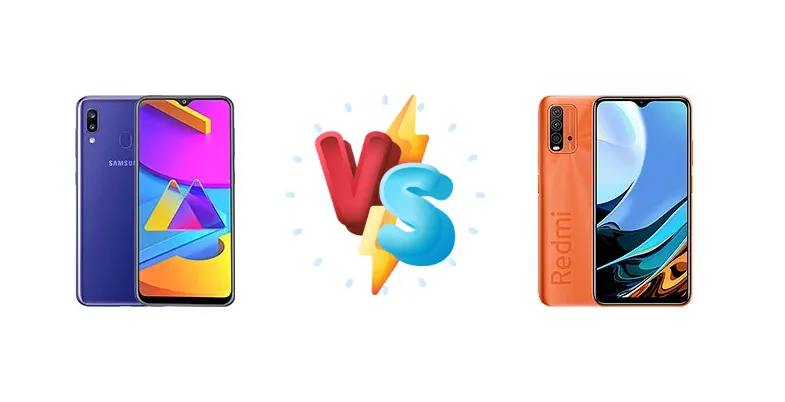
Looking for a reliable smartphone without breaking the bank? The Samsung Galaxy M10s and Xiaomi Redmi 9T are popular contenders in the budget phone arena. But which one reigns supreme? We'll break down their features, performance, and value to help you decide.
🏆 Quick Verdict
The Xiaomi Redmi 9T edges out the Samsung Galaxy M10s thanks to its more powerful Snapdragon 662 chipset, better battery life, and faster charging. While the M10s offers a decent experience, the Redmi 9T provides a more modern and feature-rich package for a similar price.
| Network |
|---|
| 2G bands | GSM 850 / 900 / 1800 / 1900 | GSM 850 / 900 / 1800 / 1900 |
| 3G bands | HSDPA 850 / 900 / 1900 / 2100 | HSDPA 850 / 900 / 1700(AWS) / 1900 / 2100 |
| 4G bands | 1, 3, 5, 7, 8, 20, 38, 40, 41 | 1, 2, 3, 4, 5, 7, 8, 20, 28, 38, 40, 41 |
| Speed | HSPA 42.2/5.76 Mbps, LTE (2CA) Cat6 300/50 Mbps | HSPA, LTE |
| Technology | GSM / HSPA / LTE | GSM / HSPA / LTE |
| Launch |
|---|
| Announced | 2019, September. Released 2019, September | 2021, January 08 |
| Status | Discontinued | Available. Released 2021, January 18 |
| Body |
|---|
| Build | Glass front, plastic back, plastic frame | Glass front (Gorilla Glass 3), plastic frame, plastic back |
| Dimensions | 158.4 x 74.7 x 7.8 mm (6.24 x 2.94 x 0.31 in) | 162.3 x 77.3 x 9.6 mm (6.39 x 3.04 x 0.38 in) |
| SIM | Nano-SIM + Nano-SIM | Nano-SIM + Nano-SIM |
| Weight | 169 g (5.96 oz) | 198 g (6.98 oz) |
| | - | Water-repellent coating |
| Display |
|---|
| Protection | - | Corning Gorilla Glass 3 |
| Resolution | 720 x 1560 pixels, 19.5:9 ratio (~268 ppi density) | 1080 x 2340 pixels, 19.5:9 ratio (~395 ppi density) |
| Size | 6.4 inches, 100.5 cm2 (~85.0% screen-to-body ratio) | 6.53 inches, 104.7 cm2 (~83.4% screen-to-body ratio) |
| Type | Super AMOLED | IPS LCD, 400 nits (typ) |
| Platform |
|---|
| CPU | Octa-core (2x1.6 GHz Cortex-A73 & 6x1.35 GHz Cortex-A53) | Octa-core (4x2.0 GHz Kryo 260 Gold & 4x1.8 GHz Kryo 260 Silver) |
| Chipset | Exynos 7884B (14 nm) | Qualcomm SM6115 Snapdragon 662 (11 nm) |
| GPU | Mali-G71 MP2 | Adreno 610 |
| OS | Android 9.0 (Pie), upgradable to Android 10, One UI 2.0 | Android 10, MIUI 12 |
| Memory |
|---|
| Card slot | microSDXC (dedicated slot) | microSDXC (dedicated slot) |
| Internal | 32GB 3GB RAM | 64GB 4GB RAM, 128GB 4GB RAM, 128GB 6GB RAM |
| | eMMC 5.1 | UFS 2.1 - 64GB
UFS 2.2 - 128GB |
| Main Camera |
|---|
| Dual | 13 MP, f/1.9, 27mm (wide), 1/3.1", 1.12µm, PDAF
5 MP, f/2.2, 12mm (ultrawide) | - |
| Features | LED flash, panorama, HDR | LED flash, HDR, panorama |
| Quad | - | 48 MP, f/1.8, 26mm (wide), 1/2.0", 0.8µm, PDAF
8 MP, f/2.2, 120˚ (ultrawide), 1/4.0", 1.12µm
2 MP (macro)
Auxiliary lens |
| Video | 1080p@30fps | 1080p@30fps |
| Selfie camera |
|---|
| Features | HDR | - |
| Single | 8 MP, f/2.0 | 8 MP, f/2.1, 27mm (wide), 1/4.0", 1.12µm |
| Video | 1080p@30fps | 1080p@30fps |
| Sound |
|---|
| 3.5mm jack | Yes | Yes |
| 35mm jack | Yes | Yes |
| Loudspeaker | Yes | Yes, with stereo speakers |
| | - | 24-bit/192kHz audio |
| Comms |
|---|
| Bluetooth | 5.0, A2DP, LE | 5.0, A2DP, LE |
| Infrared port | - | Yes |
| NFC | No | Yes (market/region dependent) |
| Positioning | GPS, GLONASS, BDS | GPS, GLONASS, GALILEO, BDS |
| Radio | FM radio | FM radio |
| USB | USB Type-C 2.0 | USB Type-C 2.0, OTG |
| WLAN | Wi-Fi 802.11 b/g/n, Wi-Fi Direct | Wi-Fi 802.11 a/b/g/n/ac, dual-band, Wi-Fi Direct |
| Features |
|---|
| Sensors | Fingerprint (rear-mounted), accelerometer, gyro, proximity, compass | Fingerprint (side-mounted), accelerometer, proximity, compass |
| Battery |
|---|
| Charging | 15W wired | 18W wired
2.5W reverse wired |
| Type | Li-Ion 4000 mAh, non-removable | Li-Po 6000 mAh |
| Misc |
|---|
| Colors | Stone Blue, Piano Black | Carbon Gray, Twilight Blue, Sunrise Orange, Ocean Green |
| Models | SM-M107F, SM-M107G, SM-M107Y, SM-M107M | J19S, M2010J19SG, M2010J19SY |
| Price | About 110 EUR | € 87.56 |
| SAR | 0.39 W/kg (head) | 1.09 W/kg (head) 1.00 W/kg (body) |
| SAR EU | - | 0.60 W/kg (head) 0.81 W/kg (body) |
| Pricing |
|---|
| 128GB 6GB RAM | - | Rp 2,272,000 |
| 64GB 4GB RAM | - | $ 168.78 |
| Tests |
|---|
| Battery life | - |
Endurance rating 150h
|
| Camera | - |
Photo / Video |
| Display | - |
Contrast ratio: 1594:1 |
| Loudspeaker | - |
-25.6 LUFS (Very good)
|
| Performance | - |
AnTuTu: 177917 (v8)
GeekBench: 1400 (v5.1)
GFXBench: 5.8fps (ES 3.1 onscreen) |
Samsung Galaxy M10s
- Familiar Samsung UI
- Compact size
- Decent display
- Reliable brand
- Older chipset
- Slower charging
- Lower battery life
- Less powerful camera
Xiaomi Redmi 9T
- Powerful Snapdragon 662 chipset
- Long battery life
- Fast charging (18W)
- Reverse charging
- Better camera performance
- More modern features
- MIUI can be polarizing
- Plastic build
Display Comparison
The Redmi 9T boasts a slightly brighter display (437 nits vs M10s's estimated 380 nits) and a similar impressive contrast ratio (1594:1). Both offer HD+ resolution, making them suitable for everyday use, but the Redmi 9T's slightly improved brightness gives it a minor edge.
Camera Comparison
Both phones offer a multi-camera setup. The Redmi 9T generally delivers better image quality, especially in low light, thanks to its more advanced image processing capabilities. While both are adequate for casual photography, the Redmi 9T provides a more consistent and pleasing experience.
Performance
Here, the Redmi 9T shines. Its Snapdragon 662 chipset is significantly faster and more efficient than the Exynos 7884B in the M10s. Expect smoother multitasking, faster app loading times, and better gaming performance on the Redmi 9T.
Battery Life
The Redmi 9T's endurance rating of 150h is a clear winner. It offers significantly longer battery life than the M10s, allowing you to go longer between charges. The 18W charging on the Redmi 9T is also faster than the M10s's 15W charging, and the reverse charging capability is a bonus.
Buying Guide
Who should buy the Samsung Galaxy M10s? Those prioritizing a familiar Samsung UI and a slightly smaller form factor. Who should buy the Xiaomi Redmi 9T? Users seeking better performance, longer battery life, reverse charging, and a more modern feature set.
Frequently Asked Questions
❓ Which phone has better gaming performance?
The Xiaomi Redmi 9T's Snapdragon 662 chipset provides significantly better gaming performance than the Samsung Galaxy M10s's Exynos 7884B.
❓ Can the Redmi 9T charge other devices?
Yes, the Redmi 9T supports 2.5W reverse wired charging, allowing you to use it as a power bank for other devices.
❓ Is the Samsung Galaxy M10s still a good phone?
The M10s remains a functional phone, especially for basic tasks. However, the Redmi 9T offers a more modern and feature-rich experience for a similar price.