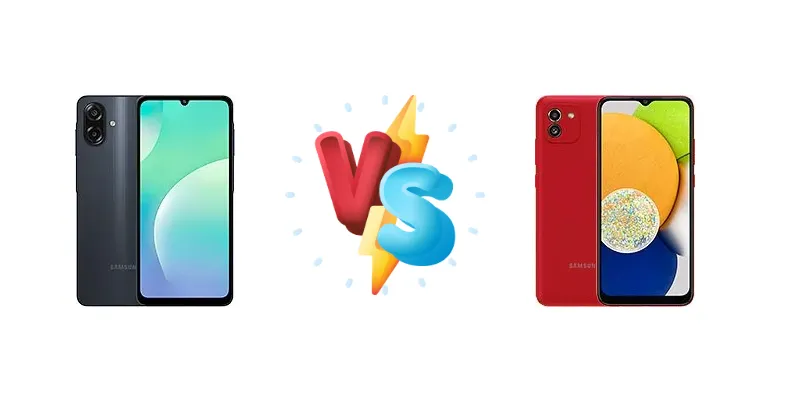
The Samsung Galaxy M07 and A03 represent Samsung’s entry-level offerings, but they diverge significantly under the hood. The M07, featuring the Mediatek Helio G99, aims for a balance of performance and efficiency, while the A03 relies on the Unisoc T606 to deliver affordability. This comparison dissects these key differences to help you determine which device best suits your needs.
🏆 Quick Verdict
For most users, the Samsung Galaxy M07 is the superior choice. Its Mediatek Helio G99 chipset, built on a more efficient 6nm process, delivers noticeably better performance and responsiveness compared to the A03’s Unisoc T606. While both phones target the budget segment, the M07 offers a more future-proof experience.
| Network |
|---|
| 2G bands | GSM 850 / 900 / 1800 / 1900 | GSM 850 / 900 / 1800 / 1900 |
| 3G bands | HSDPA 850 / 900 / 2100 | HSDPA 850 / 900 / 2100 |
| 4G bands | 1, 3, 5, 7, 8, 20, 28, 38, 40, 41 | 1, 3, 5, 7, 8, 20, 28, 38, 40, 41 |
| Speed | HSPA, LTE | HSPA 42.2/5.76 Mbps, LTE Cat4 150/50 Mbps |
| Technology | GSM / HSPA / LTE | GSM / HSPA / LTE |
| Launch |
|---|
| Announced | 2025, October 01 | 2021, November 26 |
| Status | Available. Released 2025, October 01 | Available. Released 2022, January 21 |
| Body |
|---|
| Build | Glass front, plastic back, plastic frame | Glass front, plastic back, plastic frame |
| Dimensions | 167.4 x 77.4 x 7.6 mm (6.59 x 3.05 x 0.30 in) | 164.2 x 75.9 x 9.1 mm (6.46 x 2.99 x 0.36 in) |
| SIM | Nano-SIM + Nano-SIM | · Nano-SIM· Nano-SIM + Nano-SIM |
| Weight | 184 g (6.49 oz) | 196 g (6.91 oz) |
| Display |
|---|
| Resolution | 720 x 1600 pixels, 20:9 ratio (~262 ppi density) | 720 x 1600 pixels, 20:9 ratio (~270 ppi density) |
| Size | 6.7 inches, 108.4 cm2 (~83.6% screen-to-body ratio) | 6.5 inches, 102.0 cm2 (~81.8% screen-to-body ratio) |
| Type | PLS LCD, 90Hz | PLS LCD |
| Platform |
|---|
| CPU | Octa-core (2x2.2 GHz Cortex-A76 & 6x2.0 GHz Cortex-A55) | Octa-core (2x1.6 GHz Cortex-A75 & 6x1.6 GHz Cortex-A55) |
| Chipset | Mediatek Helio G99 (6 nm) | Unisoc T606 (12 nm) |
| GPU | Mali-G57 MC2 | Mali-G57 MP1 |
| OS | Android 15, up to 6 major Android upgrades, One UI 7 | Android 11, upgradable to Android 13, One UI core 5 |
| Memory |
|---|
| Card slot | microSDXC (dedicated slot) | microSDXC (dedicated slot) |
| Internal | 64GB 4GB RAM | 32GB 2GB RAM, 32GB 3GB RAM, 32GB 4GB RAM, 64GB 4GB RAM, 64GB 3GB RAM, 128GB 4GB RAM |
| | - | eMMC 5.1 |
| Main Camera |
|---|
| Dual | 50 MP, f/1.8, (wide), 1/2.76", 0.64µm, PDAF
Auxiliary lens | 48 MP, f/1.8, (wide), AF
Auxiliary lens |
| Features | LED flash | LED flash |
| Single | - | 5 MP, f/2.2 |
| Video | 1080p@30fps | 1080p@30fps |
| Selfie camera |
|---|
| Single | 8 MP, f/2.0, (wide), 1/4.0", 1.12µm | 5 MP, f/2.2 |
| Video | Yes | Yes |
| Sound |
|---|
| 3.5mm jack | - | Yes |
| 35mm jack | Yes | Yes |
| Loudspeaker | Yes | Yes |
| Comms |
|---|
| Bluetooth | 5.3, A2DP, LE | 5.0, A2DP, LE |
| NFC | No | No |
| Positioning | GPS, GALILEO, GLONASS, BDS, QZSS | GPS |
| Radio | FM radio | Unspecified |
| USB | USB Type-C 2.0 | microUSB 2.0 |
| WLAN | Wi-Fi 802.11 a/b/g/n/ac, dual-band, Wi-Fi Direct | Wi-Fi 802.11 a/b/g/n/ac, dual-band, Wi-Fi Direct |
| Features |
|---|
| Sensors | Fingerprint (side-mounted), accelerometer, proximity | Accelerometer, proximity |
| Battery |
|---|
| Charging | 25W wired | - |
| Type | 5000 mAh | Li-Po 5000 mAh |
| Misc |
|---|
| Colors | Black | Black, Blue, Red |
| Models | SM-M075F/DS, SM-M075F | SM-A035F, SM-A035F/DS, SM-A035M, SM-A035G |
| Price | ₹ 6,799 | € 119.90 / £ 88.00 / ₹ 11,990 |
| SAR | 0.24 W/kg (head) | - |
| SAR EU | - | 0.20 W/kg (head) 1.35 W/kg (body) |
Samsung Galaxy M07
- Significantly faster processor (Helio G99)
- More efficient 6nm process
- Faster 25W charging
- Better gaming performance
- Potentially slightly higher price
- May not have a significantly better camera
Samsung Galaxy A03
- Lower price point
- Functional for basic tasks
- Acceptable battery life for light use
- Simple and easy to use
- Slower processor (Unisoc T606)
- Less efficient 12nm process
- Slower charging speeds
- Struggles with multitasking and gaming
Display Comparison
Neither Samsung provides display specifications beyond resolution. However, given their market positioning, both likely utilize LCD panels. The key difference lies in the underlying performance of the chipsets driving them. A more powerful chipset like the Helio G99 in the M07 will translate to smoother scrolling and animations, even on a similar display. Bezels are expected to be comparable, typical of this price bracket.
Camera Comparison
Without detailed camera specs, a direct comparison is difficult. However, both phones likely feature similar basic camera setups, potentially with a primary sensor and a depth sensor. The image signal processor (ISP) within the Helio G99 is likely more advanced, potentially leading to better image processing and slightly improved photo quality in the M07. The A03’s Unisoc T606 ISP will be adequate for basic photography, but will likely struggle in low-light conditions.
Performance
The Mediatek Helio G99 in the M07 is the clear winner here. Built on a 6nm process, it offers significantly improved power efficiency and performance compared to the Unisoc T606’s 12nm node. The G99’s octa-core configuration, with 2x2.2 GHz Cortex-A76 cores, provides a substantial boost in CPU performance over the A03’s 2x1.6 GHz Cortex-A75 cores. This translates to faster app loading times, smoother multitasking, and a more responsive user experience. The G99 also boasts a more capable GPU, making it better suited for light gaming. The Unisoc T606 is adequate for basic tasks, but will struggle with demanding applications.
Battery Life
While battery capacity isn't specified, the Helio G99’s 6nm process contributes to better power efficiency, potentially offsetting any capacity differences. More importantly, the M07 supports 25W wired charging, a significant advantage over the A03, which likely offers slower charging speeds. This means the M07 can be topped up much faster, reducing downtime and improving usability.
Buying Guide
Buy the Samsung Galaxy M07 if you prioritize smoother multitasking, occasional gaming, and faster charging speeds. This phone is ideal for users who want a device that can handle more than just basic tasks. Buy the Samsung Galaxy A03 if your primary needs are limited to calls, texts, and light social media use, and you are seeking the absolute lowest price point. It’s a functional device for those on a very tight budget.
Frequently Asked Questions
❓ Will the Unisoc T606 in the A03 struggle with popular apps like Facebook and WhatsApp?
While the A03 can run these apps, you may experience occasional lag or slowdowns, especially when multitasking. The Unisoc T606 is designed for basic tasks, and these apps can be resource-intensive. The M07’s Helio G99 will provide a much smoother experience.
❓ Is the 25W charging on the M07 a significant advantage in real-world use?
Yes, absolutely. 25W charging allows you to significantly reduce charging times. You can expect to go from 0% to 50% in around 30-45 minutes, compared to potentially over an hour with the A03’s slower charging. This is particularly useful if you frequently find yourself needing to quickly top up your battery.
❓ Can the Samsung Galaxy M07 handle mobile games like PUBG Mobile or Call of Duty Mobile?
The M07 can run these games, but you’ll likely need to lower the graphics settings to achieve a playable frame rate. The Helio G99’s GPU is capable, but it’s not a high-end gaming chip. The A03 would struggle significantly with these titles.
❓ Does the M07's processor make a noticeable difference in everyday tasks like browsing and opening apps?
Yes, the difference is quite noticeable. The Helio G99’s faster CPU cores and more efficient architecture result in snappier app launches, smoother scrolling, and a more responsive overall user experience. The A03 will feel noticeably slower in comparison.