
Samsung Galaxy M06 vs Xiaomi Redmi 13C 5G: A Deep Dive into Budget 5G Contenders
| Phones Images | |||||
|---|---|---|---|---|---|
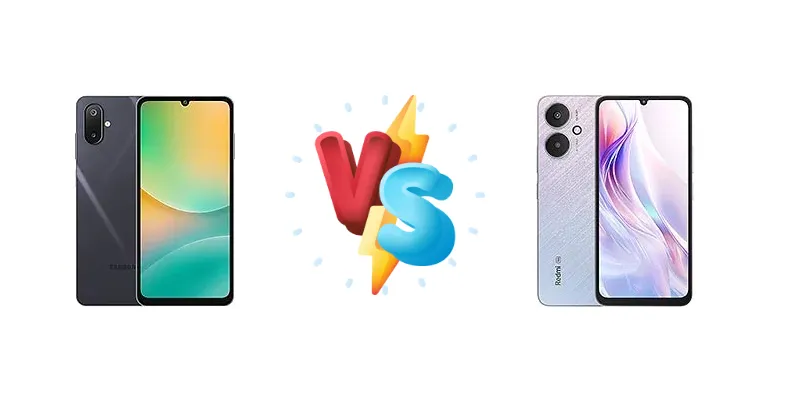
|
🏆 Quick Verdict
For most users, the Samsung Galaxy M06 emerges as the slightly stronger choice. Its Mediatek Dimensity 6300 chipset, with its higher clocked Cortex-A76 cores, provides a noticeable performance edge in demanding tasks. While the Redmi 13C 5G offers Power Delivery (PD) charging, the M06’s faster 25W charging ultimately provides a quicker top-up.
| PHONES | ||
|---|---|---|
| Phone Names | Samsung Galaxy M06 | Xiaomi Redmi 13C 5G |
| Network | ||
|---|---|---|
| 2G bands | GSM 850 / 900 / 1800 / 1900 | GSM 850 / 900 / 1800 / 1900 |
| 3G bands | HSDPA 850 / 900 / 1700(AWS) / 1900 / 2100 | HSDPA 800 / 850 / 900 / 1700(AWS) / 1900 / 2100 - International |
| 4G bands | 1, 2, 3, 4, 5, 7, 8, 12, 17, 20, 26, 28, 38, 40, 41, 66 | 1, 2, 3, 4, 5, 7, 8, 12, 13, 17, 18, 19, 20, 26, 28, 32, 38, 40, 41, 66 - International |
| 5G bands | 1, 3, 5, 7, 8, 26, 28, 40, 41, 66, 77, 78 SA/NSA/Sub6 | 1, 3, 5, 7, 8, 20, 28, 38, 40, 41, 66, 77, 78 SA/NSA - International |
| Speed | HSPA, LTE, 5G | HSPA, LTE, 5G |
| Technology | GSM / HSPA / LTE / 5G | GSM / HSPA / LTE / 5G |
| Launch | ||
|---|---|---|
| Announced | 2025, February 27 | 2023, December 06 |
| Status | Available. Released 2025, March 07 | Available. Released 2023, December 16 |
| Body | ||
|---|---|---|
| Build | Glass front, plastic back, plastic frame | Glass front (Gorilla Glass 3), plastic frame, plastic back |
| Dimensions | 167.4 x 77.4 x 8 mm (6.59 x 3.05 x 0.31 in) | 168.1 x 77.9 x 8.2 mm (6.62 x 3.07 x 0.32 in) |
| SIM | Nano-SIM + Nano-SIM | Nano-SIM + Nano-SIM |
| Weight | 191 g (6.74 oz) | 192 g or 195 g (6.77 oz) |
| Display | ||
|---|---|---|
| Protection | - | Corning Gorilla Glass 3 |
| Resolution | 720 x 1600 pixels, 20:9 ratio (~260 ppi density) | 720 x 1600 pixels, 20:9 ratio (~260 ppi density) |
| Size | 6.74 inches, 109.7 cm2 (~84.6% screen-to-body ratio) | 6.74 inches, 109.7 cm2 (~83.8% screen-to-body ratio) |
| Type | PLS LCD, 90Hz, 800 nits (HBM) | IPS LCD, 90Hz, 450 nits (typ), 600 nits (HBM) |
| Platform | ||
|---|---|---|
| CPU | Octa-core (2x2.4 GHz Cortex-A76 & 6x2.0 GHz Cortex-A55) | Octa-core (2x2.2 GHz Cortex-A76 & 6x2.0 GHz Cortex-A55) |
| Chipset | Mediatek Dimensity 6300 (6 nm) | Mediatek Dimensity 6100+ (6 nm) |
| GPU | Mali-G57 MC2 | Mali-G57 MC2 |
| OS | Android 15, up to 4 major Android upgrades, One UI Core 7.0 | Android 13, MIUI 14 |
| Memory | ||
|---|---|---|
| Card slot | microSDXC (uses shared SIM slot) | microSDXC (dedicated slot) |
| Internal | 64GB 4GB RAM, 128GB 4GB RAM, 128GB 6GB RAM | 64GB 4GB RAM, 128GB 4GB RAM, 128GB 6GB RAM, 256GB 8GB RAM |
| Main Camera | ||
|---|---|---|
| Dual | 50 MP, f/1.8, (wide), PDAF Auxiliary lens | - |
| Features | LED flash | LED flash, HDR |
| Single | - | 50 MP, f/1.8, 28mm (wide), 1/2.76", 1.12µm, PDAF Auxiliary lens |
| Video | 1080p@30fps | 1080p@30fps |
| Selfie camera | ||
|---|---|---|
| Features | - | HDR |
| Single | 8 MP, f/2.0, (wide), 1/4.0", 1.12µm | 5 MP, f/2.2, (wide) |
| Video | Yes | 1080p@30fps |
| Sound | ||
|---|---|---|
| 35mm jack | Yes | Yes |
| Loudspeaker | Yes | Yes |
| Comms | ||
|---|---|---|
| Bluetooth | 5.3, A2DP, LE | 5.3, A2DP, LE |
| NFC | No | Yes (market/region dependent) |
| Positioning | GPS, GALILEO, GLONASS, BDS, QZSS | GPS, GLONASS, GALILEO, BDS |
| Radio | Unspecified | FM radio |
| USB | USB Type-C 2.0, OTG | USB Type-C 2.0, OTG |
| WLAN | Wi-Fi 802.11 a/b/g/n/ac, dual-band, Wi-Fi Direct | Wi-Fi 802.11 a/b/g/n/ac, dual-band |
| Features | ||
|---|---|---|
| Sensors | Fingerprint (side-mounted), accelerometer, gyro, proximity, compass | Fingerprint (side-mounted), accelerometer, compass |
| Battery | ||
|---|---|---|
| Charging | 25W wired | 18W wired, PD |
| Type | Li-Ion 5000 mAh | 5000 mAh |
| Misc | ||
|---|---|---|
| Colors | Blazing Black, Sage Green | Starry Black, Twilight Blue, Starry Silver, Starlight Black, Startrail Green, Startrail Silver |
| Models | SM-M066B, SM-M066B/DS | 23124RN87G, 23124RN87I, 23124RN87C |
| Price | ₹ 8,499 | $ 198.99 / £ 119.00 / € 116.99 / ₹ 10,895 |
| SAR | 1.05 W/kg (head) | 1.09 W/kg (head) 1.09 W/kg (body) |
| SAR EU | 1.30 W/kg (head) 1.30 W/kg (body) | 0.98 W/kg (head) 0.98 W/kg (body) |
Samsung Galaxy M06
- Faster CPU performance due to the Dimensity 6300
- Faster 25W wired charging
- Potentially better sustained performance in demanding apps
- Charging lacks Power Delivery (PD) compatibility
- Camera specs are currently unknown
Xiaomi Redmi 13C 5G
- Power Delivery (PD) charging for wider charger compatibility
- Potentially more efficient GPU
- Competitive pricing
- Slightly slower CPU performance
- Slower 18W charging speed
Display Comparison
Neither Samsung nor Xiaomi provide display specifications beyond the basic resolution. However, given the price bracket, both likely utilize LCD panels. The real differentiator will be color accuracy and peak brightness, which are currently unknown. The absence of high refresh rate panels is expected at this price point. Bezels are likely comparable, focusing on maximizing screen real estate within the budget constraints.
Camera Comparison
Without detailed sensor information, a direct camera comparison is difficult. Both phones likely feature a primary camera paired with depth and macro sensors (the usefulness of the latter is questionable). The aperture of the main sensor will be a key factor; a wider aperture (lower f-number) will improve low-light performance. Image processing algorithms will also play a significant role, with Samsung typically favoring vibrant colors and Xiaomi leaning towards more natural tones. The absence of Optical Image Stabilization (OIS) is expected in this price range.
Performance
The core of the difference lies in the chipsets. The Samsung Galaxy M06 features the Mediatek Dimensity 6300, boasting a 2.4 GHz clock speed on its Cortex-A76 cores, compared to the Redmi 13C 5G’s Dimensity 6100+ with 2.2 GHz Cortex-A76 cores. While both utilize the same Cortex-A55 efficiency cores, the higher clock speed on the M06 translates to a roughly 8-10% performance advantage in CPU-intensive tasks. Both phones utilize a 6nm process, suggesting similar power efficiency. The Redmi 13C 5G’s chipset benefits from incremental improvements in the GPU, but the CPU difference is more impactful for general responsiveness. RAM configurations are likely similar, impacting multitasking capabilities.
Battery Life
Battery capacity is not specified, but both phones likely house batteries in the 5000mAh range, typical for this segment. The Samsung Galaxy M06’s 25W wired charging offers a faster charging experience than the Redmi 13C 5G’s 18W wired charging with Power Delivery (PD). While PD offers wider compatibility with chargers, the M06 will likely achieve a full charge in a shorter timeframe. The actual 0-100% charge time will depend on the battery capacity, but the M06 has a clear advantage in charging speed.
Buying Guide
Buy the Samsung Galaxy M06 if you prioritize sustained performance for gaming or multitasking and value faster charging speeds. This phone is ideal for users who frequently switch between apps or enjoy mobile games. Buy the Xiaomi Redmi 13C 5G if you prefer the convenience of Power Delivery charging compatibility and are primarily focused on basic smartphone tasks like browsing, social media, and light communication. It’s a solid option for those seeking a reliable and affordable 5G experience without demanding performance needs.