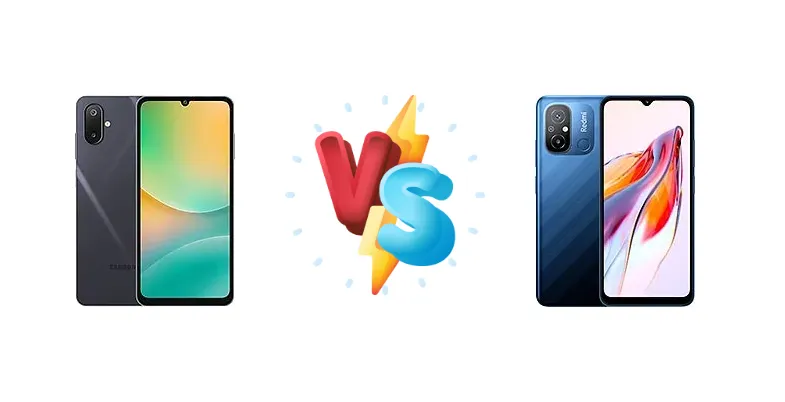
The Samsung Galaxy M06 and Xiaomi Redmi 12C represent two compelling options in the ultra-budget smartphone space. While both aim to deliver essential smartphone functionality at an accessible price, they diverge significantly in their core hardware, particularly in their chipsets and charging capabilities. This comparison will dissect these differences to determine which device offers the best value for your money.
🏆 Quick Verdict
For the average user prioritizing sustained performance and faster charging, the Samsung Galaxy M06 is the better choice. Its Mediatek Dimensity 6300, built on a 6nm process, offers a noticeable advantage over the Redmi 12C’s 12nm Helio G85, translating to smoother multitasking and potentially better gaming. However, the Redmi 12C remains a viable option for basic users.
| Network |
|---|
| 2G bands | GSM 850 / 900 / 1800 / 1900 | GSM 850 / 900 / 1800 / 1900 |
| 3G bands | HSDPA 850 / 900 / 1700(AWS) / 1900 / 2100 | HSDPA 850 / 900 / 2100 |
| 4G bands | 1, 2, 3, 4, 5, 7, 8, 12, 17, 20, 26, 28, 38, 40, 41, 66 | 1, 3, 5, 7, 8, 20, 28, 38, 40, 41 - International |
| 5G bands | 1, 3, 5, 7, 8, 26, 28, 40, 41, 66, 77, 78 SA/NSA/Sub6 | - |
| Speed | HSPA, LTE, 5G | HSPA, LTE |
| Technology | GSM / HSPA / LTE / 5G | GSM / CDMA / HSPA / EVDO / LTE |
| | - | CDMA2000 1xEV-DO |
| Launch |
|---|
| Announced | 2025, February 27 | 2022, December 31 |
| Status | Available. Released 2025, March 07 | Available. Released 2023, January 01 |
| Body |
|---|
| Build | Glass front, plastic back, plastic frame | - |
| Dimensions | 167.4 x 77.4 x 8 mm (6.59 x 3.05 x 0.31 in) | 168.8 x 76.4 x 8.8 mm (6.65 x 3.01 x 0.35 in) |
| SIM | Nano-SIM + Nano-SIM | Nano-SIM + Nano-SIM |
| Weight | 191 g (6.74 oz) | 192 g (6.77 oz) |
| Display |
|---|
| Resolution | 720 x 1600 pixels, 20:9 ratio (~260 ppi density) | 720 x 1650 pixels (~268 ppi density) |
| Size | 6.74 inches, 109.7 cm2 (~84.6% screen-to-body ratio) | 6.71 inches, 106.5 cm2 (~82.6% screen-to-body ratio) |
| Type | PLS LCD, 90Hz, 800 nits (HBM) | IPS LCD, 500 nits (typ) |
| Platform |
|---|
| CPU | Octa-core (2x2.4 GHz Cortex-A76 & 6x2.0 GHz Cortex-A55) | Octa-core (2x2.0 GHz Cortex-A75 & 6x1.8 GHz Cortex-A55) |
| Chipset | Mediatek Dimensity 6300 (6 nm) | Mediatek MT6769Z Helio G85 (12 nm) |
| GPU | Mali-G57 MC2 | Mali-G52 MC2 |
| OS | Android 15, up to 4 major Android upgrades, One UI Core 7.0 | Android 12, MIUI 13 |
| Memory |
|---|
| Card slot | microSDXC (uses shared SIM slot) | microSDXC (dedicated slot) |
| Internal | 64GB 4GB RAM, 128GB 4GB RAM, 128GB 6GB RAM | 32GB 2GB RAM, 32GB 3GB RAM, 32GB 4GB RAM, 64GB 3GB RAM, 64GB 4GB RAM, 128GB 3GB RAM, 128GB 4GB RAM, 128GB 6GB RAM |
| | - | eMMC 5.1 |
| Main Camera |
|---|
| Dual | 50 MP, f/1.8, (wide), PDAF
Auxiliary lens | 50 MP, (wide), PDAF
0.08 MP (depth) |
| Features | LED flash | LED flash, HDR |
| Single | - | 50 MP, f/1.8, (wide), 1/2.76", PDAF
Auxiliary lens |
| Video | 1080p@30fps | 1080p@30fps |
| Selfie camera |
|---|
| Single | 8 MP, f/2.0, (wide), 1/4.0", 1.12µm | 5 MP, f/2.2, (wide) |
| Video | Yes | 1080p@30fps |
| Sound |
|---|
| 3.5mm jack | - | Yes |
| 35mm jack | Yes | Yes |
| Loudspeaker | Yes | Yes |
| Comms |
|---|
| Bluetooth | 5.3, A2DP, LE | 5.1, A2DP, LE |
| NFC | No | Yes (market/region dependent) |
| Positioning | GPS, GALILEO, GLONASS, BDS, QZSS | GPS, GLONASS, BDS, GALILEO |
| Radio | Unspecified | FM radio |
| USB | USB Type-C 2.0, OTG | microUSB 2.0 |
| WLAN | Wi-Fi 802.11 a/b/g/n/ac, dual-band, Wi-Fi Direct | Wi-Fi 802.11 a/b/g/n/ac, dual-band, Wi-Fi Direct |
| Features |
|---|
| Sensors | Fingerprint (side-mounted), accelerometer, gyro, proximity, compass | Fingerprint (rear-mounted), accelerometer |
| | - | Virtual proximity sensing |
| Battery |
|---|
| Charging | 25W wired | 10W wired |
| Type | Li-Ion 5000 mAh | Li-Po 5000 mAh |
| Misc |
|---|
| Colors | Blazing Black, Sage Green | Graphite Gray, Ocean Blue, Mint Green, Lavender Purple |
| Models | SM-M066B, SM-M066B/DS | 22120RN86G, 22120RN86I, 22126RN91Y, 2212ARNC4L |
| Price | ₹ 8,499 | £ 132.99 / € 107.41 |
| SAR | 1.05 W/kg (head) | 1.08 W/kg (head) 0.64 W/kg (body) |
| SAR EU | 1.30 W/kg (head) 1.30 W/kg (body) | 0.98 W/kg (head) 0.99 W/kg (body) |
Samsung Galaxy M06
- More powerful and efficient Dimensity 6300 chipset
- Faster 25W wired charging
- Potentially better image processing
- Price may be slightly higher than the Redmi 12C
- Specific battery capacity unknown
Xiaomi Redmi 12C
- Lower price point
- Likely larger battery capacity (unconfirmed)
- Widely available
- Slower and less efficient Helio G85 chipset
- Slow 10W charging
- Potentially lower image quality
Display Comparison
Neither Samsung nor Xiaomi provide display specifications beyond resolution in their marketing materials. However, given the price point, both likely utilize LCD panels. The key difference lies in the underlying processing power impacting UI smoothness. While display quality is likely similar, the Dimensity 6300 in the M06 will ensure a more fluid experience when navigating the interface, even if the panels themselves are comparable.
Camera Comparison
Without detailed camera specs, a direct comparison is difficult. Both phones likely feature a primary camera and depth/macro sensors. However, the processing capabilities of the Dimensity 6300 in the M06 will likely result in better image processing, particularly in low-light conditions. The Redmi 12C’s Helio G85, while capable, lacks the image signal processor (ISP) prowess of the newer Dimensity chip. Expect slightly more detailed and vibrant photos from the M06, even with similar sensor hardware.
Performance
The core differentiator here is the chipset. The Samsung Galaxy M06’s Mediatek Dimensity 6300 (6nm) boasts a more modern architecture than the Xiaomi Redmi 12C’s Helio G85 (12nm). The Dimensity 6300’s Cortex-A76 cores, clocked at 2.4 GHz, are significantly more powerful than the Redmi 12C’s Cortex-A75 cores at 2.0 GHz. The 6nm fabrication process also contributes to improved power efficiency, meaning less heat generation and potentially less performance throttling under sustained load. This translates to a smoother experience in demanding apps and games for the M06.
Battery Life
While battery capacity isn't specified, the Redmi 12C’s 10W charging is a significant disadvantage compared to the M06’s 25W charging. The faster charging on the M06 drastically reduces the time spent plugged into the wall. Even if the Redmi 12C has a slightly larger battery, the M06’s efficiency and faster charging will likely result in a more convenient user experience. A full charge on the Redmi 12C will take considerably longer, impacting daily usability.
Buying Guide
Buy the Samsung Galaxy M06 if you need a phone capable of handling moderate multitasking, enjoy occasional gaming, and value faster 25W charging. This phone is ideal for users who want a device that feels responsive and won't leave you tethered to a charger for hours. Buy the Xiaomi Redmi 12C if you prioritize absolute affordability and primarily use your phone for calls, texts, and light social media. It’s a good fit for first-time smartphone users or those on a very tight budget.
Frequently Asked Questions
❓ Will the Mediatek Dimensity 6300 in the Galaxy M06 handle demanding games like PUBG Mobile?
The Dimensity 6300 is capable of running PUBG Mobile, but expect to play at medium settings for a smooth experience. The 6nm process and Cortex-A76 cores provide a performance boost over the Helio G85, but it's not a gaming powerhouse. Frame rate stability will depend on the specific device configuration and game settings.
❓ How long will it take to fully charge the Samsung Galaxy M06 with the 25W charger?
While the exact 0-100% charge time isn't officially stated, with 25W charging, you can expect a full charge in approximately 1 hour and 30 minutes to 2 hours, depending on usage during charging. This is a significant improvement over the Redmi 12C’s much slower 10W charging.
❓ Is the camera on the Xiaomi Redmi 12C good enough for casual social media photos?
The Redmi 12C’s camera is adequate for basic social media photos in good lighting conditions. However, the Helio G85’s image processing capabilities are limited, so expect less detail and vibrancy compared to the Galaxy M06, especially in low light. Don't expect flagship-level image quality.
❓ Does the Samsung Galaxy M06 support software updates for security patches and Android versions?
Samsung typically provides a reasonable level of software support for its devices, including security patches and Android version updates. However, given the M06's budget positioning, expect a limited number of major Android updates (likely one or two) and consistent security patches for a period of around two years.