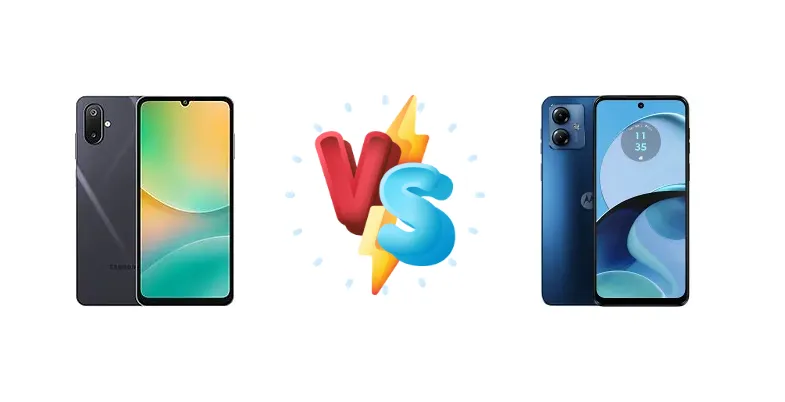
The Samsung Galaxy M06 and Motorola Moto G14 represent compelling options in the crowded budget smartphone space. While both aim to deliver essential features at an accessible price, they diverge significantly in their core hardware, particularly in their chipsets and charging capabilities. This comparison dissects these differences to determine which device offers the best overall experience.
🏆 Quick Verdict
For most users, the Samsung Galaxy M06 is the stronger choice. Its Mediatek Dimensity 6300 chipset, built on a more efficient 6nm process, provides a noticeable performance advantage over the Motorola Moto G14’s Unisoc Tiger T616. While the Moto G14 offers a slightly more variable charging experience (15W/20W), the M06’s consistent 25W charging and superior processing power make it the better all-rounder.
| Network |
|---|
| 2G bands | GSM 850 / 900 / 1800 / 1900 | GSM 850 / 900 / 1800 / 1900 |
| 3G bands | HSDPA 850 / 900 / 1700(AWS) / 1900 / 2100 | HSDPA 850 / 900 / 1900 / 2100 |
| 4G bands | 1, 2, 3, 4, 5, 7, 8, 12, 17, 20, 26, 28, 38, 40, 41, 66 | 1, 2, 3, 5, 7, 8, 20, 28, 38, 40, 41 |
| 5G bands | 1, 3, 5, 7, 8, 26, 28, 40, 41, 66, 77, 78 SA/NSA/Sub6 | - |
| Speed | HSPA, LTE, 5G | HSPA, LTE |
| Technology | GSM / HSPA / LTE / 5G | GSM / HSPA / LTE |
| Launch |
|---|
| Announced | 2025, February 27 | 2023, August 01 |
| Status | Available. Released 2025, March 07 | Available. Released 2023, August 08 |
| Body |
|---|
| Build | Glass front, plastic back, plastic frame | Glass front (Panda glass), plastic frame, plastic back |
| Dimensions | 167.4 x 77.4 x 8 mm (6.59 x 3.05 x 0.31 in) | 161.5 x 73.8 x 8 mm (6.36 x 2.91 x 0.31 in) |
| SIM | Nano-SIM + Nano-SIM | Nano-SIM + Nano-SIM |
| Weight | 191 g (6.74 oz) | 177 g (6.24 oz) |
| Display |
|---|
| Protection | - | Panda glass |
| Resolution | 720 x 1600 pixels, 20:9 ratio (~260 ppi density) | 1080 x 2400 pixels, 20:9 ratio (~405 ppi density) |
| Size | 6.74 inches, 109.7 cm2 (~84.6% screen-to-body ratio) | 6.5 inches, 102.0 cm2 (~85.6% screen-to-body ratio) |
| Type | PLS LCD, 90Hz, 800 nits (HBM) | IPS LCD |
| Platform |
|---|
| CPU | Octa-core (2x2.4 GHz Cortex-A76 & 6x2.0 GHz Cortex-A55) | Octa-core (2x2.0 GHz Cortex-A75 & 6x1.8 GHz Cortex-A55) |
| Chipset | Mediatek Dimensity 6300 (6 nm) | Unisoc Tiger T616 (12 nm) |
| GPU | Mali-G57 MC2 | Mali-G57 MP1 |
| OS | Android 15, up to 4 major Android upgrades, One UI Core 7.0 | Android 13, planned upgrade to Android 14 |
| Memory |
|---|
| Card slot | microSDXC (uses shared SIM slot) | microSDXC (dedicated slot) |
| Internal | 64GB 4GB RAM, 128GB 4GB RAM, 128GB 6GB RAM | 128GB 4GB RAM, 256GB 8GB RAM |
| Main Camera |
|---|
| Dual | 50 MP, f/1.8, (wide), PDAF
Auxiliary lens | 50 MP, f/1.8, (wide), 0.64µm, PDAF
2 MP (macro) |
| Features | LED flash | LED flash, HDR, panorama |
| Video | 1080p@30fps | 1080p@30fps |
| Selfie camera |
|---|
| Single | 8 MP, f/2.0, (wide), 1/4.0", 1.12µm | 8 MP, f/2.0, (wide), 1/4.0", 1.12µm |
| Video | Yes | 1080p@30fps |
| Sound |
|---|
| 35mm jack | Yes | Yes |
| Loudspeaker | Yes | Yes, with stereo speakers |
| Comms |
|---|
| Bluetooth | 5.3, A2DP, LE | 5.0, A2DP, LE |
| NFC | No | Yes (market/region dependent) |
| Positioning | GPS, GALILEO, GLONASS, BDS, QZSS | GPS, GLONASS, GALILEO |
| Radio | Unspecified | FM radio |
| USB | USB Type-C 2.0, OTG | USB Type-C 2.0 |
| WLAN | Wi-Fi 802.11 a/b/g/n/ac, dual-band, Wi-Fi Direct | Wi-Fi 802.11 a/b/g/n/ac, dual-band |
| Features |
|---|
| Sensors | Fingerprint (side-mounted), accelerometer, gyro, proximity, compass | Fingerprint (side-mounted), accelerometer, gyro, proximity, compass (market/region dependent) |
| Battery |
|---|
| Charging | 25W wired | 15W wired
20W wired (India) |
| Type | Li-Ion 5000 mAh | Li-Po 5000 mAh |
| Misc |
|---|
| Colors | Blazing Black, Sage Green | Steel Gray, Sky Blue, Butter Cream, Pale Lilac |
| Models | SM-M066B, SM-M066B/DS | PAYF0010IN |
| Price | ₹ 8,499 | $ 190.00 / £ 89.99 / € 149.90 |
| SAR | 1.05 W/kg (head) | - |
| SAR EU | 1.30 W/kg (head) 1.30 W/kg (body) | - |
Samsung Galaxy M06
- Superior chipset performance with the Dimensity 6300
- Faster 25W wired charging
- More efficient 6nm fabrication process
- Potentially slightly higher price point
- No specific display details available
Motorola Moto G14
- Potentially lower price
- Simple and functional Android experience
- Variable charging speed (20W in India)
- Less powerful Unisoc Tiger T616 chipset
- Slower 15W (or 20W) wired charging
- Less efficient 12nm fabrication process
Display Comparison
Neither Samsung nor Motorola provide display specifications beyond the basic resolution. However, the chipset differences suggest potential implications. The Dimensity 6300’s stronger GPU could drive a smoother experience with higher refresh rate displays, should Samsung choose to implement one in future revisions. The Moto G14, constrained by the Tiger T616, is likely optimized for a standard 60Hz panel. Bezels and color accuracy are assumed to be comparable given the price bracket, leaning towards functional rather than premium.
Camera Comparison
Without detailed camera specifications, a direct comparison is difficult. However, given the market positioning, both phones likely feature similar primary sensors. The image signal processor (ISP) within the Dimensity 6300 is likely more advanced, potentially leading to better image processing, noise reduction, and dynamic range in the M06. The Unisoc Tiger T616’s ISP is adequate for basic photography, but will likely struggle in low-light conditions compared to the M06. The inclusion of a 2MP macro lens on both devices is largely a marketing tactic, offering minimal practical benefit.
Performance
The core difference lies in the chipsets. The Samsung Galaxy M06’s Mediatek Dimensity 6300 (6nm) boasts a more modern architecture with 2x2.4 GHz Cortex-A76 cores and 6x2.0 GHz Cortex-A55 cores. This contrasts with the Motorola Moto G14’s Unisoc Tiger T616 (12nm) featuring 2x2.0 GHz Cortex-A75 cores and 6x1.8 GHz Cortex-A55 cores. The 6nm fabrication process of the Dimensity 6300 translates to better power efficiency and reduced thermal throttling under sustained load, benefiting gamers and multi-taskers. The Cortex-A76 cores in the M06 also offer a performance uplift over the A75 cores in the G14. While both utilize octa-core configurations, the architectural advantages of the Dimensity 6300 are significant.
Battery Life
Battery capacity isn’t specified, but both phones likely house batteries in the 5000mAh range, typical for this price segment. The key differentiator is charging speed. The Samsung Galaxy M06 supports 25W wired charging, enabling significantly faster top-ups compared to the Motorola Moto G14’s 15W (or 20W in India) charging. This means the M06 will reach 100% charge in a shorter timeframe, reducing downtime. While a larger battery capacity *could* offset slower charging, the efficiency gains of the Dimensity 6300 in the M06 likely minimize the impact of a potentially slightly smaller battery.
Buying Guide
Buy the Samsung Galaxy M06 if you prioritize sustained performance for multitasking, moderate gaming, and future-proofing. The Dimensity 6300 offers a more capable platform for demanding applications. Buy the Motorola Moto G14 if you are on an extremely tight budget and prioritize simplicity, and are willing to trade performance for potential cost savings. The Moto G14 is a functional device for basic communication and light usage.
Frequently Asked Questions
❓ Will the Unisoc Tiger T616 in the Moto G14 struggle with demanding games like PUBG Mobile?
Yes, the Unisoc Tiger T616 is a budget-focused chipset. While it can run PUBG Mobile, you'll likely need to lower graphics settings and accept lower frame rates for a smooth experience. The Dimensity 6300 in the Galaxy M06 offers a significantly better gaming experience with higher settings and more stable performance.
❓ Does the Samsung Galaxy M06 overheat during prolonged use, like video recording or gaming?
The Mediatek Dimensity 6300’s 6nm process is designed for improved thermal efficiency. While some heat generation is inevitable, the M06 is less likely to experience significant throttling during extended use compared to the Moto G14, which uses the less efficient 12nm Tiger T616.
❓ Is the 20W charging on the Moto G14 (India variant) a significant improvement over the 15W version?
Yes, a 20W charger will noticeably reduce charging times compared to the 15W version. However, even with 20W, it still falls short of the consistent 25W charging offered by the Samsung Galaxy M06, which will likely reach full charge faster overall.