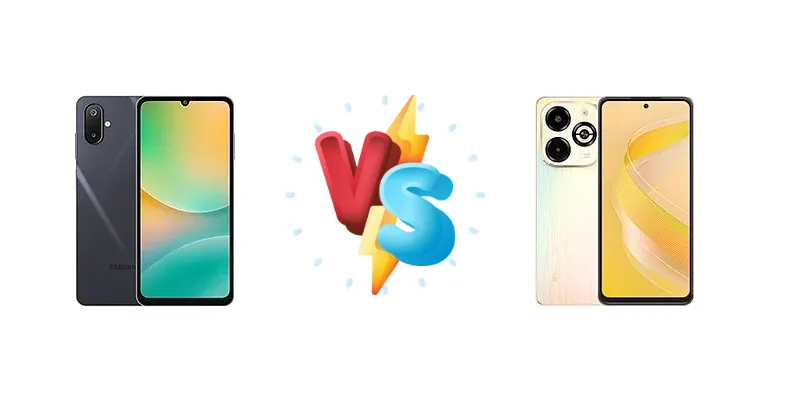
The Samsung Galaxy M06 and Infinix Smart 8 Plus represent two approaches to the ultra-budget smartphone market. The M06 prioritizes processing power with its newer Dimensity 6300 chipset, while the Smart 8 Plus focuses on practical features like reverse wired charging and affordability. This comparison dissects their key differences to help you choose the right device.
🏆 Quick Verdict
For most users, the Samsung Galaxy M06 is the superior choice. Its Mediatek Dimensity 6300 chipset delivers a significantly faster and more responsive experience than the Infinix Smart 8 Plus’ Helio G36. While the Smart 8 Plus offers reverse charging, the performance gap justifies the slightly higher price for the M06.
| Network |
|---|
| 2G bands | GSM 850 / 900 / 1800 / 1900 | GSM 850 / 900 / 1800 / 1900 |
| 3G bands | HSDPA 850 / 900 / 1700(AWS) / 1900 / 2100 | HSDPA 850 / 900 / 1700(AWS) / 1900 / 2100 |
| 4G bands | 1, 2, 3, 4, 5, 7, 8, 12, 17, 20, 26, 28, 38, 40, 41, 66 | 1, 2, 3, 4, 5, 7, 8, 20, 28, 38, 41, 40 |
| 5G bands | 1, 3, 5, 7, 8, 26, 28, 40, 41, 66, 77, 78 SA/NSA/Sub6 | - |
| Speed | HSPA, LTE, 5G | HSPA, LTE |
| Technology | GSM / HSPA / LTE / 5G | GSM / HSPA / LTE |
| Launch |
|---|
| Announced | 2025, February 27 | 2024, January 30 |
| Status | Available. Released 2025, March 07 | Available. Released 2024, February |
| Body |
|---|
| Build | Glass front, plastic back, plastic frame | Glass front, plastic back, plastic frame |
| Dimensions | 167.4 x 77.4 x 8 mm (6.59 x 3.05 x 0.31 in) | 163.7 x 75.7 x 9 mm (6.44 x 2.98 x 0.35 in) |
| SIM | Nano-SIM + Nano-SIM | Nano-SIM + Nano-SIM |
| Weight | 191 g (6.74 oz) | 204 g (7.20 oz) |
| Display |
|---|
| Resolution | 720 x 1600 pixels, 20:9 ratio (~260 ppi density) | 720 x 1612 pixels, 20:9 ratio (~267 ppi density) |
| Size | 6.74 inches, 109.7 cm2 (~84.6% screen-to-body ratio) | 6.6 inches, 104.6 cm2 (~84.4% screen-to-body ratio) |
| Type | PLS LCD, 90Hz, 800 nits (HBM) | IPS LCD, 90Hz, 500 nits (peak) |
| Platform |
|---|
| CPU | Octa-core (2x2.4 GHz Cortex-A76 & 6x2.0 GHz Cortex-A55) | Octa-core (4x2.2 GHz Cortex-A53 & 4x1.6 GHz Cortex-A53) |
| Chipset | Mediatek Dimensity 6300 (6 nm) | Mediatek Helio G36 (12 nm) |
| GPU | Mali-G57 MC2 | PowerVR GE8320 |
| OS | Android 15, up to 4 major Android upgrades, One UI Core 7.0 | Android 13 (Go edition), XOS 13 |
| Memory |
|---|
| Card slot | microSDXC (uses shared SIM slot) | microSDXC (dedicated slot) |
| Internal | 64GB 4GB RAM, 128GB 4GB RAM, 128GB 6GB RAM | 64GB 4GB RAM, 128GB 4GB RAM |
| Main Camera |
|---|
| Dual | 50 MP, f/1.8, (wide), PDAF
Auxiliary lens | - |
| Features | LED flash | Ring-LED flash, HDR, panorama |
| Single | - | 50 MP, f/1.9, (wide), AF
Auxiliary lens |
| Video | 1080p@30fps | 1080p@30fps |
| Selfie camera |
|---|
| Single | 8 MP, f/2.0, (wide), 1/4.0", 1.12µm | 8 MP, f/2.0, (wide) |
| Video | Yes | Yes |
| Sound |
|---|
| 35mm jack | Yes | Yes |
| Loudspeaker | Yes | Yes |
| Comms |
|---|
| Bluetooth | 5.3, A2DP, LE | 5.0, A2DP, LE |
| NFC | No | No |
| Positioning | GPS, GALILEO, GLONASS, BDS, QZSS | GPS |
| Radio | Unspecified | FM radio |
| USB | USB Type-C 2.0, OTG | USB Type-C 2.0, OTG |
| WLAN | Wi-Fi 802.11 a/b/g/n/ac, dual-band, Wi-Fi Direct | Wi-Fi 802.11 a/b/g/n/ac, dual-band |
| Features |
|---|
| Sensors | Fingerprint (side-mounted), accelerometer, gyro, proximity, compass | Fingerprint (side-mounted), accelerometer, proximity, compass |
| Battery |
|---|
| Charging | 25W wired | 18W wired
Reverse wired |
| Type | Li-Ion 5000 mAh | 6000 mAh |
| Misc |
|---|
| Colors | Blazing Black, Sage Green | Galaxy White, Shiny Gold, Timber Black |
| Models | SM-M066B, SM-M066B/DS | X6526 |
| Price | ₹ 8,499 | About 100 EUR |
| SAR | 1.05 W/kg (head) | - |
| SAR EU | 1.30 W/kg (head) 1.30 W/kg (body) | - |
Samsung Galaxy M06
- Significantly faster processor (Dimensity 6300)
- Faster 25W charging
- Potentially better image processing
- Lacks reverse charging
- May be slightly more expensive
Infinix Smart 8 Plus
- Reverse wired charging capability
- More affordable price point
- Decent battery life (estimated)
- Slower processor (Helio G36)
- Slower 18W charging
- Likely less responsive user experience
Display Comparison
Neither device's display specifications are provided, so a direct comparison is limited. However, given the market segment, both likely utilize LCD panels. The M06, benefiting from a more modern chipset, *may* have access to slightly better display drivers for improved color accuracy. The absence of high refresh rate support is expected on both, focusing on maximizing battery life. Bezels are likely comparable, prioritizing cost reduction over premium aesthetics.
Camera Comparison
Without detailed camera specifications, analysis is limited. Both phones likely feature a primary camera and potentially a depth or macro sensor. The absence of OIS is almost certain on both. The M06’s superior processing power *could* translate to better image processing, particularly in low-light conditions, but this is speculative. The 2MP macro cameras often found in this price range are generally of limited practical use on either device.
Performance
The core difference lies in the chipsets. The Samsung Galaxy M06’s Mediatek Dimensity 6300 (6nm) is a substantial upgrade over the Infinix Smart 8 Plus’ Helio G36 (12nm). The 6nm process node inherently offers better power efficiency and thermal performance, allowing the Dimensity 6300 to sustain higher clock speeds for longer. The CPU architecture also favors the M06; its Cortex-A76 cores (2x2.4 GHz) are significantly more powerful than the Cortex-A53 cores (4x2.2 GHz) found in the Smart 8 Plus. The remaining Cortex-A55 cores (6x2.0 GHz in M06 vs 4x1.6 GHz in Smart 8 Plus) further widen the performance gap. This translates to faster app launches, smoother multitasking, and a more enjoyable gaming experience on the M06.
Battery Life
Battery capacity isn't specified, but both likely fall in the 5000mAh range, typical for this segment. The key difference is charging speed: 25W for the M06 versus 18W for the Smart 8 Plus. This means the M06 will charge significantly faster, reducing downtime. The Smart 8 Plus’ inclusion of reverse wired charging is a unique feature, allowing it to act as a power bank for other devices, a benefit the M06 lacks. However, the slower charging speed and potential battery drain from reverse charging need to be considered.
Buying Guide
Buy the Samsung Galaxy M06 if you prioritize smooth multitasking, responsive app loading, and a generally faster user experience. This phone is ideal for users who frequently use social media, browse the web, or play casual games. Buy the Infinix Smart 8 Plus if you absolutely need reverse wired charging to top up accessories or other devices, and are willing to compromise on processing speed for that convenience. It's a better fit for users who primarily make calls, send texts, and use a limited number of apps.
Frequently Asked Questions
❓ Will the Mediatek Dimensity 6300 in the Galaxy M06 handle demanding games like PUBG Mobile?
While the Dimensity 6300 isn't a flagship chipset, it's capable of running PUBG Mobile at medium settings with reasonable frame rates. Expect some occasional frame drops during intense firefights, but the experience should be playable. The Helio G36 in the Smart 8 Plus will struggle with consistent performance in PUBG Mobile, requiring significantly lower settings.
❓ How useful is the reverse wired charging feature on the Infinix Smart 8 Plus in real-world scenarios?
The reverse wired charging is most useful for topping up accessories like Bluetooth earbuds or smartwatches. It can also provide a small emergency charge to another phone, but the 18W output is relatively slow. Don't expect to fully charge another phone quickly using this feature.
❓ Is the difference in charging speed between 25W and 18W noticeable in everyday use?
Yes, the difference is quite noticeable. 25W charging will get you from 0% to 50% in approximately 30-40 minutes, while 18W will take closer to an hour. This can be a significant time saver, especially if you frequently need to quickly top up your phone.