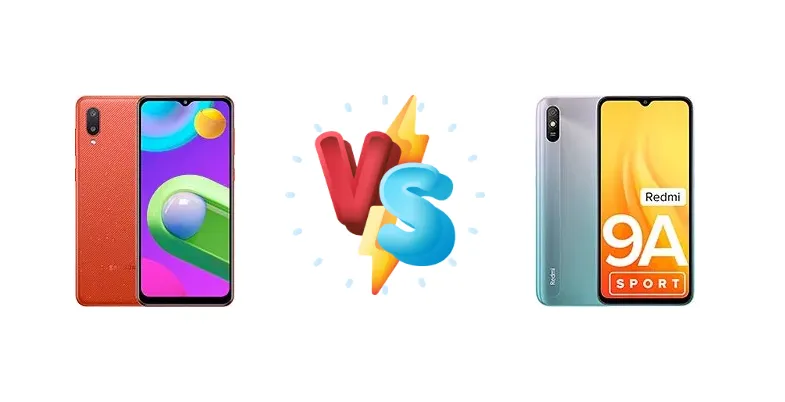
The Samsung Galaxy M02 and Xiaomi Redmi 9A Sport represent the extreme end of the budget smartphone spectrum. Both aim to deliver essential smartphone functionality at the lowest possible price, but they take different approaches to achieving this. This comparison dissects their core components to determine which offers the best value for users prioritizing affordability.
🏆 Quick Verdict
For the average user, the Xiaomi Redmi 9A Sport emerges as the better choice. Its newer, more efficient Helio G25 chipset and octa-core CPU provide a noticeable performance boost over the Galaxy M02’s aging Mediatek MT6739W, making it more capable for everyday tasks and light gaming.
| Network |
|---|
| 2G bands | GSM 850 / 900 / 1800 / 1900 | GSM 850 / 900 / 1800 / 1900 |
| 3G bands | HSDPA 850 / 900 / 2100 | HSDPA 850 / 900 / 2100 |
| 4G bands | 1, 3, 5, 7, 8, 20, 28, 38, 40, 41 | 1, 3, 5, 8, 40, 41 |
| Speed | HSPA 42.2/5.76 Mbps, LTE Cat4 150/50 Mbps | HSPA, LTE |
| Technology | GSM / HSPA / LTE | GSM / HSPA / LTE |
| Launch |
|---|
| Announced | 2021, February 02 | 2021, September 28 |
| Status | Available. Released 2021, February 09 | Available. Released 2021, September 28 |
| Body |
|---|
| Build | Glass front, plastic back, plastic frame | - |
| Dimensions | 164 x 75.9 x 9.1 mm (6.46 x 2.99 x 0.36 in) | 164.9 x 77.1 x 9 mm (6.49 x 3.04 x 0.35 in) |
| SIM | · Nano-SIM· Nano-SIM + Nano-SIM | Nano-SIM + Nano-SIM |
| Weight | 206 g (7.27 oz) | 194 g (6.84 oz) |
| | - | Water-repellent coating |
| Display |
|---|
| Resolution | 720 x 1600 pixels, 20:9 ratio (~270 ppi density) | 720 x 1600 pixels, 20:9 ratio (~269 ppi density) |
| Size | 6.5 inches, 102.0 cm2 (~81.9% screen-to-body ratio) | 6.53 inches, 102.9 cm2 (~81.0% screen-to-body ratio) |
| Type | PLS LCD | IPS LCD, 400 nits (typ) |
| Platform |
|---|
| CPU | Quad-core 1.5 GHz Cortex-A53 | Octa-core (4x2.0 GHz Cortex-A53 & 4x1.5 GHz Cortex-A53) |
| Chipset | Mediatek MT6739W (28 nm) | Mediatek MT6762G Helio G25 (12 nm) |
| GPU | PowerVR GE8100 | PowerVR GE8320 |
| OS | Android 10, One UI 2.0 | Android 10, MIUI 12 |
| Memory |
|---|
| Card slot | microSDXC (dedicated slot) | microSDXC (dedicated slot) |
| Internal | 32GB 2GB RAM, 32GB 3GB RAM | 32GB 2GB RAM, 32GB 3GB RAM |
| | - | eMMC 5.1 |
| Main Camera |
|---|
| Dual | 13 MP, f/1.9, (wide), AF
2 MP (macro) | - |
| Features | LED flash | LED flash, HDR |
| Single | - | 13 MP, f/2.2, 28mm (wide), 1.0µm, PDAF |
| Video | 1080p@30fps | 1080p@30/60fps |
| Selfie camera |
|---|
| Features | - | HDR |
| Single | 5 MP, f/2.0 | 5 MP, f/2.2, (wide), 1.12µm |
| Video | - | 1080p@30fps |
| Sound |
|---|
| 3.5mm jack | - | Yes |
| 35mm jack | Yes | Yes |
| Loudspeaker | Yes | Yes |
| Comms |
|---|
| Bluetooth | 5.0, A2DP, LE | 5.0, A2DP, LE |
| NFC | No | No |
| Positioning | GPS, GLONASS | GPS, GLONASS, BDS |
| Radio | Unspecified | FM radio |
| USB | microUSB 2.0 | microUSB 2.0, OTG |
| WLAN | Wi-Fi 802.11 b/g/n, Wi-Fi Direct | Wi-Fi 802.11 a/b/g/n, Wi-Fi Direct |
| Features |
|---|
| Sensors | Accelerometer | Accelerometer, proximity |
| Battery |
|---|
| Charging | - | 10W wired |
| Type | Li-Po 5000 mAh | Li-Po 5000 mAh |
| Misc |
|---|
| Colors | Black, Gray, Blue, Red | Carbon Black, Coral Green, Metallic Blue |
| Models | SM-M022F, SM-M022F/DS, SM-M022G, SM-M022G/DS | - |
| Price | About 80 EUR | About 100 EUR |
| SAR EU | 0.65 W/kg (head) 1.71 W/kg (body) | - |
Samsung Galaxy M02
- Samsung Brand Recognition
- Potentially lower price (depending on region)
- Functional for basic tasks
- Outdated Mediatek MT6739W chipset
- Quad-core CPU limits multitasking
- Likely slower performance overall
Xiaomi Redmi 9A Sport
- More powerful Mediatek Helio G25 chipset
- Octa-core CPU for smoother performance
- Improved power efficiency
- Xiaomi's MIUI software can be bloated
- 10W charging is relatively slow
Display Comparison
Neither device boasts a standout display. Both likely utilize LCD panels, typical for this price bracket. However, detailed display specs (resolution, brightness) are unavailable. The Redmi 9A Sport benefits from a more modern chipset which *could* translate to slightly better image processing, but this is speculative. Bezels are expected to be substantial on both, impacting the overall screen-to-body ratio.
Camera Comparison
Camera performance on both devices will be limited. Without specific sensor details, it’s safe to assume both rely on basic sensors for capturing images. The presence of a 2MP macro lens on the Redmi 9A Sport is largely a marketing gimmick; its utility is minimal. Image processing will likely be basic on both, with limited dynamic range and detail in challenging lighting conditions. The Redmi 9A Sport *may* benefit from slightly better image signal processing (ISP) capabilities integrated into the Helio G25 chipset.
Performance
The performance gap is the most significant differentiator. The Xiaomi Redmi 9A Sport’s Mediatek Helio G25 (12nm) is a clear upgrade over the Samsung Galaxy M02’s Mediatek MT6739W (28nm). The G25’s octa-core configuration (4x2.0 GHz Cortex-A53 & 4x1.5 GHz Cortex-A53) provides more processing power than the M02’s quad-core 1.5 GHz Cortex-A53. The 12nm process node of the G25 also offers improved power efficiency, potentially leading to longer battery life under load. This translates to snappier app launches and smoother multitasking on the Redmi 9A Sport.
Battery Life
Battery capacity is not specified for either device, but both likely feature batteries in the 4000-5000 mAh range, common for this segment. The Redmi 9A Sport’s 10W wired charging is standard for budget phones. The Helio G25’s improved power efficiency could translate to slightly longer battery life compared to the M02, despite potentially similar battery capacities. However, the difference will likely be marginal in real-world usage.
Buying Guide
Buy the Samsung Galaxy M02 if you absolutely need the Samsung brand ecosystem and are willing to compromise on performance. It's a functional device for basic communication and light usage. Buy the Xiaomi Redmi 9A Sport if you prioritize a smoother user experience, slightly better gaming capabilities, and a more modern chipset, even if it means sacrificing brand recognition.
Frequently Asked Questions
❓ Will the Redmi 9A Sport handle popular games like PUBG Mobile?
While the Helio G25 isn't a gaming powerhouse, the Redmi 9A Sport can run PUBG Mobile at lower settings. Expect frame rate drops during intense action, but it's playable for casual gaming. The M02's MT6739W will struggle significantly with this title.
❓ Is the software experience significantly different between Samsung and Xiaomi?
Yes. Samsung's One UI is generally considered cleaner and more intuitive, while Xiaomi's MIUI is heavily customized and often includes pre-installed apps (bloatware). MIUI offers more customization options, but can be less responsive than One UI on this hardware.
❓ How much does the 12nm process node of the Helio G25 impact real-world battery life?
The 12nm process node allows the Helio G25 to operate more efficiently than the 28nm MT6739W. This means it consumes less power for the same tasks, potentially adding an hour or two of usage on a single charge, especially during demanding activities like video playback or gaming.