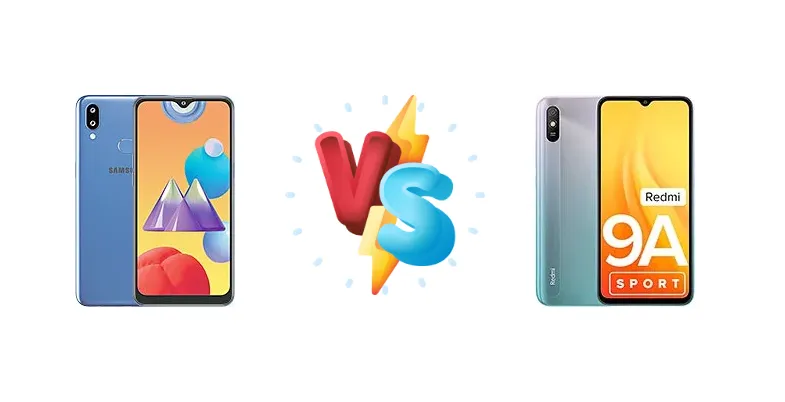
The Samsung Galaxy M01s and Xiaomi Redmi 9A Sport represent the extreme end of the smartphone price spectrum. Both aim to deliver essential functionality at a minimal cost, but they achieve this with slightly different approaches to chipset selection. This comparison dissects the nuances between the Mediatek Helio P22 powering the M01s and the Helio G25 in the Redmi 9A Sport, revealing which device offers the best experience for the price.
🏆 Quick Verdict
For the average user prioritizing slightly better sustained performance and potential software support, the Xiaomi Redmi 9A Sport emerges as the winner. While both phones are incredibly similar, the Helio G25’s minor architectural improvements and 10W charging provide a small but noticeable edge in everyday use and convenience.
| Network |
|---|
| 2G bands | GSM 850 / 900 / 1800 / 1900 | GSM 850 / 900 / 1800 / 1900 |
| 3G bands | HSDPA 850 / 900 / 2100 | HSDPA 850 / 900 / 2100 |
| 4G bands | 1, 3, 5, 7, 8, 20, 28, 38, 40, 41 | 1, 3, 5, 8, 40, 41 |
| Speed | HSPA 42.2/5.76 Mbps, LTE Cat4 150/50 Mbps | HSPA, LTE |
| Technology | GSM / HSPA / LTE | GSM / HSPA / LTE |
| Launch |
|---|
| Announced | 2020, July 16. Released 2020, July 16 | 2021, September 28 |
| Status | Discontinued | Available. Released 2021, September 28 |
| Body |
|---|
| Build | Glass front, plastic back, plastic frame | - |
| Dimensions | 156.9 x 75.8 x 7.8 mm (6.18 x 2.98 x 0.31 in) | 164.9 x 77.1 x 9 mm (6.49 x 3.04 x 0.35 in) |
| SIM | Nano-SIM + Nano-SIM | Nano-SIM + Nano-SIM |
| Weight | 168 g (5.93 oz) | 194 g (6.84 oz) |
| | - | Water-repellent coating |
| Display |
|---|
| Resolution | 720 x 1520 pixels, 19:9 ratio (~271 ppi density) | 720 x 1600 pixels, 20:9 ratio (~269 ppi density) |
| Size | 6.2 inches, 95.9 cm2 (~80.7% screen-to-body ratio) | 6.53 inches, 102.9 cm2 (~81.0% screen-to-body ratio) |
| Type | PLS LCD | IPS LCD, 400 nits (typ) |
| Platform |
|---|
| CPU | Octa-core (4x2.0 GHz & 4x1.5 GHz) | Octa-core (4x2.0 GHz Cortex-A53 & 4x1.5 GHz Cortex-A53) |
| Chipset | Mediatek MT6762 Helio P22 (12 nm) | Mediatek MT6762G Helio G25 (12 nm) |
| GPU | PowerVR GE8320 | PowerVR GE8320 |
| OS | Android 9.0 (Pie), upgradable to Android 10, One UI 2.1 | Android 10, MIUI 12 |
| Memory |
|---|
| Card slot | microSDXC (dedicated slot) | microSDXC (dedicated slot) |
| Internal | 32GB 3GB RAM | 32GB 2GB RAM, 32GB 3GB RAM |
| | eMMC 5.1 | eMMC 5.1 |
| Main Camera |
|---|
| Dual | 13 MP, f/1.8, 28mm (wide), 1/3.1", 1.12µm, AF
Auxiliary lens | - |
| Features | LED flash | LED flash, HDR |
| Single | - | 13 MP, f/2.2, 28mm (wide), 1.0µm, PDAF |
| Video | 1080p@30fps | 1080p@30/60fps |
| Selfie camera |
|---|
| Features | - | HDR |
| Single | 8 MP, f/2.0 | 5 MP, f/2.2, (wide), 1.12µm |
| Video | - | 1080p@30fps |
| Sound |
|---|
| 3.5mm jack | Yes | Yes |
| 35mm jack | Yes | Yes |
| Loudspeaker | Yes | Yes |
| Comms |
|---|
| Bluetooth | 4.2, A2DP, LE | 5.0, A2DP, LE |
| NFC | No | No |
| Positioning | GPS, GLONASS, GALILEO, BDS | GPS, GLONASS, BDS |
| Radio | FM radio | FM radio |
| USB | microUSB 2.0, OTG | microUSB 2.0, OTG |
| WLAN | Wi-Fi 802.11 b/g/n, Wi-Fi Direct | Wi-Fi 802.11 a/b/g/n, Wi-Fi Direct |
| Features |
|---|
| Sensors | Fingerprint (rear-mounted), accelerometer, proximity | Accelerometer, proximity |
| Battery |
|---|
| Charging | - | 10W wired |
| Type | Li-Ion 4000 mAh | Li-Po 5000 mAh |
| Misc |
|---|
| Colors | Light Blue, Gray | Carbon Black, Coral Green, Metallic Blue |
| Models | SM-M017F, SM-M017F/DS | - |
| Price | About 110 EUR | About 100 EUR |
| SAR | 0.26 W/kg (head) | - |
Samsung Galaxy M01s
- Established Brand Reputation (Samsung)
- Potentially better software updates (Samsung)
- Similar CPU performance to Redmi 9A Sport
- Slower charging (likely 5W)
- Slightly less efficient chipset (Helio P22)
Xiaomi Redmi 9A Sport
- Slightly improved GPU performance (Helio G25)
- 10W wired charging for faster top-ups
- More efficient chipset architecture
- Xiaomi's MIUI software can be bloated
- Potentially less consistent software updates
Display Comparison
Neither Samsung nor Xiaomi provide detailed display specifications for these models. Given their price point, both likely utilize LCD panels with 720p+ resolution. The real-world difference in display quality will likely be minimal, focusing on color calibration and viewing angles rather than peak brightness or advanced features like HDR. Bezels are expected to be substantial on both devices, reflecting their budget nature.
Camera Comparison
Camera performance on both devices will be limited by their sensor quality and image processing capabilities. Details on sensor sizes are scarce, but both likely feature a primary sensor around 13MP. The Redmi 9A Sport may benefit from slightly improved image signal processing (ISP) within the Helio G25 chipset, potentially leading to better dynamic range and noise reduction. The inclusion of 2MP macro/depth sensors on both phones is largely marketing fluff; their image quality is typically poor and offers limited practical value. Expect acceptable results in well-lit conditions, but struggles in low light.
Performance
Both the Samsung Galaxy M01s and Xiaomi Redmi 9A Sport are equipped with Mediatek Helio P22 and Helio G25 chipsets, respectively, both fabricated on a 12nm process. The core CPU configuration is identical – an octa-core setup with four cores clocked at 2.0 GHz and four at 1.5 GHz, utilizing Cortex-A53 cores. However, the Helio G25 in the Redmi 9A Sport features a slightly more efficient CPU design and a marginally improved GPU. This translates to a small performance uplift in gaming and multitasking, though both phones will struggle with demanding titles. The G25’s architecture is optimized for basic gaming, offering a smoother experience in less intensive games compared to the P22. RAM configurations are likely similar, further minimizing the performance gap.
Battery Life
Battery capacity is likely similar on both devices, around 4000-5000 mAh, providing all-day battery life with moderate usage. However, the Xiaomi Redmi 9A Sport gains an advantage with its 10W wired charging support, while the Samsung Galaxy M01s likely relies on slower 5W charging. This means the Redmi 9A Sport can be topped up more quickly, reducing downtime and improving convenience. While neither phone supports fast charging, the 10W capability on the Redmi 9A Sport is a tangible benefit.
Buying Guide
Buy the Samsung Galaxy M01s if you prioritize brand recognition and a potentially more refined software experience, even if it means sacrificing a small amount of processing power. Buy the Xiaomi Redmi 9A Sport if you prefer a slightly more capable chipset for light gaming and multitasking, coupled with the convenience of 10W wired charging, all while staying within a very tight budget.
Frequently Asked Questions
❓ Will the Redmi 9A Sport handle PUBG Mobile smoothly?
While the Helio G25 is optimized for basic gaming, PUBG Mobile will likely require the lowest graphics settings and frame rate to achieve playable performance on the Redmi 9A Sport. Expect occasional frame drops and stuttering, especially in intense firefights. The M01s will likely perform similarly or slightly worse.
❓ How does the software experience differ between Samsung's One UI and Xiaomi's MIUI on these phones?
Samsung's One UI is generally considered cleaner and more intuitive, with a focus on usability. Xiaomi's MIUI is highly customizable but often comes pre-loaded with bloatware and aggressive battery optimization that can interfere with app performance. Both interfaces are heavily skinned, but One UI typically offers a smoother, more refined experience.
❓ Is the difference in chipset performance between the Helio P22 and G25 noticeable in everyday tasks?
The difference in performance is subtle but present. The Helio G25 offers a slight edge in multitasking and app launch speeds. However, for basic tasks like browsing, social media, and calling, the difference will be barely perceptible to most users.
❓ Which phone is likely to receive more software updates and security patches?
Samsung generally provides more consistent and long-term software support for its devices, even at the budget end. While Xiaomi has improved its update schedule, Samsung is still the more reliable choice for receiving timely security patches and potentially even a major Android version update.