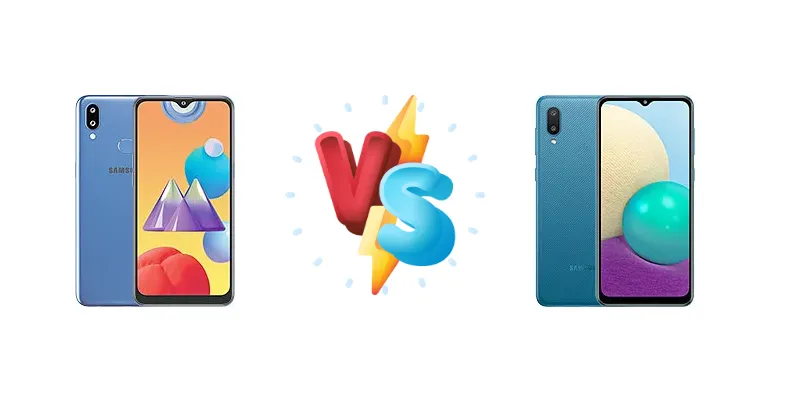
Samsung's entry-level A and M series offer compelling options for budget-conscious buyers. The Galaxy M01s and A02 represent two distinct approaches within this segment. The M01s, released earlier, boasts a more powerful chipset, while the A02 aims to provide a balanced experience at an even lower price point. This comparison dissects their key differences to help you choose the right phone.
🏆 Quick Verdict
For most users, the Samsung Galaxy M01s is the better choice. Its Mediatek Helio P22 chipset provides a significantly more responsive experience for everyday tasks and light gaming, justifying the potential price premium. However, the A02's lower price and availability of different RAM configurations make it a viable option for extremely basic usage.
| Network |
|---|
| 2G bands | GSM 850 / 900 / 1800 / 1900 | GSM 850 / 900 / 1800 / 1900 |
| 3G bands | HSDPA 850 / 900 / 2100 | HSDPA 850 / 900 / 2100 |
| 4G bands | 1, 3, 5, 7, 8, 20, 28, 38, 40, 41 | 1, 3, 5, 7, 8, 20, 28, 38, 40, 41 |
| Speed | HSPA 42.2/5.76 Mbps, LTE Cat4 150/50 Mbps | HSPA 42.2/5.76 Mbps, LTE Cat4 150/50 Mbps |
| Technology | GSM / HSPA / LTE | GSM / HSPA / LTE |
| Launch |
|---|
| Announced | 2020, July 16. Released 2020, July 16 | 2021, January 27 |
| Status | Discontinued | Available. Released 2021, January 27 |
| Body |
|---|
| Build | Glass front, plastic back, plastic frame | Glass front, plastic back, plastic frame |
| Dimensions | 156.9 x 75.8 x 7.8 mm (6.18 x 2.98 x 0.31 in) | 164 x 75.9 x 9.1 mm (6.46 x 2.99 x 0.36 in) |
| SIM | Nano-SIM + Nano-SIM | · Nano-SIM· Nano-SIM + Nano-SIM |
| Weight | 168 g (5.93 oz) | 206 g (7.27 oz) |
| Display |
|---|
| Resolution | 720 x 1520 pixels, 19:9 ratio (~271 ppi density) | 720 x 1600 pixels, 20:9 ratio (~270 ppi density) |
| Size | 6.2 inches, 95.9 cm2 (~80.7% screen-to-body ratio) | 6.5 inches, 102.0 cm2 (~81.9% screen-to-body ratio) |
| Type | PLS LCD | PLS LCD |
| Platform |
|---|
| CPU | Octa-core (4x2.0 GHz & 4x1.5 GHz) | Quad-core 1.5 GHz Cortex-A53 |
| Chipset | Mediatek MT6762 Helio P22 (12 nm) | Mediatek MT6739W (28 nm) |
| GPU | PowerVR GE8320 | PowerVR GE8100 |
| OS | Android 9.0 (Pie), upgradable to Android 10, One UI 2.1 | Android 10, upgradable to Android 11, One UI Core 3.1 |
| Memory |
|---|
| Card slot | microSDXC (dedicated slot) | microSDXC (dedicated slot) |
| Internal | 32GB 3GB RAM | 32GB 2GB RAM, 32GB 3GB RAM, 32GB 4GB RAM, 64GB 3GB RAM |
| | eMMC 5.1 | eMMC 5.1 |
| Main Camera |
|---|
| Dual | 13 MP, f/1.8, 28mm (wide), 1/3.1", 1.12µm, AF
Auxiliary lens | 13 MP, f/1.9, (wide), AF
2 MP (macro) |
| Features | LED flash | LED flash |
| Video | 1080p@30fps | 1080p@30fps |
| Selfie camera |
|---|
| Single | 8 MP, f/2.0 | 5 MP, f/2.0 |
| Sound |
|---|
| 3.5mm jack | Yes | Yes |
| 35mm jack | Yes | Yes |
| Loudspeaker | Yes | Yes |
| Comms |
|---|
| Bluetooth | 4.2, A2DP, LE | 5.1, A2DP, LE |
| NFC | No | No |
| Positioning | GPS, GLONASS, GALILEO, BDS | GPS, GLONASS |
| Radio | FM radio | FM radio |
| USB | microUSB 2.0, OTG | microUSB 2.0 |
| WLAN | Wi-Fi 802.11 b/g/n, Wi-Fi Direct | Wi-Fi 802.11 b/g/n, Wi-Fi Direct |
| Features |
|---|
| Sensors | Fingerprint (rear-mounted), accelerometer, proximity | Accelerometer |
| | - | Virtual proximity sensing |
| Battery |
|---|
| Type | Li-Ion 4000 mAh | Li-Po 5000 mAh |
| Misc |
|---|
| Colors | Light Blue, Gray | Black, Blue |
| Models | SM-M017F, SM-M017F/DS | SM-A022F, SM-A022F/DS, SM-A022M, SM-A022M/DS, SM-A022G, SM-A022G/DS |
| Price | About 110 EUR | € 97.46 |
| SAR | 0.26 W/kg (head) | - |
| SAR EU | - | 0.65 W/kg (head) 1.71 W/kg (body) |
| Pricing |
|---|
| 32GB 2GB RAM | - | $ 149.99 |
| 32GB 3GB RAM | - | $ 129.99 |
| 64GB 3GB RAM | - | $ 199.99 |
| RENEWED | - | £ 113.00 |
Samsung Galaxy M01s
- Significantly faster processor (Helio P22)
- Octa-core CPU for better multitasking
- More responsive user experience
- Potentially higher price
- May consume battery faster due to more powerful processor
- Detailed specs (display, battery) are unknown
Samsung Galaxy A02
- Lower price point
- Multiple RAM/storage configurations
- Potentially better battery life due to less powerful processor
- Significantly slower processor (MT6739W)
- Quad-core CPU struggles with multitasking
- Less responsive user experience
Display Comparison
Neither device boasts a standout display. Both are likely to feature LCD panels, typical for this price range. However, detailed display specs (resolution, brightness) are missing. The A02's availability in different storage/RAM configurations doesn't suggest display variations. The focus here is on functionality, not visual fidelity. Expect adequate, but not impressive, viewing experiences on both.
Camera Comparison
Camera performance is likely to be similar, leaning towards basic functionality on both devices. Detailed sensor information is absent, but both are expected to feature a primary camera alongside auxiliary lenses (likely 2MP depth/macro sensors). The A02's camera system is unlikely to benefit from any advanced features like optical image stabilization (OIS). Image processing will likely be similar across both devices, focusing on basic scene optimization. The 2MP macro cameras on both are unlikely to deliver significant detail.
Performance
The performance gap is the most significant difference. The Galaxy M01s utilizes the Mediatek Helio P22, an octa-core processor built on a 12nm process. This contrasts sharply with the A02's Mediatek MT6739W, a quad-core processor fabricated on a larger, less efficient 28nm node. The P22's higher core count and smaller manufacturing process translate to substantially better CPU and GPU performance. The A02's Cortex-A53 cores, while power-efficient, are significantly older architecture and will struggle with demanding applications. The M01s will offer a smoother experience with multitasking and app loading times.
Battery Life
Battery capacity details are missing for both devices. However, the A02's less powerful chipset and older 28nm process *should* result in comparable, if not slightly better, battery life despite potentially having a smaller capacity. The M01s' more demanding processor will consume more power. Charging wattage is also unknown, making it difficult to assess charging speeds. Real-world battery performance will depend heavily on usage patterns.
Buying Guide
Buy the Samsung Galaxy M01s if you prioritize performance and responsiveness for tasks like social media, browsing, and occasional gaming. It's ideal for users who want a phone that feels fluid and doesn't struggle with multitasking. Buy the Samsung Galaxy A02 if your primary needs are making calls, sending texts, and very light app usage, and you're on a strict budget. It's best suited for first-time smartphone users or those needing a simple, reliable device.
Frequently Asked Questions
❓ Will the Galaxy A02 struggle with popular apps like Facebook and WhatsApp?
While the A02 can run these apps, its Mediatek MT6739W processor and limited RAM (especially in the 2GB variant) may result in noticeable lag and slow loading times. Expect a less fluid experience compared to the M01s.
❓ Is the Galaxy M01s a good choice for playing mobile games?
The M01s is a better option for gaming than the A02, but it's still a budget device. It can handle less demanding games at lower settings. However, graphically intensive titles will likely require significant compromises in graphics quality and frame rates.
❓ Does the Galaxy A02 support expandable storage via microSD card?
While not explicitly stated in the provided data, Samsung's A-series phones typically include a microSD card slot for expandable storage. It's highly probable the A02 supports this feature, allowing you to increase storage capacity beyond the internal 32GB or 64GB options.
❓ What kind of charging does the A02 support? Is it fast charging?
Charging specifications are not provided. Given the price point, it's unlikely the A02 supports fast charging. Expect standard 5W or 10W charging via Micro-USB, resulting in relatively slow charging times.