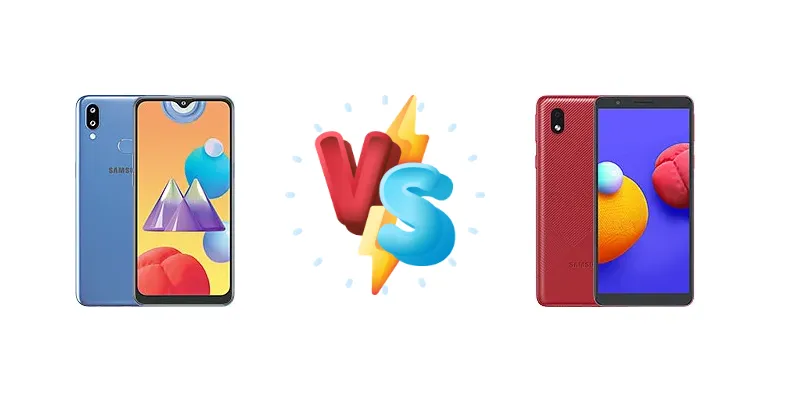
Samsung's entry-level smartphone lineup often presents a confusing array of choices. The Galaxy M01s and A01 Core represent two of the most affordable options, but a significant difference in their underlying hardware dictates vastly different user experiences. This comparison dissects the key specifications to determine which device delivers the best value for the budget-conscious consumer.
🏆 Quick Verdict
For most users, the Samsung Galaxy M01s is the superior choice. Its Mediatek Helio P22 chipset, with its octa-core CPU, provides a noticeably smoother and more responsive experience than the quad-core MT6739 in the A01 Core. While both phones target the ultra-budget segment, the M01s offers a better balance of performance and usability.
| Network |
|---|
| 2G bands | GSM 850 / 900 / 1800 / 1900 | GSM 850 / 900 / 1800 / 1900 |
| 3G bands | HSDPA 850 / 900 / 2100 | HSDPA 850 / 900 / 2100 |
| 4G bands | 1, 3, 5, 7, 8, 20, 28, 38, 40, 41 | 1, 3, 5, 7, 8, 20, 28, 38, 40, 41 |
| Speed | HSPA 42.2/5.76 Mbps, LTE Cat4 150/50 Mbps | HSPA 21.1/5.76 Mbps, LTE |
| Technology | GSM / HSPA / LTE | GSM / HSPA / LTE |
| Launch |
|---|
| Announced | 2020, July 16. Released 2020, July 16 | 2020, July 21. Released 2020, August 06 |
| Status | Discontinued | Discontinued |
| Body |
|---|
| Build | Glass front, plastic back, plastic frame | Plastic back, plastic frame |
| Dimensions | 156.9 x 75.8 x 7.8 mm (6.18 x 2.98 x 0.31 in) | 141.7 x 67.5 x 8.6 mm (5.58 x 2.66 x 0.34 in) |
| SIM | Nano-SIM + Nano-SIM | · Nano-SIM· Nano-SIM + Nano-SIM |
| Weight | 168 g (5.93 oz) | 150 g (5.29 oz) |
| Display |
|---|
| Resolution | 720 x 1520 pixels, 19:9 ratio (~271 ppi density) | 720 x 1480 pixels, 18.5:9 ratio (~311 ppi density) |
| Size | 6.2 inches, 95.9 cm2 (~80.7% screen-to-body ratio) | 5.3 inches, 71.3 cm2 (~74.5% screen-to-body ratio) |
| Type | PLS LCD | PLS LCD |
| Platform |
|---|
| CPU | Octa-core (4x2.0 GHz & 4x1.5 GHz) | Quad-core 1.5 GHz Cortex-A53 |
| Chipset | Mediatek MT6762 Helio P22 (12 nm) | Mediatek MT6739 (28 nm) |
| GPU | PowerVR GE8320 | PowerVR GE8100 |
| OS | Android 9.0 (Pie), upgradable to Android 10, One UI 2.1 | Android 10 (Go edition) |
| Memory |
|---|
| Card slot | microSDXC (dedicated slot) | microSDXC (dedicated slot) |
| Internal | 32GB 3GB RAM | 16GB 1GB RAM, 16GB 2GB RAM, 32GB 2GB RAM |
| | eMMC 5.1 | eMMC 5.1 |
| Main Camera |
|---|
| Dual | 13 MP, f/1.8, 28mm (wide), 1/3.1", 1.12µm, AF
Auxiliary lens | - |
| Features | LED flash | LED flash |
| Single | - | 8 MP, f/2.2, AF |
| Video | 1080p@30fps | 1080p@30fps |
| Selfie camera |
|---|
| Single | 8 MP, f/2.0 | 5 MP, f/2.4 |
| Sound |
|---|
| 3.5mm jack | Yes | Yes |
| 35mm jack | Yes | Yes |
| Loudspeaker | Yes | Yes |
| Comms |
|---|
| Bluetooth | 4.2, A2DP, LE | 5.0, A2DP, LE |
| NFC | No | No |
| Positioning | GPS, GLONASS, GALILEO, BDS | GPS |
| Radio | FM radio | FM radio |
| USB | microUSB 2.0, OTG | microUSB 2.0 |
| WLAN | Wi-Fi 802.11 b/g/n, Wi-Fi Direct | Wi-Fi 802.11 b/g/n, Wi-Fi Direct |
| Features |
|---|
| Sensors | Fingerprint (rear-mounted), accelerometer, proximity | Accelerometer |
| Battery |
|---|
| Type | Li-Ion 4000 mAh | Li-Ion 3000 mAh |
| Misc |
|---|
| Colors | Light Blue, Gray | Black, Blue, Red |
| Models | SM-M017F, SM-M017F/DS | SM-A013F, SM-A013F/DS, SM-A013G, SM-A013G/DS, SM-A013M |
| Price | About 110 EUR | About 150 EUR |
| SAR | 0.26 W/kg (head) | - |
| SAR EU | - | 0.64 W/kg (head) 1.18 W/kg (body) |
Samsung Galaxy M01s
- Significantly faster processor for smoother performance
- More efficient chipset for potentially better battery life
- Better suited for multitasking and light gaming
- Likely a slightly higher price point
- May not offer a dramatically better camera experience
Samsung Galaxy A01 Core
- Lowest possible price point in Samsung's lineup
- Functional for basic communication tasks
- Simple and easy-to-use interface
- Slow processor leads to noticeable lag and stuttering
- Less efficient chipset results in shorter battery life
- Poor performance with multiple apps or demanding tasks
Display Comparison
Neither Samsung provides detailed display specifications beyond resolution. However, the focus here isn't display quality, but rather the processing power needed to drive the UI. Both likely utilize LCD panels, and the difference in display experience will be minimal. The more significant factor is the chipset's ability to render the interface smoothly, favoring the M01s.
Camera Comparison
Both devices likely feature basic camera setups, and detailed sensor information is scarce. Given the market segment, image quality will be heavily reliant on software processing. However, the M01s’ more powerful chipset will allow for faster image processing and potentially better low-light performance. Any differences in sensor quality will be secondary to the processing capabilities. Expect both to struggle with complex scenes and dynamic range.
Performance
The core difference lies in the chipsets. The M01s boasts the Mediatek MT6762 Helio P22, a 12nm process chipset with an octa-core CPU (4x2.0 GHz & 4x1.5 GHz). This contrasts sharply with the A01 Core’s Mediatek MT6739, a 28nm process chipset with a quad-core 1.5 GHz Cortex-A53 CPU. The 28nm process of the MT6739 is significantly less efficient, leading to more heat generation and potentially more throttling under sustained load. The octa-core configuration of the Helio P22 provides a substantial advantage in multi-tasking and handling more demanding applications. The M01s will exhibit faster app launch times and a more fluid user interface.
Battery Life
Battery capacity is not specified in the provided data. However, the more efficient 12nm process of the Helio P22 in the M01s will likely result in better battery life compared to the A01 Core’s 28nm MT6739, even with similar battery capacities. The A01 Core will need to work harder to perform the same tasks, consuming more power in the process. Charging wattage is also unknown, but the M01s’ chipset may support faster charging protocols.
Buying Guide
Buy the Samsung Galaxy M01s if you prioritize a smoother user experience for everyday tasks like browsing, social media, and light gaming. The extra processing power will translate to fewer stutters and faster app loading times. Buy the Samsung Galaxy A01 Core if your primary needs are extremely basic – making calls, sending texts, and very light app usage – and you are looking for the absolute lowest possible price point. It's a functional device, but compromises are significant.
Frequently Asked Questions
❓ Will the Samsung A01 Core struggle with popular apps like WhatsApp and Facebook?
Yes, the A01 Core's MT6739 chipset is quite limited. While it can run these apps, expect noticeable lag when scrolling through feeds, loading images, or switching between apps. The experience won't be fluid, and multitasking will be frustrating.
❓ Is the Samsung M01s a good option for playing mobile games?
The M01s is capable of playing some light mobile games, but don't expect high frame rates or detailed graphics. Games like PUBG Mobile will likely need to be played on the lowest settings to achieve playable performance. More demanding games may be unplayable.
❓ Does the Samsung A01 Core run Android Go edition?
Yes, the Samsung A01 Core runs Android Go edition, a lightweight version of Android designed for devices with limited resources. While this helps improve performance, it also means some features are stripped down, and you may not have access to the full functionality of standard Android apps.
❓ How much faster is the M01s in real-world usage compared to the A01 Core?
The M01s is significantly faster in almost every aspect. App launch times are noticeably quicker, scrolling is smoother, and multitasking is far more responsive. The difference is particularly apparent when switching between apps or performing more demanding tasks.