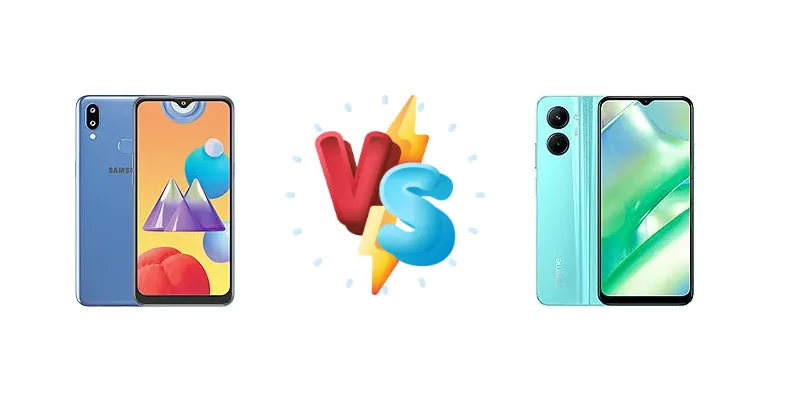
The sub-$150 smartphone market is fiercely competitive. The Samsung Galaxy M01s, while an older model, remains available in some regions. The Realme C33 2023 enters as a newer contender, aiming to disrupt with its Unisoc chipset. This comparison dissects the key differences to determine which device offers the best value for budget-conscious consumers.
🏆 Quick Verdict
For most users, the Realme C33 2023 is the better choice. Its Unisoc Tiger T612 chipset, featuring Cortex-A75 cores, provides a noticeable performance uplift over the Samsung Galaxy M01s’ Helio P22, making it more responsive for everyday tasks and light gaming. While both offer similar battery life, the C33’s slightly more modern architecture provides a better user experience.
| Network |
|---|
| 2G bands | GSM 850 / 900 / 1800 / 1900 | GSM 850 / 900 / 1800 / 1900 |
| 3G bands | HSDPA 850 / 900 / 2100 | HSDPA 850 / 900 / 2100 |
| 4G bands | 1, 3, 5, 7, 8, 20, 28, 38, 40, 41 | 1, 3, 5, 8, 38, 40, 41 |
| Speed | HSPA 42.2/5.76 Mbps, LTE Cat4 150/50 Mbps | HSPA, LTE |
| Technology | GSM / HSPA / LTE | GSM / HSPA / LTE |
| Launch |
|---|
| Announced | 2020, July 16. Released 2020, July 16 | 2023, March 14 |
| Status | Discontinued | Available. Released 2023, March 14 |
| Body |
|---|
| Build | Glass front, plastic back, plastic frame | Glass front, plastic frame, plastic back |
| Dimensions | 156.9 x 75.8 x 7.8 mm (6.18 x 2.98 x 0.31 in) | 164.2 x 75.7 x 8.3 mm (6.46 x 2.98 x 0.33 in) |
| SIM | Nano-SIM + Nano-SIM | Nano-SIM + Nano-SIM |
| Weight | 168 g (5.93 oz) | 187 g (6.60 oz) |
| Display |
|---|
| Resolution | 720 x 1520 pixels, 19:9 ratio (~271 ppi density) | 720 x 1600 pixels, 20:9 ratio (~270 ppi density) |
| Size | 6.2 inches, 95.9 cm2 (~80.7% screen-to-body ratio) | 6.5 inches, 102.0 cm2 (~82.1% screen-to-body ratio) |
| Type | PLS LCD | IPS LCD, 400 nits (typ) |
| Platform |
|---|
| CPU | Octa-core (4x2.0 GHz & 4x1.5 GHz) | Octa-core (2x1.8 GHz Cortex-A75 & 6x1.8 GHz Cortex-A55) |
| Chipset | Mediatek MT6762 Helio P22 (12 nm) | Unisoc Tiger T612 (12 nm) |
| GPU | PowerVR GE8320 | Mali-G57 |
| OS | Android 9.0 (Pie), upgradable to Android 10, One UI 2.1 | Android 12, Realme UI S |
| Memory |
|---|
| Card slot | microSDXC (dedicated slot) | microSDXC (dedicated slot) |
| Internal | 32GB 3GB RAM | 64GB 4GB RAM, 128GB 4GB RAM |
| | eMMC 5.1 | UFS 2.2 |
| Main Camera |
|---|
| Dual | 13 MP, f/1.8, 28mm (wide), 1/3.1", 1.12µm, AF
Auxiliary lens | 50 MP, (wide), PDAF
Auxiliary lens |
| Features | LED flash | LED flash, HDR, panorama |
| Single | - | 5 MP, f/2.2, 27mm (wide), 1/5.0", 1.12µm |
| Video | 1080p@30fps | 1080p@30fps |
| Selfie camera |
|---|
| Features | - | HDR |
| Single | 8 MP, f/2.0 | 5 MP, f/2.2, 27mm (wide), 1/5.0", 1.12µm |
| Video | - | 720p@30fps |
| Sound |
|---|
| 3.5mm jack | Yes | Yes |
| 35mm jack | Yes | Yes |
| Loudspeaker | Yes | Yes |
| Comms |
|---|
| Bluetooth | 4.2, A2DP, LE | 5.0, A2DP, LE |
| NFC | No | No |
| Positioning | GPS, GLONASS, GALILEO, BDS | GPS, GLONASS, GALILEO, BDS |
| Radio | FM radio | Unspecified |
| USB | microUSB 2.0, OTG | microUSB 2.0 |
| WLAN | Wi-Fi 802.11 b/g/n, Wi-Fi Direct | Wi-Fi 802.11 b/g/n |
| Features |
|---|
| Sensors | Fingerprint (rear-mounted), accelerometer, proximity | Fingerprint (side-mounted), accelerometer, proximity |
| Battery |
|---|
| Charging | - | 10W wired |
| Type | Li-Ion 4000 mAh | 5000 mAh |
| Misc |
|---|
| Colors | Light Blue, Gray | Sandy Gold, Aqua Blue, Night Sea |
| Models | SM-M017F, SM-M017F/DS | RMX3627 |
| Price | About 110 EUR | About 110 EUR |
| SAR | 0.26 W/kg (head) | - |
Samsung Galaxy M01s
- Established Brand Reputation (Samsung)
- Potentially Lower Price (depending on region)
- Wide Availability (in some markets)
- Older, Less Powerful Chipset (Helio P22)
- Likely Limited Software Updates
- Slower App Loading Times
Realme C33 2023
- More Powerful Chipset (Unisoc Tiger T612)
- Modern CPU Architecture (Cortex-A75)
- Improved Responsiveness
- Less Established Brand (Realme)
- Slower 10W Charging
- Potential for More Bloatware
Display Comparison
Neither device boasts a standout display. Both are likely to feature LCD panels, typical for this price bracket. Without specific display specs, it's reasonable to assume similar resolutions (likely 720p+). The Realme C33’s newer design may offer slightly slimmer bezels, but the real difference will be in color accuracy and brightness, which are unknown without testing. The absence of features like high refresh rates or LTPO technology is expected at this price point.
Camera Comparison
Camera performance is likely to be similar, with both devices relying on basic sensors. Without detailed sensor information, it’s safe to assume both feature a primary camera and potentially depth/macro sensors of limited utility. Image processing will play a crucial role, and Realme’s software tends to be more aggressive with sharpening and color boosting. The C33’s newer chipset *may* offer slightly faster image processing, but don’t expect flagship-level results from either device. Focusing on the primary sensor’s megapixel count is misleading; sensor size and lens aperture are more important.
Performance
The core difference lies in the chipsets. The Realme C33 2023’s Unisoc Tiger T612 utilizes two Cortex-A75 cores clocked at 1.8 GHz alongside six Cortex-A55 cores, also at 1.8 GHz. This architecture is a significant step up from the Samsung Galaxy M01s’ MediaTek Helio P22, which features a more homogenous octa-core setup with lower peak clock speeds (2.0 GHz & 1.5 GHz). The Cortex-A75 cores in the C33 provide a substantial boost in single-core performance, translating to snappier app launches and smoother multitasking. While both are 12nm chips, the architectural improvements in the Unisoc T612 offer a clear advantage. The M01s will struggle with more demanding applications.
Battery Life
Both devices likely house batteries in the 5000mAh range, common for budget smartphones. The Realme C33 2023 includes 10W wired charging, while the M01s’ charging speed is unknown but likely similar. Real-world battery life will be comparable, offering a full day of moderate use. The Unisoc T612’s slightly more efficient architecture *could* translate to marginally better standby time, but the difference will be minimal. The 10W charging on the C33 will result in a relatively slow 0-100% charge time.
Buying Guide
Buy the Samsung Galaxy M01s if you prioritize brand recognition and are on an extremely tight budget, accepting a slower processor and potentially limited software updates. Buy the Realme C33 2023 if you value performance, a more modern chipset architecture, and a slightly improved user experience for everyday tasks, even if it means opting for a less established brand.
Frequently Asked Questions
❓ Will the Realme C33 2023 handle popular games like PUBG Mobile?
The Unisoc Tiger T612 in the Realme C33 2023 can run PUBG Mobile, but expect to play at lower graphics settings (low to medium) to maintain a stable frame rate. The Helio P22 in the Galaxy M01s will struggle significantly with PUBG, even on the lowest settings.
❓ How long will software updates be supported on the Realme C33 2023?
Realme typically provides at least one major Android update and two years of security patches for its budget devices. While not guaranteed, the C33 2023 is likely to receive Android 13 and security updates through 2025. The Samsung Galaxy M01s, being an older model, may have limited or no further software updates.
❓ Is the Unisoc Tiger T612 chipset reliable?
Unisoc has significantly improved its chipset designs in recent years. The Tiger T612 is a capable processor for entry-level smartphones, offering a good balance of performance and efficiency. While it doesn't match the performance of Snapdragon or MediaTek's higher-end chips, it's a reliable option for everyday tasks.