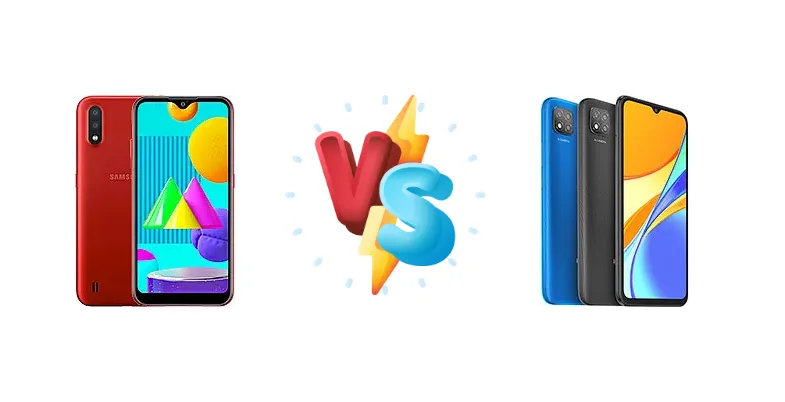
The Samsung Galaxy M01 and Xiaomi Redmi 9C NFC represent the extreme end of the smartphone price spectrum. Both aim to deliver essential smartphone functionality at a minimal cost, but they achieve this with different approaches to chipset selection and feature sets. This comparison dissects their core components to determine which device offers the most compelling experience for budget-conscious users.
🏆 Quick Verdict
For the average user prioritizing basic functionality and occasional NFC payments, the Xiaomi Redmi 9C NFC emerges as the slightly better choice. Its Helio G35 chipset, with higher clocked Cortex-A53 cores, provides a noticeable performance edge over the Galaxy M01’s Snapdragon 439, despite both being built on a 12nm process. The inclusion of 10W charging is also a practical benefit.
| Network |
|---|
| 2G bands | GSM 850 / 900 / 1800 / 1900 | GSM 850 / 900 / 1800 / 1900 |
| 3G bands | HSDPA 850 / 900 / 2100 | HSDPA 850 / 900 / 1700(AWS) / 1900 / 2100 |
| 4G bands | 1, 3, 5, 7, 8, 20, 28, 38, 40, 41 | 1, 2, 3, 4, 5, 7, 8, 20, 38, 40 |
| Speed | HSPA 42.2/5.76 Mbps, LTE Cat4 150/50 Mbps | HSPA, LTE |
| Technology | GSM / HSPA / LTE | GSM / HSPA / LTE |
| Launch |
|---|
| Announced | 2020, June 02. Released 2020, June 02 | 2020, August 27. Released 2020, August 27 |
| Status | Discontinued | Discontinued |
| Body |
|---|
| Build | Glass front, plastic back, plastic frame | - |
| Dimensions | 147.5 x 70.9 x 9.8 mm (5.81 x 2.79 x 0.39 in) | 164.9 x 77.1 x 9 mm (6.49 x 3.04 x 0.35 in) |
| SIM | Nano-SIM + Nano-SIM | Nano-SIM + Nano-SIM |
| Weight | 168 g (5.93 oz) | 196 g (6.91 oz) |
| Display |
|---|
| Resolution | 720 x 1520 pixels, 19:9 ratio (~294 ppi density) | 720 x 1600 pixels, 20:9 ratio (~269 ppi density) |
| Size | 5.7 inches, 81.6 cm2 (~78.1% screen-to-body ratio) | 6.53 inches, 102.9 cm2 (~81.0% screen-to-body ratio) |
| Type | PLS LCD | IPS LCD, 400 nits (typ) |
| Platform |
|---|
| CPU | Octa-core (4x1.95 GHz Cortex-A53 & 4x1.45 GHz Cortex A53) | Octa-core (4x2.3 GHz Cortex-A53 & 4x1.8 GHz Cortex-A53) |
| Chipset | Qualcomm SDM439 Snapdragon 439 (12 nm) | Mediatek MT6765G Helio G35 (12 nm) |
| GPU | Adreno 505 | PowerVR GE8320 |
| OS | Android 10, upgradable to Android 11, One UI 3.1 | Android 10, MIUI 12 |
| Memory |
|---|
| Card slot | microSDXC (dedicated slot) | microSDXC (dedicated slot) |
| Internal | 32GB 3GB RAM | 32GB 2GB RAM, 32GB 3GB RAM, 64GB 2GB RAM, 64GB 3GB RAM, 128GB 3GB RAM, 128GB 4GB RAM |
| | eMMC 5.1 | eMMC 5.1 |
| Main Camera |
|---|
| Dual | 13 MP, f/2.2, 28mm (wide), 1/3.1", 1.12µm, AF
Auxiliary lens | 13 MP, f/2.2, 28mm (wide), 1.0µm, PDAF
2 MP (macro) |
| Features | LED flash | LED flash, HDR |
| Video | 1080p@30fps | 1080p@30fps |
| Selfie camera |
|---|
| Features | - | HDR |
| Single | 5 MP, f/2.2, 1/5.0", 1.12µm | 5 MP, f/2.2, (wide), 1.12µm |
| Video | - | 1080p@30fps |
| Sound |
|---|
| 3.5mm jack | Yes | Yes |
| 35mm jack | Yes | Yes |
| Loudspeaker | Yes | Yes |
| Comms |
|---|
| Bluetooth | 4.2, A2DP, LE | 5.0, A2DP, LE |
| NFC | No | Yes |
| Positioning | GPS, GLONASS, GALILEO, BDS | GPS, GLONASS, BDS |
| Radio | FM radio | FM radio |
| USB | microUSB 2.0, OTG | microUSB 2.0, OTG |
| WLAN | Wi-Fi 802.11 b/g/n, Wi-Fi Direct | Wi-Fi 802.11 b/g/n, Wi-Fi Direct |
| Features |
|---|
| Sensors | Accelerometer, proximity | Fingerprint (rear-mounted), accelerometer, proximity |
| Battery |
|---|
| Charging | - | 10W wired |
| Type | Li-Ion 4000 mAh | Li-Po 5000 mAh |
| Misc |
|---|
| Colors | Black, Blue, Red | Midnight Gray, Sunshine Yellow, Twilight Blue |
| Models | SM-M015G, SM-M015F, SM-M015G/DS, SM-M015F/DS | M2006C3MNG |
| Price | About 110 EUR | About 100 EUR |
| SAR | - | 0.57 W/kg (head) 0.90 W/kg (body) |
| SAR EU | 0.42 W/kg (head) 1.56 W/kg (body) | 0.37 W/kg (head) 1.14 W/kg (body) |
Samsung Galaxy M01
- Established Samsung brand
- Potentially cleaner software experience
- Compact and lightweight design
- Slower processor compared to Redmi 9C NFC
- Likely slower charging speeds
- Limited performance for demanding apps
Xiaomi Redmi 9C NFC
- Faster processor (Helio G35)
- NFC support for contactless payments
- 10W wired charging
- Xiaomi’s MIUI software can be bloated
- Build quality may feel less premium
- Potential for more pre-installed apps
Display Comparison
Neither device boasts a standout display. Both likely utilize LCD panels, common in this price bracket. Detailed specs like resolution and brightness are missing, but we can infer that they are similar – likely 720p+ resolution. The focus here isn’t on visual fidelity, but on basic readability. Bezels are expected to be substantial on both, maximizing screen real estate within a compact form factor. Color accuracy is unlikely to be a priority for either manufacturer.
Camera Comparison
Camera performance is expected to be modest on both devices. Without detailed sensor information, it’s difficult to make precise comparisons. Both likely feature a primary camera alongside depth and macro sensors (the latter often being of limited utility). The aperture of the main sensor will be a key determinant of low-light performance, but this data is unavailable. Image processing will likely lean towards boosting saturation and contrast to create visually appealing images, but detail preservation will be limited. The Redmi 9C NFC’s image signal processor (ISP) within the Helio G35 may offer slightly better noise reduction capabilities.
Performance
The core difference lies in the chipsets. The Xiaomi Redmi 9C NFC’s MediaTek Helio G35 features four Cortex-A53 cores clocked at 2.3 GHz, alongside another four at 1.8 GHz. This contrasts with the Samsung Galaxy M01’s Qualcomm Snapdragon 439, which uses four Cortex-A53 cores at 1.95 GHz and another four at 1.45 GHz. While both are octa-core designs, the higher clock speeds of the Helio G35 translate to faster application loading and smoother multitasking. The 12nm fabrication process is shared, meaning thermal efficiency will be comparable, but the Redmi 9C NFC will likely exhibit less throttling under sustained load. RAM configurations are crucial, but unspecified; however, the chipset advantage favors the Redmi 9C NFC.
Battery Life
Battery capacity is not specified for either device, but both likely fall in the 4000-5000 mAh range, typical for this segment. However, the Redmi 9C NFC gains a significant advantage with its 10W wired charging support. The Galaxy M01’s charging speed is unknown, but likely slower. This means the Redmi 9C NFC will spend less time tethered to a charger, offering greater convenience for users who frequently use their phones throughout the day. The efficiency of the respective chipsets will also play a role in overall battery life, with the Helio G35 potentially offering slightly better power management.
Buying Guide
Buy the Samsung Galaxy M01 if you prioritize a well-established brand reputation and a potentially cleaner software experience, understanding that performance will be limited to basic tasks. Buy the Xiaomi Redmi 9C NFC if you prefer a more responsive user experience for the price, and value the convenience of NFC for mobile payments and quick pairing, accepting that Xiaomi’s MIUI software may include more pre-installed applications.
Frequently Asked Questions
❓ Does the Xiaomi Redmi 9C NFC’s Helio G35 chipset handle popular apps like WhatsApp and Facebook smoothly?
Yes, the Helio G35 is more than capable of handling everyday apps like WhatsApp, Facebook, and web browsing without significant lag. The higher clock speeds of its Cortex-A53 cores provide a noticeable improvement in responsiveness compared to the Snapdragon 439 in the Galaxy M01, making for a smoother user experience.
❓ Is NFC on the Redmi 9C NFC useful even if I don't use mobile payments?
Absolutely. NFC isn't limited to payments. It enables quick pairing with Bluetooth devices like headphones and speakers, simplifying the connection process. It can also be used for sharing files with other NFC-enabled phones, and for interacting with NFC tags for various automation tasks.
❓ Will I experience significant bloatware on the Xiaomi Redmi 9C NFC with MIUI?
Xiaomi’s MIUI is known for including pre-installed apps, often referred to as bloatware. While some can be uninstalled, others may require more effort to remove. However, MIUI also offers a range of customization options and features that some users appreciate. The extent of bloatware can vary depending on the region and carrier.