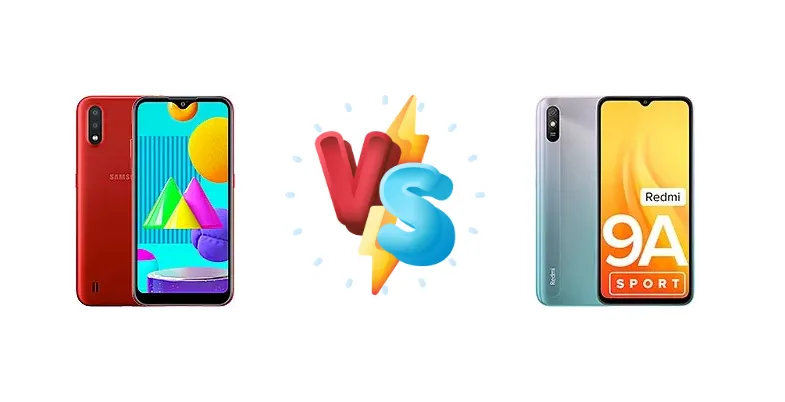
The Samsung Galaxy M01 and Xiaomi Redmi 9A Sport represent the extreme end of the smartphone price spectrum. Both aim to deliver essential smartphone functionality at a minimal cost, but they achieve this with different chipsets and approaches. This comparison dissects their strengths and weaknesses to help you determine which offers the best value for your needs.
🏆 Quick Verdict
For the average user prioritizing slightly better CPU performance and potential software support, the Xiaomi Redmi 9A Sport edges out the Samsung Galaxy M01. Its Helio G25 chipset, with a marginally higher clock speed, provides a smoother experience for everyday tasks, while the inclusion of 10W charging is a practical benefit.
| Network |
|---|
| 2G bands | GSM 850 / 900 / 1800 / 1900 | GSM 850 / 900 / 1800 / 1900 |
| 3G bands | HSDPA 850 / 900 / 2100 | HSDPA 850 / 900 / 2100 |
| 4G bands | 1, 3, 5, 7, 8, 20, 28, 38, 40, 41 | 1, 3, 5, 8, 40, 41 |
| Speed | HSPA 42.2/5.76 Mbps, LTE Cat4 150/50 Mbps | HSPA, LTE |
| Technology | GSM / HSPA / LTE | GSM / HSPA / LTE |
| Launch |
|---|
| Announced | 2020, June 02. Released 2020, June 02 | 2021, September 28 |
| Status | Discontinued | Available. Released 2021, September 28 |
| Body |
|---|
| Build | Glass front, plastic back, plastic frame | - |
| Dimensions | 147.5 x 70.9 x 9.8 mm (5.81 x 2.79 x 0.39 in) | 164.9 x 77.1 x 9 mm (6.49 x 3.04 x 0.35 in) |
| SIM | Nano-SIM + Nano-SIM | Nano-SIM + Nano-SIM |
| Weight | 168 g (5.93 oz) | 194 g (6.84 oz) |
| | - | Water-repellent coating |
| Display |
|---|
| Resolution | 720 x 1520 pixels, 19:9 ratio (~294 ppi density) | 720 x 1600 pixels, 20:9 ratio (~269 ppi density) |
| Size | 5.7 inches, 81.6 cm2 (~78.1% screen-to-body ratio) | 6.53 inches, 102.9 cm2 (~81.0% screen-to-body ratio) |
| Type | PLS LCD | IPS LCD, 400 nits (typ) |
| Platform |
|---|
| CPU | Octa-core (4x1.95 GHz Cortex-A53 & 4x1.45 GHz Cortex A53) | Octa-core (4x2.0 GHz Cortex-A53 & 4x1.5 GHz Cortex-A53) |
| Chipset | Qualcomm SDM439 Snapdragon 439 (12 nm) | Mediatek MT6762G Helio G25 (12 nm) |
| GPU | Adreno 505 | PowerVR GE8320 |
| OS | Android 10, upgradable to Android 11, One UI 3.1 | Android 10, MIUI 12 |
| Memory |
|---|
| Card slot | microSDXC (dedicated slot) | microSDXC (dedicated slot) |
| Internal | 32GB 3GB RAM | 32GB 2GB RAM, 32GB 3GB RAM |
| | eMMC 5.1 | eMMC 5.1 |
| Main Camera |
|---|
| Dual | 13 MP, f/2.2, 28mm (wide), 1/3.1", 1.12µm, AF
Auxiliary lens | - |
| Features | LED flash | LED flash, HDR |
| Single | - | 13 MP, f/2.2, 28mm (wide), 1.0µm, PDAF |
| Video | 1080p@30fps | 1080p@30/60fps |
| Selfie camera |
|---|
| Features | - | HDR |
| Single | 5 MP, f/2.2, 1/5.0", 1.12µm | 5 MP, f/2.2, (wide), 1.12µm |
| Video | - | 1080p@30fps |
| Sound |
|---|
| 3.5mm jack | Yes | Yes |
| 35mm jack | Yes | Yes |
| Loudspeaker | Yes | Yes |
| Comms |
|---|
| Bluetooth | 4.2, A2DP, LE | 5.0, A2DP, LE |
| NFC | No | No |
| Positioning | GPS, GLONASS, GALILEO, BDS | GPS, GLONASS, BDS |
| Radio | FM radio | FM radio |
| USB | microUSB 2.0, OTG | microUSB 2.0, OTG |
| WLAN | Wi-Fi 802.11 b/g/n, Wi-Fi Direct | Wi-Fi 802.11 a/b/g/n, Wi-Fi Direct |
| Features |
|---|
| Sensors | Accelerometer, proximity | Accelerometer, proximity |
| Battery |
|---|
| Charging | - | 10W wired |
| Type | Li-Ion 4000 mAh | Li-Po 5000 mAh |
| Misc |
|---|
| Colors | Black, Blue, Red | Carbon Black, Coral Green, Metallic Blue |
| Models | SM-M015G, SM-M015F, SM-M015G/DS, SM-M015F/DS | - |
| Price | About 110 EUR | About 100 EUR |
| SAR EU | 0.42 W/kg (head) 1.56 W/kg (body) | - |
Samsung Galaxy M01
- Established Samsung brand reputation
- Potentially longer software support
- Efficient Snapdragon 439 chipset
- Slower CPU clock speed compared to Redmi 9A Sport
- Likely lacks fast charging support
Xiaomi Redmi 9A Sport
- Slightly faster CPU performance with Helio G25
- Includes 10W wired charging
- More aggressive pricing
- Xiaomi’s software experience can be polarizing
- Potentially shorter software support lifecycle
Display Comparison
Neither device boasts a standout display. Both likely utilize LCD panels, typical for this price point. Detailed specs like resolution and brightness are missing, but we can assume both are 720p+ to maximize usability. The focus here isn't on visual fidelity, but on basic readability. Bezels are expected to be substantial on both, minimizing screen-to-body ratio.
Camera Comparison
Camera performance on both devices will be limited. Without detailed sensor information, it’s safe to assume both feature a primary sensor paired with a depth or macro sensor of minimal utility. Image quality will be acceptable in good lighting conditions, but struggle in low light. The focus should be on capturing memories, not professional-grade photography. Expect significant compromises in dynamic range and detail.
Performance
The core difference lies in the chipsets. The Redmi 9A Sport’s MediaTek Helio G25 (12nm) features a slightly higher peak CPU clock speed (2.0 GHz vs 1.95 GHz on the M01’s Snapdragon 439, also 12nm). While both use Cortex-A53 cores, the G25’s higher clock speed translates to a small performance advantage in app loading and multitasking. The Snapdragon 439 is known for its efficiency, but the G25’s marginal speed boost is more noticeable in daily use. Both are adequate for basic tasks like calling, texting, and light social media, but neither is suited for demanding games.
Battery Life
Battery capacity is likely similar on both devices (around 5000mAh is typical for this segment), offering all-day battery life with moderate usage. However, the Redmi 9A Sport includes 10W wired charging, a significant advantage over the M01, which likely lacks fast charging support. While 10W is still slow, it’s preferable to relying solely on overnight charging.
Buying Guide
Buy the Samsung Galaxy M01 if you prioritize a well-established brand and a potentially longer software support lifecycle, even if performance is slightly lower. Buy the Xiaomi Redmi 9A Sport if you prefer a bit more processing power for the price, and appreciate the convenience of faster (albeit still slow) 10W charging. Both are ideal for first-time smartphone users or those needing a reliable secondary device.
Frequently Asked Questions
❓ Will the Redmi 9A Sport struggle with popular apps like WhatsApp and Facebook?
No, the Helio G25 chipset is sufficient to run essential apps like WhatsApp and Facebook smoothly. However, expect some lag when switching between multiple apps or using more demanding features within those apps. It's designed for basic connectivity and communication.
❓ Is the 10W charging on the Redmi 9A Sport significantly faster than not having fast charging at all?
While 10W is still a slow charging standard, it's considerably faster than relying solely on overnight charging. Expect a full charge to take around 3-4 hours, which is a practical improvement over leaving the phone plugged in all night.
❓ Which phone is better for a senior citizen who primarily uses the phone for calls and messaging?
Both phones are suitable for this use case. However, the Samsung Galaxy M01 might be preferable due to the Samsung brand's familiarity and potentially simpler user interface. The slightly slower performance won't be noticeable for basic tasks.