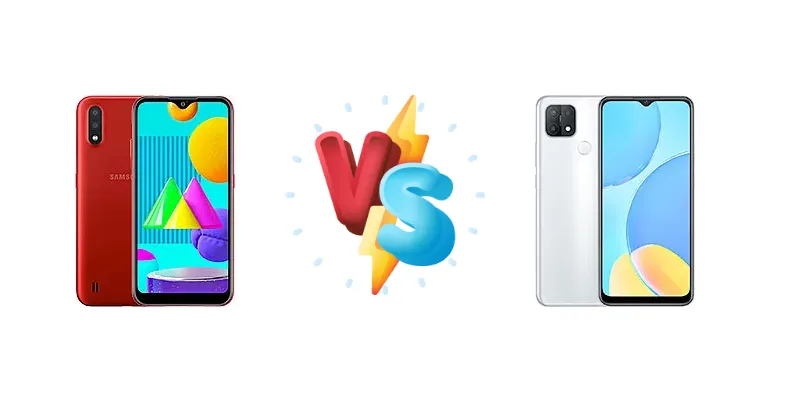
The Samsung Galaxy M01 and Oppo A15s represent the ultra-budget end of the smartphone spectrum. Both aim to deliver essential smartphone functionality at the lowest possible price point, but they achieve this with different chipsets and feature sets. This comparison dives deep into the specifications to determine which device offers the best value for users prioritizing affordability.
🏆 Quick Verdict
For most users, the Oppo A15s emerges as the slightly better choice. Its Mediatek Helio P35 chipset, with higher clock speeds on its primary cores (2.35 GHz vs 1.95 GHz), provides a noticeable performance edge in everyday tasks and light gaming, while the inclusion of 10W charging is a practical benefit.
| Network |
|---|
| 2G bands | GSM 850 / 900 / 1800 / 1900 | GSM 850 / 900 / 1800 / 1900 |
| 3G bands | HSDPA 850 / 900 / 2100 | HSDPA 850 / 900 / 2100 |
| 4G bands | 1, 3, 5, 7, 8, 20, 28, 38, 40, 41 | 1, 3, 5, 8, 38, 40, 41 |
| Speed | HSPA 42.2/5.76 Mbps, LTE Cat4 150/50 Mbps | HSPA, LTE |
| Technology | GSM / HSPA / LTE | GSM / HSPA / LTE |
| Launch |
|---|
| Announced | 2020, June 02. Released 2020, June 02 | 2020, December 18. Released 2020, December 18 |
| Status | Discontinued | Discontinued |
| Body |
|---|
| Build | Glass front, plastic back, plastic frame | Glass front, plastic back, plastic frame |
| Dimensions | 147.5 x 70.9 x 9.8 mm (5.81 x 2.79 x 0.39 in) | 164 x 75.4 x 7.9 mm (6.46 x 2.97 x 0.31 in) |
| SIM | Nano-SIM + Nano-SIM | Nano-SIM + Nano-SIM |
| Weight | 168 g (5.93 oz) | 177 g (6.24 oz) |
| Display |
|---|
| Resolution | 720 x 1520 pixels, 19:9 ratio (~294 ppi density) | 720 x 1600 pixels, 20:9 ratio (~269 ppi density) |
| Size | 5.7 inches, 81.6 cm2 (~78.1% screen-to-body ratio) | 6.52 inches, 102.6 cm2 (~83.0% screen-to-body ratio) |
| Type | PLS LCD | IPS LCD, 480 nits (typ) |
| Platform |
|---|
| CPU | Octa-core (4x1.95 GHz Cortex-A53 & 4x1.45 GHz Cortex A53) | Octa-core (4x2.35 GHz Cortex-A53 & 4x1.8 GHz Cortex-A53) |
| Chipset | Qualcomm SDM439 Snapdragon 439 (12 nm) | Mediatek MT6765 Helio P35 (12 nm) |
| GPU | Adreno 505 | PowerVR GE8320 |
| OS | Android 10, upgradable to Android 11, One UI 3.1 | Android 10, ColorOS 7.2 |
| Memory |
|---|
| Card slot | microSDXC (dedicated slot) | microSDXC |
| Internal | 32GB 3GB RAM | 64GB 4GB RAM, 128GB 4GB RAM |
| | eMMC 5.1 | eMMC 5.1 |
| Main Camera |
|---|
| Dual | 13 MP, f/2.2, 28mm (wide), 1/3.1", 1.12µm, AF
Auxiliary lens | - |
| Features | LED flash | LED flash, HDR, panorama |
| Triple | - | 13 MP, f/2.2, (wide), 1/3.1", 1.12µm, PDAF
2 MP (macro)
Auxiliary lens |
| Video | 1080p@30fps | 1080p@30fps |
| Selfie camera |
|---|
| Features | - | HDR |
| Single | 5 MP, f/2.2, 1/5.0", 1.12µm | 8 MP, f/2.0, (wide) |
| Video | - | 1080p@30fps |
| Sound |
|---|
| 3.5mm jack | Yes | Yes |
| 35mm jack | Yes | Yes |
| Loudspeaker | Yes | Yes |
| Comms |
|---|
| Bluetooth | 4.2, A2DP, LE | 5.0, A2DP, LE, aptX |
| NFC | No | No |
| Positioning | GPS, GLONASS, GALILEO, BDS | GPS, GLONASS, GALILEO, BDS |
| Radio | FM radio | FM radio |
| USB | microUSB 2.0, OTG | microUSB 2.0, OTG |
| WLAN | Wi-Fi 802.11 b/g/n, Wi-Fi Direct | Wi-Fi 802.11 b/g/n, Wi-Fi Direct |
| Features |
|---|
| Sensors | Accelerometer, proximity | Fingerprint (rear-mounted), accelerometer, proximity |
| Battery |
|---|
| Charging | - | 10W wired |
| Type | Li-Ion 4000 mAh | Li-Po 4230 mAh |
| Misc |
|---|
| Colors | Black, Blue, Red | Dynamic Black, Fancy White |
| Models | SM-M015G, SM-M015F, SM-M015G/DS, SM-M015F/DS | CPH2179 |
| Price | About 110 EUR | About 130 EUR |
| SAR EU | 0.42 W/kg (head) 1.56 W/kg (body) | - |
Samsung Galaxy M01
- Established Samsung brand
- Potentially slightly better software optimization (depending on One UI version)
- Compact and lightweight design
- Slower processor compared to Oppo A15s
- No dedicated charging standard (likely Micro-USB)
- Likely slower app loading times
Oppo A15s
- Faster processor (Helio P35)
- 10W wired charging support
- Potentially smoother multitasking
- Oppo's ColorOS may not appeal to all users
- Build quality may feel less premium than Samsung
- Macro camera is likely of limited use
Display Comparison
Neither device boasts a standout display. Both are likely to feature LCD panels, typical for this price bracket. Specifics like resolution and brightness are not provided, but we can infer they are similar – likely 720p+ resolution. The focus here isn't on visual fidelity, but on basic readability. Bezels are expected to be substantial on both, maximizing screen real estate within a compact form factor.
Camera Comparison
Camera performance is likely to be similar and limited on both devices. Without specific sensor details, it's safe to assume both rely on basic sensors for capturing images. The inclusion of a 2MP macro lens on the Oppo A15s is a common marketing tactic, but its practical utility is minimal. Image processing will be basic, prioritizing speed over detail. Expect acceptable results in good lighting conditions, but significant noise and softness in low light.
Performance
The core difference lies in the chipsets. The Oppo A15s utilizes the Mediatek Helio P35, featuring an octa-core configuration with four cores clocked at 2.35 GHz and four at 1.8 GHz. The Samsung Galaxy M01, conversely, employs the Qualcomm Snapdragon 439, also octa-core, but with a split of 1.95 GHz and 1.45 GHz. While both use Cortex-A53 cores, the higher clock speeds of the Helio P35 translate to faster processing in CPU-bound tasks. The 12nm fabrication process is shared, suggesting similar power efficiency. However, the Helio P35's GPU is likely to offer a slightly better graphical experience, though neither is suited for demanding games.
Battery Life
Battery capacity isn't specified for the M01, but typical for this segment is around 4000-5000mAh. The Oppo A15s benefits from 10W wired charging, a feature absent on the M01. While 10W isn't fast by modern standards, it provides a tangible advantage over relying solely on overnight charging. The slightly more efficient Helio P35 may also contribute to marginally better battery life in real-world usage, but the difference will likely be minimal.
Buying Guide
Buy the Samsung Galaxy M01 if you prioritize a well-established brand reputation and are primarily focused on extremely basic smartphone functions like calls, messaging, and light social media use. Buy the Oppo A15s if you need a bit more processing power for smoother multitasking, occasional gaming, and appreciate the convenience of even basic wired charging support.
Frequently Asked Questions
❓ Will the Oppo A15s be able to run popular apps like WhatsApp and Facebook smoothly?
Yes, the Mediatek Helio P35 chipset in the Oppo A15s is sufficient to run common social media applications like WhatsApp and Facebook without significant lag. The higher clock speeds of the processor cores will contribute to a smoother user experience compared to the Samsung Galaxy M01.
❓ Is the 10W charging on the Oppo A15s significantly faster than charging the Samsung Galaxy M01 with a standard charger?
While 10W isn't 'fast charging' in the modern sense, it's considerably faster than charging the Samsung Galaxy M01 with a generic charger. The M01 likely lacks any dedicated charging protocol, resulting in slower charging times. Expect a noticeable difference in how quickly you can replenish the battery.
❓ Can I play games like PUBG Mobile on either of these phones?
While technically possible, playing PUBG Mobile on either the Samsung Galaxy M01 or Oppo A15s will likely be a compromised experience. Both chipsets lack the graphical power for smooth gameplay at higher settings. You'll need to lower the graphics settings significantly and expect occasional frame drops.
❓ Which phone is better for taking quick photos of documents?
Neither phone excels at document scanning. However, the Oppo A15s might offer slightly better image processing, potentially resulting in clearer text capture, though the difference will be minimal. Ensure good lighting conditions for optimal results.