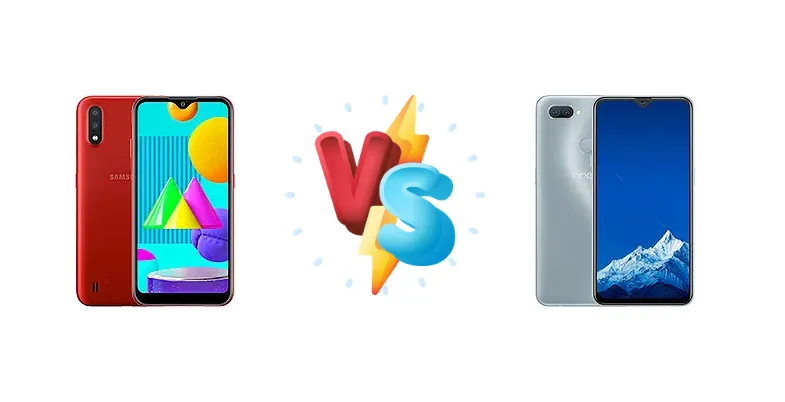
The Samsung Galaxy M01 and Oppo A12s represent the extreme end of the smartphone price spectrum. Both aim to deliver essential smartphone functionality at a minimal cost, but they achieve this with different chipsets and feature sets. This comparison dives deep into the specifications to determine which device offers the best value for users prioritizing affordability.
🏆 Quick Verdict
For the average user prioritizing slightly better CPU performance and a more established brand, the Oppo A12s is the better choice. Its Helio P35 chipset, with higher clock speeds, offers a noticeable edge in responsiveness, while the inclusion of 10W charging is a practical benefit. However, the M01 remains a viable option for those on the tightest of budgets.
| Network |
|---|
| 2G bands | GSM 850 / 900 / 1800 / 1900 | GSM 850 / 900 / 1800 / 1900 |
| 3G bands | HSDPA 850 / 900 / 2100 | HSDPA 850 / 900 / 2100 |
| 4G bands | 1, 3, 5, 7, 8, 20, 28, 38, 40, 41 | 1, 3, 5, 8, 38, 40, 41 |
| EDGE | - | No |
| GPRS | - | Yes |
| Speed | HSPA 42.2/5.76 Mbps, LTE Cat4 150/50 Mbps | HSPA, LTE |
| Technology | GSM / HSPA / LTE | GSM / HSPA / LTE |
| Launch |
|---|
| Announced | 2020, June 02. Released 2020, June 02 | 2020, July 14. Released 2020, July 26 |
| Status | Discontinued | Discontinued |
| Body |
|---|
| Build | Glass front, plastic back, plastic frame | Glass front, plastic back, plastic frame |
| Dimensions | 147.5 x 70.9 x 9.8 mm (5.81 x 2.79 x 0.39 in) | 155.9 x 75.5 x 8.3 mm (6.14 x 2.97 x 0.33 in) |
| SIM | Nano-SIM + Nano-SIM | Nano-SIM + Nano-SIM |
| Weight | 168 g (5.93 oz) | 165 g (5.82 oz) |
| Display |
|---|
| Protection | - | Corning Gorilla Glass 3 |
| Resolution | 720 x 1520 pixels, 19:9 ratio (~294 ppi density) | 720 x 1520 pixels, 19:9 ratio (~271 ppi density) |
| Size | 5.7 inches, 81.6 cm2 (~78.1% screen-to-body ratio) | 6.2 inches, 95.9 cm2 (~81.5% screen-to-body ratio) |
| Type | PLS LCD | IPS LCD, 450 nits (typ) |
| Platform |
|---|
| CPU | Octa-core (4x1.95 GHz Cortex-A53 & 4x1.45 GHz Cortex A53) | Octa-core (4x2.35 GHz Cortex-A53 & 4x1.8 GHz Cortex-A53) |
| Chipset | Qualcomm SDM439 Snapdragon 439 (12 nm) | Mediatek MT6765 Helio P35 (12 nm) |
| GPU | Adreno 505 | PowerVR GE8320 |
| OS | Android 10, upgradable to Android 11, One UI 3.1 | Android 9.0 (Pie), ColorOS 6.1 |
| Memory |
|---|
| Call records | - | Yes |
| Card slot | microSDXC (dedicated slot) | microSDXC (dedicated slot) |
| Internal | 32GB 3GB RAM | 32GB 3GB RAM |
| Phonebook | - | Yes |
| | eMMC 5.1 | eMMC 5.1 |
| Main Camera |
|---|
| Dual | 13 MP, f/2.2, 28mm (wide), 1/3.1", 1.12µm, AF
Auxiliary lens | 13 MP, f/2.2, (wide), 1/3.1", 1.12µm, PDAF
Auxiliary lens |
| Features | LED flash | LED flash, HDR, panorama |
| Video | 1080p@30fps | 1080p@30fps |
| Selfie camera |
|---|
| Features | - | HDR |
| Single | 5 MP, f/2.2, 1/5.0", 1.12µm | 5 MP, f/2.4, 1/5.0", 1.12µm |
| Sound |
|---|
| 3.5mm jack | Yes | Yes |
| 35mm jack | Yes | Yes |
| Loudspeaker | Yes | Yes |
| Comms |
|---|
| Bluetooth | 4.2, A2DP, LE | 5.0, A2DP, LE |
| NFC | No | No |
| Positioning | GPS, GLONASS, GALILEO, BDS | GPS, GLONASS, BDS |
| Radio | FM radio | FM radio |
| USB | microUSB 2.0, OTG | microUSB 2.0, OTG |
| WLAN | Wi-Fi 802.11 b/g/n, Wi-Fi Direct | Wi-Fi 802.11 a/b/g/n/ac, dual-band, Wi-Fi Direct |
| Features |
|---|
| Games | - | No |
| Messaging | - | SMS |
| Sensors | Accelerometer, proximity | Fingerprint (rear-mounted), accelerometer, gyro, proximity, compass |
| Battery |
|---|
| Charging | - | 10W wired |
| Type | Li-Ion 4000 mAh | Li-Po 4230 mAh |
| Misc |
|---|
| Colors | Black, Blue, Red | Deep Blue, Flowing Silver |
| Models | SM-M015G, SM-M015F, SM-M015G/DS, SM-M015F/DS | - |
| Price | About 110 EUR | About 120 EUR |
| SAR | - | 1.28 W/kg (head) 0.42 W/kg (body) |
| SAR EU | 0.42 W/kg (head) 1.56 W/kg (body) | 1.49 W/kg (head) |
Samsung Galaxy M01
- Potentially lower price point
- Reliable Qualcomm chipset
- Established Samsung brand
- Slower processor than Oppo A12s
- Likely slower charging speeds
- May have limited software updates
Oppo A12s
- Faster processor (Helio P35)
- 10W wired charging
- More responsive user experience
- Mediatek chipset may receive fewer updates
- Oppo's software skin can be intrusive
- Potentially slightly higher price
Display Comparison
Neither device boasts a standout display. Both are likely to feature LCD panels, typical for this price bracket. Detailed display specs (resolution, brightness) are unavailable, but the focus here is on processing power, not visual fidelity. Expect similar viewing experiences, with neither offering exceptional color accuracy or peak brightness. Bezels are likely to be substantial on both devices, maximizing screen real estate within a compact form factor.
Camera Comparison
Camera performance on both devices will be limited. Detailed sensor information is unavailable, but it’s safe to assume both rely on basic sensors. The marketing materials for these phones often highlight megapixel counts, but sensor size and image processing are far more critical. Expect adequate performance in well-lit conditions, but significant noise and a lack of detail in low-light scenarios. The inclusion of a 2MP macro lens on the Oppo A12s is largely a marketing gimmick, offering minimal practical benefit due to its low resolution and fixed focus. The primary camera on the A12s will likely perform slightly better due to the more powerful ISP within the Helio P35 chipset.
Performance
The core difference lies in the chipsets. The Oppo A12s utilizes the Mediatek Helio P35, an octa-core processor clocked up to 2.35 GHz, while the Samsung Galaxy M01 features the Qualcomm Snapdragon 439, clocked up to 1.95 GHz. While both employ Cortex-A53 cores, the higher clock speeds of the Helio P35 translate to faster single-core performance, impacting app launch times and general responsiveness. The Snapdragon 439’s architecture, while efficient, is demonstrably slower. This difference will be most noticeable when multitasking or running slightly more demanding applications. Both devices will struggle with graphically intensive games, but the A12s will likely offer a marginally smoother experience.
Battery Life
Battery capacity is not specified for the M01, but typical for this segment is around 4000-5000mAh. The Oppo A12s benefits from 10W wired charging, a significant advantage over the likely 5W or slower charging on the M01. While both phones should easily last a full day with moderate use, the A12s’ faster charging will reduce downtime, allowing users to quickly top up the battery when needed. The difference in charging speed will be more noticeable for users who frequently use their phones throughout the day.
Buying Guide
Buy the Samsung Galaxy M01 if you need a basic, reliable smartphone for essential tasks like calls, messaging, and light social media use, and are constrained by the absolute lowest possible price point. Buy the Oppo A12s if you prefer a slightly more responsive user experience, faster charging, and a chipset capable of handling moderately demanding apps with less lag, even if it means spending a little more.
Frequently Asked Questions
❓ Will the Oppo A12s handle popular apps like WhatsApp and Facebook smoothly?
Yes, the Helio P35 chipset in the Oppo A12s is sufficiently powerful to run apps like WhatsApp and Facebook without significant lag. While it won't offer a flagship-level experience, it will provide a usable and responsive experience for everyday social media use.
❓ Is the Samsung Galaxy M01 a good choice for someone who primarily makes calls and sends texts?
Absolutely. The Samsung Galaxy M01 is a perfectly adequate device for basic communication tasks like making calls and sending texts. Its Snapdragon 439 chipset is capable of handling these functions reliably, and its focus is on providing essential smartphone functionality at the lowest possible price.
❓ Can either of these phones play PUBG Mobile?
While technically possible, playing PUBG Mobile on either the Samsung Galaxy M01 or Oppo A12s will be a compromised experience. Expect very low graphics settings, significant frame rate drops, and potential overheating. Neither chipset is designed for demanding gaming.
❓ How long will software updates be supported on the Oppo A12s?
Oppo's software update policy for entry-level devices like the A12s is typically limited. Expect one major Android version update and potentially a few security patches. Long-term software support is not a strength of these budget devices.