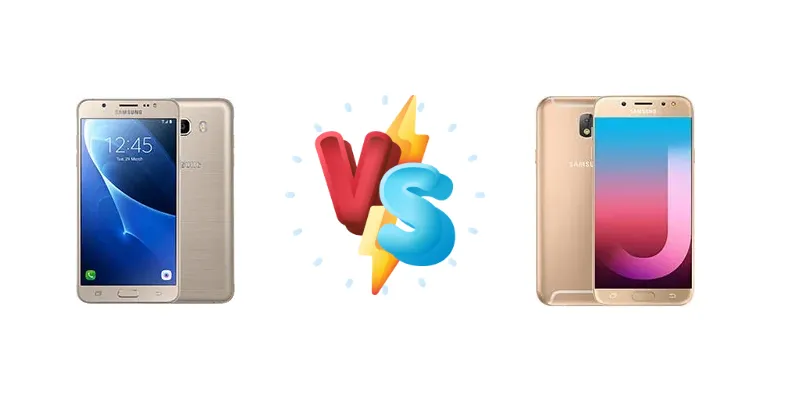
The Samsung Galaxy J7 series was a popular choice for budget-conscious smartphone users. But with two iterations – the J7 (2016) and the J7 Pro – which one offers the better value? This comprehensive comparison will delve into their key features to help you decide.
🏆 Quick Verdict
The Samsung Galaxy J7 Pro edges out the J7 (2016) with slightly improved battery life and a marginally better display. While both offer similar performance, the Pro's refinements make it the preferable choice for most users, especially considering its likely availability in the used market.
| Network |
|---|
| 2G bands | GSM 850 / 900 / 1800 / 1900 - SIM 1 & SIM 2 (dual-SIM model only) | GSM 850 / 900 / 1800 / 1900 - SIM 1 & SIM 2 (dual-SIM model only) |
| 3G bands | HSDPA 850 / 900 / 1900 / 2100 | HSDPA 850 / 900 / 1700(AWS) / 1900 / 2100 |
| 4G bands | 1, 3, 5, 7, 8, 20, 40 | 1, 2, 3, 4, 5, 7, 8, 12, 17, 20, 28, 38, 40, 41, 66 |
| Speed | HSPA, LTE Cat4 150/50 Mbps | HSPA 42.2/5.76 Mbps, LTE (2CA) Cat6 300/50 Mbps |
| Technology | GSM / HSPA / LTE | GSM / HSPA / LTE |
| Launch |
|---|
| Announced | 2016, March 29. Released 2016, April | 2017, June. Released 2017, July |
| Status | Discontinued | Discontinued |
| Body |
|---|
| Build | Glass front, plastic back, aluminum frame | Glass front, aluminum back, aluminum frame |
| Dimensions | 151.7 x 76 x 7.8 mm (5.97 x 2.99 x 0.31 in) | 152.5 x 74.8 x 8 mm (6.00 x 2.94 x 0.31 in) |
| SIM | Single SIM (Micro-SIM) or Dual SIM (Micro-SIM, dual stand-by) | · Nano-SIM· Nano-SIM + Nano-SIM |
| Weight | 170 g (6.00 oz) | 181 g (6.38 oz) |
| Display |
|---|
| Resolution | 720 x 1280 pixels, 16:9 ratio (~267 ppi density) | 1080 x 1920 pixels, 16:9 ratio (~401 ppi density) |
| Size | 5.5 inches, 83.4 cm2 (~72.3% screen-to-body ratio) | 5.5 inches, 83.4 cm2 (~73.1% screen-to-body ratio) |
| Type | Super AMOLED | Super AMOLED |
| | - | Always-on display |
| Platform |
|---|
| CPU | Octa-core (4x1.6 GHz Cortex-A53 & 4x1.0 GHz Cortex-A53)Octa-core 1.6 GHz Cortex-A53 | Octa-core 1.6 GHz Cortex-A53 |
| Chipset | Qualcomm MSM8952 Snapdragon 617 (28 nm)Exynos 7870 Octa (14 nm) | Exynos 7870 Octa (14 nm) |
| GPU | Adreno 405Mali-T830 MP1 | Mali-T830 MP1 |
| OS | Android 6.0.1 (Marshmallow), upgradable to Android 8.1 (Oreo) | Android 7.0 (Nougat), upgradable to Android 9.0 (Pie), One UI |
| Memory |
|---|
| Card slot | microSDXC (dedicated slot) | microSDXC (dedicated slot) |
| Internal | 16GB 2GB RAM | 16GB 3GB RAM, 32GB 3GB RAM, 64GB 3GB RAM |
| | eMMC 5.1 | eMMC 5.1 |
| Main Camera |
|---|
| Features | LED flash, panorama, HDR | LED flash, panorama, HDR |
| Single | 13 MP, f/1.9, 28mm (wide), AF | 13 MP, f/1.7, 27mm (wide), AF |
| Video | 1080p@30fps | 1080p@30fps |
| Selfie camera |
|---|
| Features | LED flash | LED flash |
| Single | 5 MP, f/1.9 | 13 MP, f/1.9, 28mm (wide), 1/3.1", 1.12µm |
| Video | - | 1080p@30fps |
| Sound |
|---|
| 3.5mm jack | Yes | Yes |
| 35mm jack | Yes | Yes |
| Loudspeaker | Yes | Yes |
| Comms |
|---|
| Bluetooth | 4.1, A2DP | 4.1, A2DP, LE |
| NFC | Yes (market dependent for dual-SIM model) | Yes |
| Positioning | GPS, GLONASS, BDS | GPS, GLONASS, BDS |
| Radio | FM radio, RDS, recording | FM radio |
| USB | microUSB 2.0, OTG | microUSB 2.0, OTG |
| WLAN | Wi-Fi 802.11 b/g/n, Wi-Fi Direct | Wi-Fi 802.11 a/b/g/n/ac, dual-band, Wi-Fi Direct |
| Features |
|---|
| Sensors | Accelerometer, proximity | Fingerprint (front-mounted), accelerometer, gyro, proximity, compass |
| | ANT+ | ANT+ |
| Battery |
|---|
| Music play | Up to 96 h | Up to 91 h |
| Talk time | Up to 23 h (3G) | Up to 24 h (3G) |
| Type | Li-Ion 3300 mAh, removable | Li-Ion 3600 mAh, non-removable |
| Misc |
|---|
| Colors | White, Black, Gold, Rose Gold | Black, Blue, Gold, Rose Gold |
| Models | SM-J710FN, SM-J710F, SM-J710H, SM-J710M, SM-J710GN, SM-J710MN, SM-J710K, SM-J7108, SM-J710FQ | SM-J730G, SM-J730GM |
| Price | About 230 EUR | About 200 EUR |
| SAR | 1.10 W/kg (head) 1.01 W/kg (body) | 0.71 W/kg (head) |
| SAR EU | 0.35 W/kg (head) 1.39 W/kg (body) | 0.57 W/kg (head) 1.33 W/kg (body) |
| Tests |
|---|
| Audio quality |
Noise -92.4dB / Crosstalk -92.3dB |
Noise -92.7dB / Crosstalk -92.4dB |
| Battery life |
Endurance rating 101h
|
Endurance rating 107h
|
| Camera |
Photo / Video |
Photo / Video |
| Display |
Contrast ratio: Infinite (nominal), 3.902 (sunlight) |
Contrast ratio: Infinite (nominal), 3.998 (sunlight) |
| Loudspeaker |
Voice 64dB / Noise 71dB / Ring 68dB
|
Voice 68dB / Noise 69dB / Ring 82dB
|
| Performance |
Basemark OS II 2.0: 1007Basemark X: 11199 |
GeekBench: 3768 (v4.4)
GFXBench: 1.9fps (ES 3.1 onscreen) |
Samsung Galaxy J7 (2016)
- Affordable
- Vibrant Super AMOLED display
- Decent battery life (101h)
- Older chipset
- Slightly lower sunlight readability
- May be harder to find in good condition
Samsung Galaxy J7 Pro
- Slightly better battery life (107h)
- Marginally improved display (sunlight readability)
- Potentially smoother performance (Exynos 7870)
- Still an older device
- Limited upgrade potential
- May be harder to find in good condition
Display Comparison
Both phones feature a 5.5-inch Super AMOLED display, offering vibrant colors and deep blacks. The J7 Pro boasts a slightly better sunlight readability score (3.998 vs 3.902), indicating a marginally improved viewing experience outdoors. However, both have a nominal 'infinite' contrast ratio, a marketing term that doesn't provide concrete data.
Camera Comparison
Camera specifications are largely similar, with both phones featuring a 13MP main camera and a 5MP front camera. The J7 Pro may have slightly improved image processing due to its newer chipset, potentially resulting in better low-light performance and more accurate colors. Video recording capabilities are comparable.
Performance
The J7 (2016) had both Qualcomm and Exynos variants. The J7 Pro exclusively uses the Exynos 7870 Octa. While both utilize an Octa-core 1.6 GHz Cortex-A53 CPU, the Exynos 7870 generally offers slightly better efficiency and potentially smoother performance in everyday tasks. Real-world performance differences are likely minimal.
Battery Life
The J7 Pro holds a slight advantage in battery life, with an endurance rating of 107h compared to the J7 (2016)'s 101h. This translates to roughly an hour or two of extra usage on a single charge, a noticeable improvement for some users.
Buying Guide
Who should buy the Samsung Galaxy J7 (2016)? Those seeking a very affordable, basic smartphone for light use and are comfortable with an older device. Who should buy the Samsung Galaxy J7 Pro? Users wanting a slightly better display, marginally improved battery life, and a more modern feel, even if it's still an older model.
Frequently Asked Questions
❓ Is the Samsung Galaxy J7 Pro worth buying in 2024?
Given its age, it's primarily a budget option. If you need a basic smartphone and can find one in good condition at a low price, it's a decent choice. However, consider newer budget phones for better features and software support.
❓ What is the difference between the J7 (2016) and J7 Pro?
The J7 Pro features a slightly improved display (sunlight readability), a more efficient chipset (Exynos 7870), and marginally better battery life compared to the J7 (2016), which had both Qualcomm and Exynos variants.