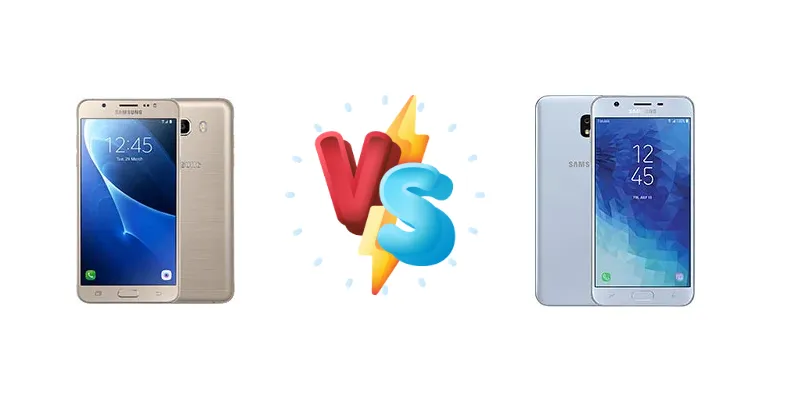
The Samsung Galaxy J7 series was a popular choice for budget-conscious consumers. But with two distinct iterations – the 2016 and 2018 models – which one offers the better value? This comprehensive comparison dives deep into their features to help you decide.
🏆 Quick Verdict
The Galaxy J7 (2016) boasts exceptional battery life and a surprisingly good display for its time. However, the J7 (2018) benefits from a slightly more refined chipset and a more modern design. Overall, the 2018 model is a marginal upgrade, especially if you prioritize a newer aesthetic.
| Network |
|---|
| 2G bands | GSM 850 / 900 / 1800 / 1900 - SIM 1 & SIM 2 (dual-SIM model only) | GSM 850 / 900 / 1800 / 1900 |
| 3G bands | HSDPA 850 / 900 / 1900 / 2100 | HSDPA 850 / 1700(AWS) / 1900 / 2100 - SM-J737U |
| 4G bands | 1, 3, 5, 7, 8, 20, 40 | 1, 2, 3, 4, 5, 7, 12, 66 - SM-J737U |
| Speed | HSPA, LTE Cat4 150/50 Mbps | HSPA, LTE |
| Technology | GSM / HSPA / LTE | GSM / HSPA / LTE |
| | - | 2, 3, 4, 5, 7, 12, 14 - SM-J737A |
| Launch |
|---|
| Announced | 2016, March 29. Released 2016, April | 2018, June. Released 2018, July |
| Status | Discontinued | Discontinued |
| Body |
|---|
| Build | Glass front, plastic back, aluminum frame | Glass front (Gorilla Glass 5), plastic back, plastic frame |
| Dimensions | 151.7 x 76 x 7.8 mm (5.97 x 2.99 x 0.31 in) | 153.2 x 76.2 x 8.6 mm (6.03 x 3.00 x 0.34 in) |
| SIM | Single SIM (Micro-SIM) or Dual SIM (Micro-SIM, dual stand-by) | Nano-SIM |
| Weight | 170 g (6.00 oz) | 181 g (6.38 oz) |
| Display |
|---|
| Protection | - | Corning Gorilla Glass 5 |
| Resolution | 720 x 1280 pixels, 16:9 ratio (~267 ppi density) | 720 x 1280 pixels, 16:9 ratio (~267 ppi density) |
| Size | 5.5 inches, 83.4 cm2 (~72.3% screen-to-body ratio) | 5.5 inches, 83.4 cm2 (~71.4% screen-to-body ratio) |
| Type | Super AMOLED | TFT |
| Platform |
|---|
| CPU | Octa-core (4x1.6 GHz Cortex-A53 & 4x1.0 GHz Cortex-A53)Octa-core 1.6 GHz Cortex-A53 | Octa-core 1.6 GHz Cortex-A53 |
| Chipset | Qualcomm MSM8952 Snapdragon 617 (28 nm)Exynos 7870 Octa (14 nm) | Exynos 7870 Octa (14 nm) |
| GPU | Adreno 405Mali-T830 MP1 | Mali-T830 MP1 |
| OS | Android 6.0.1 (Marshmallow), upgradable to Android 8.1 (Oreo) | Android 8.0 (Oreo), upgradable to Android 9.0 (Pie), One UI |
| Memory |
|---|
| Card slot | microSDXC (dedicated slot) | microSDXC (dedicated slot) |
| Internal | 16GB 2GB RAM | 16GB 2GB RAM, 32GB 2GB RAM |
| | eMMC 5.1 | eMMC 5.1 |
| Main Camera |
|---|
| Features | LED flash, panorama, HDR | LED flash, HDR, panorama |
| Single | 13 MP, f/1.9, 28mm (wide), AF | 8 MP, AF or 13 MP, f/1.7, AF (operator dependent) |
| Video | 1080p@30fps | 1080p@30fps |
| Selfie camera |
|---|
| Features | LED flash | - |
| Single | 5 MP, f/1.9 | 5 MP / 13 MP, f/1.7 (operator dependent) |
| Sound |
|---|
| 3.5mm jack | Yes | Yes |
| 35mm jack | Yes | Yes |
| Loudspeaker | Yes | Yes |
| Comms |
|---|
| Bluetooth | 4.1, A2DP | 4.1/4.2, A2DP, LE |
| NFC | Yes (market dependent for dual-SIM model) | Yes (operator dependent) |
| Positioning | GPS, GLONASS, BDS | GPS, GLONASS |
| Radio | FM radio, RDS, recording | FM radio (SM-J737T1 only) |
| USB | microUSB 2.0, OTG | microUSB 2.0, OTG |
| WLAN | Wi-Fi 802.11 b/g/n, Wi-Fi Direct | Wi-Fi 802.11 a/b/g/n/ac, dual-band, Wi-Fi Direct |
| Features |
|---|
| Sensors | Accelerometer, proximity | Accelerometer, gyro, proximity, compass |
| | ANT+ | ANT+ |
| Battery |
|---|
| Music play | Up to 96 h | - |
| Talk time | Up to 23 h (3G) | - |
| Type | Li-Ion 3300 mAh, removable | Li-Ion 3300 mAh, non-removable |
| Misc |
|---|
| Colors | White, Black, Gold, Rose Gold | Black, Blue, Gold |
| Models | SM-J710FN, SM-J710F, SM-J710H, SM-J710M, SM-J710GN, SM-J710MN, SM-J710K, SM-J7108, SM-J710FQ | SM-J737F, SM-J737V, SM-J737T, SM-J737A, SM-J737P, SM-J737T1, SM-J737U, SM-J737S, SM-J737R4 |
| Price | About 230 EUR | About 200 EUR |
| SAR | 1.10 W/kg (head) 1.01 W/kg (body) | - |
| SAR EU | 0.35 W/kg (head) 1.39 W/kg (body) | - |
| Tests |
|---|
| Audio quality |
Noise -92.4dB / Crosstalk -92.3dB | - |
| Battery life |
Endurance rating 101h
| - |
| Camera |
Photo / Video | - |
| Display |
Contrast ratio: Infinite (nominal), 3.902 (sunlight) | - |
| Loudspeaker |
Voice 64dB / Noise 71dB / Ring 68dB
| - |
| Performance |
Basemark OS II 2.0: 1007Basemark X: 11199 | - |
Samsung Galaxy J7 (2016)
- Exceptional battery life
- Bright Super AMOLED display
- Good value for money (especially used)
- Decent camera for the price
- Older design
- Slightly slower performance compared to 2018
- May lack latest software updates
Samsung Galaxy J7 (2018)
- Slightly more modern design
- Marginally improved performance (Exynos 7870)
- Potentially better software support (depending on region)
- Significantly shorter battery life than 2016
- Similar camera performance to 2016
- Limited upgrade over 2016 for most users
Display Comparison
Both phones feature a 5.5-inch Super AMOLED display, offering vibrant colors and deep blacks. The 2016 model's contrast ratio is listed as 'Infinite' (likely a marketing term), but the measured 3.902 in sunlight suggests good outdoor visibility. The 2018 model's display is comparable, though specific contrast ratio data is less readily available. Both offer a decent viewing experience for everyday use.
Camera Comparison
Camera specifications are similar between the two models, featuring a 13MP main camera and a 5MP front camera. Image quality is generally acceptable in good lighting conditions. The 2018 model might offer slightly improved image processing due to software updates, but the hardware is largely the same. Low-light performance is adequate but not exceptional on either device.
Performance
The 2016 model had a dual chipset option (Snapdragon 617 or Exynos 7870). The 2018 model exclusively uses the Exynos 7870. While both are Octa-core processors, the 2018's chipset benefits from a slightly more refined manufacturing process (14nm vs. 28nm in some 2016 variants), potentially leading to slightly better efficiency and thermal performance. However, real-world performance differences are minimal for typical usage.
Battery Life
The Galaxy J7 (2016) is the clear winner in this category. It boasts an impressive endurance rating of 101 hours, significantly outperforming the 2018 model. The 2018 model's battery life is still respectable, but it doesn't reach the same level of longevity as its predecessor.
Buying Guide
The Samsung Galaxy J7 (2016) is ideal for users prioritizing long battery life and a bright display on a tight budget. The Samsung Galaxy J7 (2018) is a better choice for those seeking a slightly more modern design and a marginally improved processor, even if the gains are subtle.
Frequently Asked Questions
❓ Is the Samsung Galaxy J7 (2018) worth the upgrade from the 2016 model?
For most users, the upgrade isn't substantial. The 2018 model offers a slightly more modern design and a marginally better processor, but the battery life is significantly reduced. If battery life is a priority, stick with the 2016 model.
❓ What software updates are available for each device?
Software support varies by region. The 2018 model generally received slightly longer software support, but both devices are likely running older versions of Android. Check Samsung's website for the latest available updates in your region.