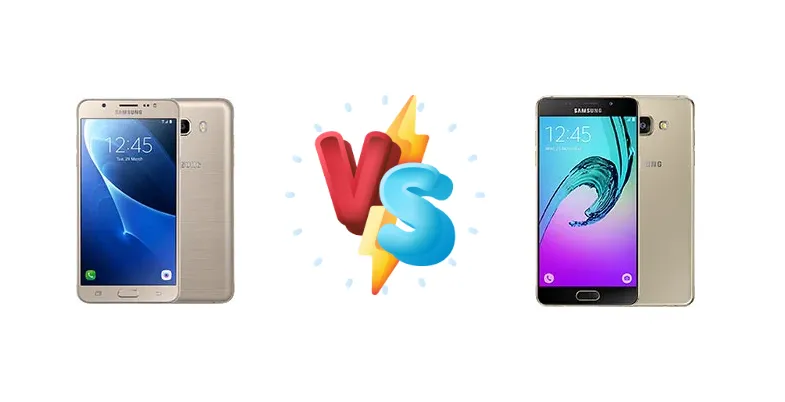
The Samsung Galaxy J7 (2016) and A5 (2016) were popular mid-range smartphones, offering a blend of features and affordability. But which one truly reigned supreme? This comprehensive comparison dives deep into their specs, performance, and overall value to help you decide which phone was the better choice.
🏆 Quick Verdict
The Galaxy J7 (2016) edges out the A5 (2016) primarily due to its significantly longer battery life. While the A5 offered a slightly more premium design and potentially better camera quality in some scenarios, the J7's endurance and often lower price point make it a compelling pick for budget-conscious users.
| Network |
|---|
| 2G bands | GSM 850 / 900 / 1800 / 1900 - SIM 1 & SIM 2 (dual-SIM model only) | GSM 850 / 900 / 1800 / 1900 - SIM 1 & SIM 2 (dual-SIM model only) |
| 3G bands | HSDPA 850 / 900 / 1900 / 2100 | HSDPA 850 / 900 / 1900 / 2100 |
| 4G bands | 1, 3, 5, 7, 8, 20, 40 | 1, 3, 5, 7, 8, 20, 40 |
| Speed | HSPA, LTE Cat4 150/50 Mbps | HSPA 42.2/5.76 Mbps, LTE Cat6 300/50 Mbps |
| Technology | GSM / HSPA / LTE | GSM / UMTS / HSPA / LTE |
| | - | UMTS 2100 |
| Launch |
|---|
| Announced | 2016, March 29. Released 2016, April | 2015, December. Released 2015, December |
| Status | Discontinued | Discontinued |
| Body |
|---|
| Build | Glass front, plastic back, aluminum frame | Glass front (Gorilla Glass 4), glass back (Gorilla Glass 4), aluminum frame |
| Dimensions | 151.7 x 76 x 7.8 mm (5.97 x 2.99 x 0.31 in) | 144.8 x 71 x 7.3 mm (5.70 x 2.80 x 0.29 in) |
| SIM | Single SIM (Micro-SIM) or Dual SIM (Micro-SIM, dual stand-by) | · Nano-SIM· Nano-SIM + Nano-SIM |
| Weight | 170 g (6.00 oz) | 155 g (5.47 oz) |
| Display |
|---|
| Protection | - | Corning Gorilla Glass 4 |
| Resolution | 720 x 1280 pixels, 16:9 ratio (~267 ppi density) | 1080 x 1920 pixels, 16:9 ratio (~424 ppi density) |
| Size | 5.5 inches, 83.4 cm2 (~72.3% screen-to-body ratio) | 5.2 inches, 74.5 cm2 (~72.5% screen-to-body ratio) |
| Type | Super AMOLED | Super AMOLED |
| Platform |
|---|
| CPU | Octa-core (4x1.6 GHz Cortex-A53 & 4x1.0 GHz Cortex-A53)Octa-core 1.6 GHz Cortex-A53 | Octa-core 1.6 GHz Cortex-A53Octa-core (4x1.2 GHz Cortex-A53 & 4x1.5 GHz Cortex-A53) - China only |
| Chipset | Qualcomm MSM8952 Snapdragon 617 (28 nm)Exynos 7870 Octa (14 nm) | Exynos 7580 Octa (28 nm)Qualcomm MSM8939 Snapdragon 615 (28 nm) - China only |
| GPU | Adreno 405Mali-T830 MP1 | Mali-T720MP2Adreno 405 - China only |
| OS | Android 6.0.1 (Marshmallow), upgradable to Android 8.1 (Oreo) | Android 5.1.1 (Lollipop), upgradable to 7.0 (Nougat) |
| Memory |
|---|
| Card slot | microSDXC (dedicated slot) | microSDXC (uses shared SIM slot) - dual SIM model only |
| Internal | 16GB 2GB RAM | 16GB 2GB RAM |
| | eMMC 5.1 | eMMC 5.0 or eMMC 4.5 |
| Main Camera |
|---|
| Features | LED flash, panorama, HDR | LED flash, panorama, HDR |
| Quad | - | 48 MP, (wide), 1/2.0", 0.8µm, PDAF
2 MP, (macro)
2 MP, (depth)
2 MP |
| Single | 13 MP, f/1.9, 28mm (wide), AF | 13 MP, f/1.9, 28mm (wide), AF, OIS |
| Video | 1080p@30fps | 1080p@30fps |
| Selfie camera |
|---|
| Features | LED flash | Dual-LED flash |
| Single | 5 MP, f/1.9 | 5 MP, f/1.9, 24mm (wide) |
| Video | - | 1080p@30fps |
| Sound |
|---|
| 3.5mm jack | Yes | Yes |
| 35mm jack | Yes | Yes |
| Loudspeaker | Yes | Yes |
| Comms |
|---|
| Bluetooth | 4.1, A2DP | 4.1, A2DP, EDR, LE |
| NFC | Yes (market dependent for dual-SIM model) | Yes |
| Positioning | GPS, GLONASS, BDS | GPS, GLONASS |
| Radio | FM radio, RDS, recording | FM radio |
| USB | microUSB 2.0, OTG | microUSB 2.0, OTG |
| WLAN | Wi-Fi 802.11 b/g/n, Wi-Fi Direct | Wi-Fi 802.11 a/b/g/n, dual-band, Wi-Fi Direct, hotspot |
| Features |
|---|
| Sensors | Accelerometer, proximity | Fingerprint (front-mounted), accelerometer, proximity, compass |
| | ANT+ | ANT+
Samsung Pay |
| Battery |
|---|
| Charging | - | 18W wired |
| Music play | Up to 96 h | Up to 75 h |
| Talk time | Up to 23 h (3G) | Up to 16 h (3G) |
| Type | Li-Ion 3300 mAh, removable | Li-Ion 2900 mAh, non-removable |
| Misc |
|---|
| Colors | White, Black, Gold, Rose Gold | Black, White, Gold, Pink |
| Models | SM-J710FN, SM-J710F, SM-J710H, SM-J710M, SM-J710GN, SM-J710MN, SM-J710K, SM-J7108, SM-J710FQ | SM-A5100, SM-A510F, SM-A510M, SM-A510Y, SM-A510FD, SM-A5108, SM-A510S, SM-A510K, SM-A510L, SM-A510 |
| Price | About 230 EUR | About 160 EUR |
| SAR | 1.10 W/kg (head) 1.01 W/kg (body) | 0.29 W/kg (head) 0.47 W/kg (body) |
| SAR EU | 0.35 W/kg (head) 1.39 W/kg (body) | 0.29 W/kg (head) 0.47 W/kg (body) |
| Tests |
|---|
| Audio quality |
Noise -92.4dB / Crosstalk -92.3dB |
Noise -93.4dB / Crosstalk -53.0dB |
| Battery life |
Endurance rating 101h
|
Endurance rating 91h
|
| Camera |
Photo / Video |
Photo / Video |
| Display |
Contrast ratio: Infinite (nominal), 3.902 (sunlight) |
Contrast ratio: Infinite (nominal), 3.789 (sunlight)3.789 |
| Loudspeaker |
Voice 64dB / Noise 71dB / Ring 68dB
|
Voice 65dB / Noise 66dB / Ring 66dB
|
| Performance |
Basemark OS II 2.0: 1007Basemark X: 11199 |
Basemark OS II 2.0: 833Basemark X: 4947 |
Samsung Galaxy J7 (2016)
- Exceptional battery life
- Larger display
- Often more affordable
- Decent performance
- Less premium design
- Camera slightly behind A5
- Plastic build
Samsung Galaxy A5 (2016)
- Slightly better camera
- More premium design (metal and glass)
- Faster charging (18W)
- Compact size
- Shorter battery life
- Potentially higher price
- Performance slightly behind J7
Display Comparison
Both phones featured Super AMOLED displays, offering vibrant colors and deep blacks. The J7 (2016) had a slightly larger 5.5-inch screen compared to the A5 (2016)'s 5.2-inch display. Sunlight readability was comparable, with both achieving around 3.7-3.9 contrast ratios. The J7's larger size might be preferable for media consumption.
Camera Comparison
The A5 (2016) generally had a slight edge in camera quality, particularly in well-lit conditions. Both phones featured 13MP rear cameras and 5MP front cameras. The A5's image processing often resulted in more natural-looking colors. Low-light performance was decent on both, but not exceptional.
Performance
The J7 (2016) offered two chipset options: Qualcomm Snapdragon 617 or Exynos 7870. The A5 (2016) used an Exynos 7580 or Snapdragon 615 (China only). While both were octa-core processors, the J7's Exynos 7870 generally provided slightly better performance. Everyday tasks were smooth on both, but the J7 handled more demanding apps a bit better.
Battery Life
This is where the J7 (2016) truly shines. Its massive 3600mAh battery provided an impressive endurance rating of 101 hours, significantly outperforming the A5 (2016)'s 2900mAh battery and 91-hour rating. The J7 could easily last two full days on a single charge.
Buying Guide
Who should buy the Samsung Galaxy J7 (2016)? Users prioritizing battery life above all else, those on a tighter budget, and those who need a reliable daily driver. Who should buy the Samsung Galaxy A5 (2016)? Users who value a slightly more premium design, potentially better camera performance (though marginal), and faster charging.
Frequently Asked Questions
❓ Which phone is better for gaming?
The Galaxy J7 (2016) with the Exynos 7870 chipset generally offers slightly better gaming performance due to its more powerful GPU.
❓ Is the A5 (2016) worth the extra cost?
If you prioritize a more premium design, faster charging, and slightly better camera quality, the A5 (2016) might be worth the extra cost. However, the J7 (2016)'s superior battery life often makes it the more practical choice.