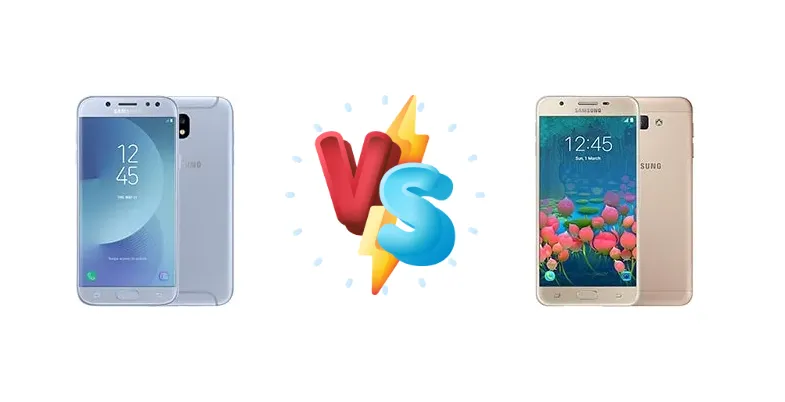
The Samsung Galaxy J5 (2017) and J5 Prime were popular budget smartphones, offering a blend of features and affordability. But which one reigns supreme? This comprehensive comparison dives deep into their specs, performance, and overall value to help you make the right choice.
🏆 Quick Verdict
The Galaxy J5 (2017) boasts significantly better battery life and a potentially brighter display. However, the J5 Prime often offered a smoother user experience due to software optimization and a slightly more modern chipset. Ultimately, battery life wins for the J5 (2017), but the J5 Prime is a close second.
| Network |
|---|
| 2G bands | GSM 850 / 900 / 1800 / 1900 - SIM 1 & SIM 2 (dual-SIM model only) | GSM 850 / 900 / 1800 / 1900 - SIM 1 & SIM 2 |
| 3G bands | HSDPA 850 / 900 / 1700(AWS) / 1900 / 2100 | HSDPA 850 / 900 / 1900 / 2100 |
| 4G bands | 1, 3, 5, 7, 8, 20, 40 | 1, 3, 5, 7, 8, 20, 38, 40 - EMEA, India |
| Speed | HSPA 42.2/5.76 Mbps, LTE (2CA) Cat6 300/50 Mbps | HSPA 42.2/5.76 Mbps, LTE Cat4 150/50 Mbps |
| Technology | GSM / HSPA / LTE | GSM / HSPA / LTE |
| | - | 1, 3, 5, 7, 8, 28, 38, 40 - Australia |
| Launch |
|---|
| Announced | 2017, June. Released 2017, June | 2016, September 19. Released 2016, October |
| Status | Discontinued | Discontinued |
| Body |
|---|
| Build | Glass front, aluminum back, aluminum frame | Glass front (Gorilla Glass), aluminum/plastic back, aluminum frame |
| Dimensions | 146.2 x 71.3 x 8 mm (5.76 x 2.81 x 0.31 in) | 142.8 x 69.5 x 8.1 mm (5.62 x 2.74 x 0.32 in) |
| SIM | · Nano-SIM· Nano-SIM + Nano-SIM | Nano-SIM + Nano-SIM |
| Weight | 160 g (5.64 oz) | 143 g (5.04 oz) |
| Display |
|---|
| Protection | - | Corning Gorilla Glass (market dependent) |
| Resolution | 720 x 1280 pixels, 16:9 ratio (~282 ppi density) | 720 x 1280 pixels, 16:9 ratio (~294 ppi density) |
| Size | 5.2 inches, 74.5 cm2 (~71.5% screen-to-body ratio) | 5.0 inches, 68.9 cm2 (~69.4% screen-to-body ratio) |
| Type | Super AMOLED | PLS LCD |
| Platform |
|---|
| CPU | Octa-core 1.6 GHz Cortex-A53 | Quad-core 1.4 GHz Cortex-A53 |
| Chipset | Exynos 7870 Octa (14 nm) | Exynos 7570 Quad (14 nm) |
| GPU | Mali-T830 MP1 | Mali-T720 MP2 |
| OS | Android 7.0 (Nougat), upgradable to Android 9.0 (Pie), One UI | Android 6.0.1 (Marshmallow), upgradable to Android 8.0 (Oreo) |
| Memory |
|---|
| Card slot | microSDXC (dedicated slot) | microSDXC (dedicated slot) |
| Internal | 16GB 2GB RAM, 32GB 2GB RAM, 32GB 3GB RAM | 16GB 2GB RAM, 32GB 2GB RAM |
| | eMMC 5.1 | eMMC 5.0 |
| Main Camera |
|---|
| Features | LED flash, panorama, HDR | LED flash, panorama, HDR |
| Single | 13 MP, f/1.7, 27mm (wide), 1/3.1", 1.12µm, AF | 13 MP, f/1.9, 28mm (wide), AF |
| Video | 1080p@30fps | 1080p@30fps |
| Selfie camera |
|---|
| Features | LED flash | - |
| Single | 13 MP, f/1.9, 1/3.1", 1.12µm | 5 MP, f/2.2 |
| Video | 1080p@30fps | - |
| Sound |
|---|
| 3.5mm jack | Yes | Yes |
| 35mm jack | Yes | Yes |
| Loudspeaker | Yes | Yes |
| Comms |
|---|
| Bluetooth | 4.1, A2DP | 4.2, A2DP, LE |
| NFC | Yes | No |
| Positioning | GPS, GLONASS, BDS | GPS, GLONASS/ BDS (region dependent) |
| Radio | FM radio | FM radio; recording |
| USB | microUSB 2.0 | microUSB 2.0, OTG |
| WLAN | Wi-Fi 802.11 a/b/g/n/ac, dual-band, Wi-Fi Direct | Wi-Fi 802.11 b/g/n, Wi-Fi Direct |
| Features |
|---|
| Sensors | Fingerprint (front-mounted), accelerometer, gyro, proximity, compass | Fingerprint (front-mounted), accelerometer, proximity |
| | ANT+ | - |
| Battery |
|---|
| Music play | Up to 83 h | Up to 54 h |
| Talk time | Up to 21 h (3G) | Up to 16 h (3G) |
| Type | Li-Ion 3000 mAh, non-removable | Li-Ion 2400 mAh, non-removable |
| Misc |
|---|
| Colors | Blue, Pink, Gold, Black | Black, Gold |
| Models | SM-J530F, SM-J530Y, SM-J530FM, SM-J530G, SM-J530YM, SM-J530L, SM-J530S, SM-J530K, SM-J530GM | SM-G570F, SM-G570F/DD, SM-G570F, SM-G570Y, SM-G570M |
| Price | About 130 EUR | About 120 EUR |
| SAR | - | 0.71 W/kg (head) |
| SAR EU | 0.35 W/kg (head) 1.36 W/kg (body) | 0.42 W/kg (head) 0.83 W/kg (body) |
| Tests |
|---|
| Audio quality |
Noise -85.0dB / Crosstalk -90.3dB | - |
| Battery life |
Endurance rating 97h
| - |
| Camera |
Photo / Video | - |
| Display |
Contrast ratio: Infinite (nominal), 3.599 (sunlight) | - |
| Loudspeaker |
Voice 68dB / Noise 70dB / Ring 82dB
| - |
| Performance |
GeekBench: 3667 (v4.4)
GFXBench: 3.8fps (ES 3.1 onscreen) | - |
Samsung Galaxy J5 (2017)
- Exceptional battery life
- Potentially brighter display
- Octa-core processor
- Slightly older chipset
- Can feel sluggish at times
- Design is dated
Samsung Galaxy J5 Prime
- Smoother user experience
- Slightly more modern design
- Wider angle front camera
- Shorter battery life
- Less vibrant display
- Quad-core processor
Display Comparison
Both phones feature a 5.0-inch HD (720 x 1280) Super AMOLED display. The J5 (2017) is reported to have an 'infinite' nominal contrast ratio, suggesting excellent blacks and vibrant colors, though sunlight readability is rated at 3.599. The J5 Prime's display is generally considered slightly less vibrant, but still offers good viewing angles. The J5 (2017) may have a slight edge in perceived brightness.
Camera Comparison
The J5 (2017) typically had a 13MP rear camera and a 5MP front camera. The J5 Prime also featured a 13MP rear camera, but often had a slightly improved 5MP front camera with a wider angle lens. Image quality is comparable on both, with decent detail in good lighting conditions. Low-light performance is average on both devices.
Performance
The J5 (2017) utilizes an Exynos 7870 Octa-core processor, while the J5 Prime features an Exynos 7570 Quad-core. While the J5 (2017) has more cores, the J5 Prime's chipset often felt more responsive in everyday use, likely due to software optimization and a more efficient architecture. Gaming performance is generally adequate on both, but don't expect high frame rates on demanding titles.
Battery Life
This is where the J5 (2017) truly shines. It boasts an impressive endurance rating of 97 hours, significantly outperforming the J5 Prime. The J5 Prime's battery life is respectable, but falls short of the J5 (2017)'s longevity.
Buying Guide
The Samsung Galaxy J5 (2017) is ideal for users prioritizing long battery life and who don't require top-tier performance. The Samsung Galaxy J5 Prime is a better choice for those seeking a more responsive experience and a slightly more refined design, even if it means sacrificing some battery endurance.
Frequently Asked Questions
❓ Which phone is better for gaming?
The Samsung Galaxy J5 Prime generally offers a slightly smoother gaming experience due to its optimized software, although both phones are limited by their hardware.
❓ Is the J5 Prime worth the extra cost (if any)?
If you prioritize a more responsive user experience and a slightly more modern design, the J5 Prime might be worth it. However, if battery life is your top concern, the J5 (2017) is the clear winner.