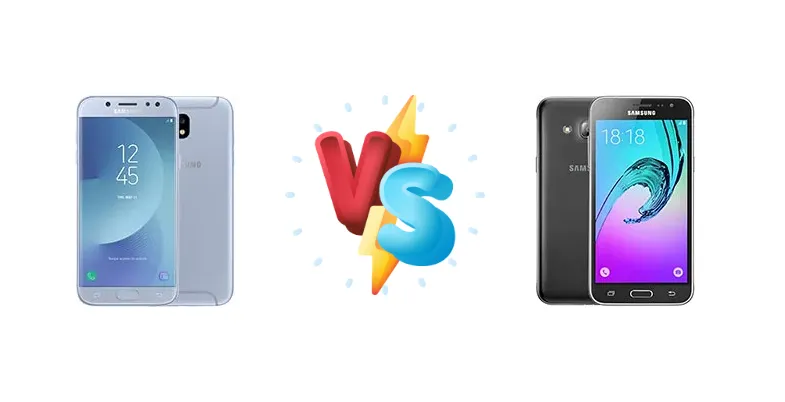
The Samsung Galaxy J series has long been a staple for budget-conscious smartphone users. Today, we're pitting two older models against each other: the Galaxy J5 (2017) and the Galaxy J3 (2016). Let's see which one holds up best in a head-to-head comparison.
🏆 Quick Verdict
The Samsung Galaxy J5 (2017) clearly takes the crown. Its significantly longer battery life, more powerful processor, and generally improved performance make it the better choice, despite both phones being quite dated now. The J3 (2016) remains a basic option, but falls short in key areas.
| Network |
|---|
| 2G bands | GSM 850 / 900 / 1800 / 1900 - SIM 1 & SIM 2 (dual-SIM model only) | GSM 850 / 900 / 1800 / 1900 - SIM 1 & SIM 2 (dual-SIM model only) |
| 3G bands | HSDPA 850 / 900 / 1700(AWS) / 1900 / 2100 | HSDPA 850 / 900 / 1900 / 2100 |
| 4G bands | 1, 3, 5, 7, 8, 20, 40 | 1, 3, 5, 7, 8, 20 |
| Speed | HSPA 42.2/5.76 Mbps, LTE (2CA) Cat6 300/50 Mbps | HSPA 42.2/5.76 Mbps, LTE Cat4 150/50 Mbps |
| Technology | GSM / HSPA / LTE | GSM / HSPA / LTE |
| Launch |
|---|
| Announced | 2017, June. Released 2017, June | 2016, March 31. Released 2016, May 06 |
| Status | Discontinued | Discontinued |
| Body |
|---|
| Build | Glass front, aluminum back, aluminum frame | Glass front (Asahi Dragontrail), plastic back, plastic frame |
| Dimensions | 146.2 x 71.3 x 8 mm (5.76 x 2.81 x 0.31 in) | 142.3 x 71 x 7.9 mm (5.60 x 2.80 x 0.31 in) |
| SIM | · Nano-SIM· Nano-SIM + Nano-SIM | · Micro-SIM· Micro-SIM + Micro-SIM· Nano-SIM (USA models only) |
| Weight | 160 g (5.64 oz) | 138 g (4.87 oz) |
| Display |
|---|
| Protection | - | Asahi Dragontrail Glass |
| Resolution | 720 x 1280 pixels, 16:9 ratio (~282 ppi density) | 720 x 1280 pixels, 16:9 ratio (~294 ppi density) |
| Size | 5.2 inches, 74.5 cm2 (~71.5% screen-to-body ratio) | 5.0 inches, 68.9 cm2 (~68.2% screen-to-body ratio) |
| Type | Super AMOLED | Super AMOLED |
| Platform |
|---|
| CPU | Octa-core 1.6 GHz Cortex-A53 | Quad-core 1.5 GHz Cortex-A7Quad-core 1.3 GHz Cortex-A7 - USA |
| Chipset | Exynos 7870 Octa (14 nm) | Spreadtrum SC9830Exynos 3475 Quad (28 nm) - USA |
| GPU | Mali-T830 MP1 | Mali-400Mali-T720 - USA |
| OS | Android 7.0 (Nougat), upgradable to Android 9.0 (Pie), One UI | Android 5.1.1 (Lollipop) or Android 6.0 (Marshmallow), upgradable to 7.1.1 (Nougat) |
| Memory |
|---|
| Card slot | microSDXC (dedicated slot) | microSDXC (dedicated slot) |
| Internal | 16GB 2GB RAM, 32GB 2GB RAM, 32GB 3GB RAM | 8GB 1.5GB RAM, 16GB 2GB RAM |
| | eMMC 5.1 | eMMC 4.5 |
| Main Camera |
|---|
| Features | LED flash, panorama, HDR | LED flash, HDR |
| Single | 13 MP, f/1.7, 27mm (wide), 1/3.1", 1.12µm, AF | 8 MP, f/2.2, AF
5 MP, f/2.2, AF - USA |
| Video | 1080p@30fps | 720p@30fps |
| Selfie camera |
|---|
| Features | LED flash | - |
| Single | 13 MP, f/1.9, 1/3.1", 1.12µm | 2 MP (USA)
5 MP, f/2.2 (all other regions) |
| Video | 1080p@30fps | 720p@30fps |
| Sound |
|---|
| 3.5mm jack | Yes | Yes |
| 35mm jack | Yes | Yes |
| Loudspeaker | Yes | Yes |
| Comms |
|---|
| Bluetooth | 4.1, A2DP | 4.0/4.1, A2DP, LE |
| NFC | Yes | Yes (market dependent) |
| Positioning | GPS, GLONASS, BDS | GPS, GLONASS |
| Radio | FM radio | FM radio, RDS, recording (market dependent) |
| USB | microUSB 2.0 | microUSB 2.0, OTG |
| WLAN | Wi-Fi 802.11 a/b/g/n/ac, dual-band, Wi-Fi Direct | Wi-Fi 802.11 b/g/n, Wi-Fi Direct |
| Features |
|---|
| Sensors | Fingerprint (front-mounted), accelerometer, gyro, proximity, compass | Accelerometer, proximity |
| | ANT+ | - |
| Battery |
|---|
| Music play | Up to 83 h | Up to 77 h |
| Stand-by | - | Up to 349 h |
| Talk time | Up to 21 h (3G) | Up to 22 h |
| Type | Li-Ion 3000 mAh, non-removable | Li-Ion 2600 mAh, removable |
| Misc |
|---|
| Colors | Blue, Pink, Gold, Black | White, Black, Gold |
| Models | SM-J530F, SM-J530Y, SM-J530FM, SM-J530G, SM-J530YM, SM-J530L, SM-J530S, SM-J530K, SM-J530GM | SM-J320H, SM-J3109, SM-J320FN, SM-J320P, SM-J320F, SM-J320M, SM-J320Y, SM-J320A, SM-J320G, SM-J327T1, SM-J320V, SM-J320YZ, SM-J320W8, SM-J320ZN, SM-J320N0, SM-J320R4 |
| Price | About 130 EUR | About 120 EUR |
| SAR | - | 1.17 W/kg (head) 1.12 W/kg (body) |
| SAR EU | 0.35 W/kg (head) 1.36 W/kg (body) | 0.48 W/kg (head) 0.42 W/kg (body) |
| Tests |
|---|
| Audio quality |
Noise -85.0dB / Crosstalk -90.3dB |
Noise -92.4dB / Crosstalk -91.3dB |
| Battery life |
Endurance rating 97h
|
Endurance rating 66h
|
| Camera |
Photo / Video |
Photo / Video |
| Display |
Contrast ratio: Infinite (nominal), 3.599 (sunlight) |
Contrast ratio: Infinite (nominal), 3.523 (sunlight) |
| Loudspeaker |
Voice 68dB / Noise 70dB / Ring 82dB
|
Voice 64dB / Noise 65dB / Ring 68dB
|
| Performance |
GeekBench: 3667 (v4.4)
GFXBench: 3.8fps (ES 3.1 onscreen) |
Basemark OS II 2.0: 326Basemark X: 1424 |
Samsung Galaxy J5 (2017)
- Significantly longer battery life
- More powerful processor
- Slightly better display visibility
- Generally smoother performance
- Older model, limited software updates
- Camera quality is basic
- Design is dated
Samsung Galaxy J3 (2016)
- Ultra-budget friendly
- Compact size
- Poor performance
- Short battery life
- Basic camera
- Outdated software
Display Comparison
Both phones feature similar display technology, likely LCD panels. The contrast ratios, while listed as 'Infinite' nominally, show a slight edge for the J5 (2017) with a 3.599 sunlight rating compared to the J3 (2016)'s 3.523. This suggests marginally better visibility in bright conditions for the J5. Resolution is likely around 720p for both, offering adequate but not exceptional sharpness.
Camera Comparison
Camera specifications are listed as 'Photo / Video' for both, indicating a lack of detailed information. However, given the more powerful chipset in the J5 (2017), it's likely to offer slightly better image processing and overall camera performance. Both cameras are likely to produce acceptable results in good lighting conditions, but struggle in low light.
Performance
The J5 (2017) boasts a significant performance advantage thanks to its Exynos 7870 Octa chipset and Octa-core 1.6 GHz Cortex-A53 CPU. The J3 (2016) uses a Spreadtrum SC9830Exynos 3475 Quad (USA) with a Quad-core 1.5 GHz Cortex-A7, which is considerably less powerful. Expect smoother multitasking and app loading on the J5.
Battery Life
This is where the J5 (2017) truly shines. It boasts an endurance rating of 97 hours, a massive difference compared to the J3 (2016)'s 66 hours. This translates to significantly longer usage time on a single charge for the J5.
Buying Guide
Who should buy the Samsung Galaxy J5 (2017)? Users needing extended battery life and a slightly smoother experience. Who should buy the Samsung Galaxy J3 (2016)? Primarily those seeking a very basic, ultra-budget option and are not concerned with performance or camera quality. Consider newer budget phones before purchasing either.
Frequently Asked Questions
❓ Are these phones still worth buying in 2024?
Given their age, neither phone is highly recommended. Newer budget smartphones offer significantly better features and performance at similar price points. Consider them only if you need a very basic phone and find them at a very low price.
❓ Which phone has better software support?
Neither phone receives regular software updates anymore. Both are running older versions of Android, posing potential security risks. It's best to opt for a newer device with ongoing support.