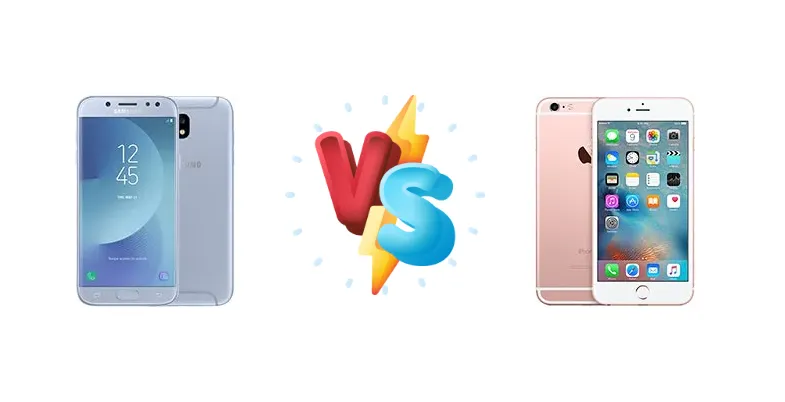
The Samsung Galaxy J5 (2017) and Apple iPhone 6s Plus represent different eras of smartphone technology. Both offer a compelling experience, but cater to different needs and budgets. Let's dive into a detailed comparison to see which phone emerges as the victor.
🏆 Quick Verdict
The Samsung Galaxy J5 (2017) boasts significantly longer battery life and a surprisingly good sunlight display. However, the iPhone 6s Plus offers a more polished user experience, a generally superior camera, and the backing of Apple's ecosystem. It's a trade-off between endurance and refinement.
| Network |
|---|
| 2G bands | GSM 850 / 900 / 1800 / 1900 - SIM 1 & SIM 2 (dual-SIM model only) | GSM 850 / 900 / 1800 / 1900 |
| 3G bands | HSDPA 850 / 900 / 1700(AWS) / 1900 / 2100 | HSDPA 850 / 900 / 1700 / 1900 / 2100 |
| 4G bands | 1, 3, 5, 7, 8, 20, 40 | 1, 2, 3, 4, 5, 7, 8, 12, 13, 17, 18, 19, 20, 25, 26, 28, 29, 30 - A1633 |
| Speed | HSPA 42.2/5.76 Mbps, LTE (2CA) Cat6 300/50 Mbps | HSPA 42.2/5.76 Mbps, LTE (2CA) Cat6 300/50 Mbps, EV-DO Rev.A 3.1 Mbps |
| Technology | GSM / HSPA / LTE | GSM / CDMA / HSPA / EVDO / LTE |
| | - | 1, 2, 3, 4, 5, 7, 8, 12, 13, 17, 18, 19, 20, 25, 26, 28, 29, 30, 38, 39, 40, 41 - A1634 |
| Launch |
|---|
| Announced | 2017, June. Released 2017, June | 2015, September 09. Released 2015, September 25 |
| Status | Discontinued | Discontinued |
| Body |
|---|
| Build | Glass front, aluminum back, aluminum frame | Glass front (Corning-made glass), aluminum back, aluminum frame |
| Dimensions | 146.2 x 71.3 x 8 mm (5.76 x 2.81 x 0.31 in) | 158.2 x 77.9 x 7.3 mm (6.23 x 3.07 x 0.29 in) |
| SIM | · Nano-SIM· Nano-SIM + Nano-SIM | Nano-SIM |
| Weight | 160 g (5.64 oz) | 192 g (6.77 oz) |
| | - | Apple Pay (Visa, MasterCard, AMEX certified) |
| Display |
|---|
| Protection | - | Ion-strengthened glass, oleophobic coating |
| Resolution | 720 x 1280 pixels, 16:9 ratio (~282 ppi density) | 1080 x 1920 pixels, 16:9 ratio (~401 ppi density) |
| Size | 5.2 inches, 74.5 cm2 (~71.5% screen-to-body ratio) | 5.5 inches, 83.4 cm2 (~67.7% screen-to-body ratio) |
| Type | Super AMOLED | IPS LCD |
| | - | 3D Touch display |
| Platform |
|---|
| CPU | Octa-core 1.6 GHz Cortex-A53 | Dual-core 1.84 GHz Twister |
| Chipset | Exynos 7870 Octa (14 nm) | Apple A9 (14/16 nm - maker dependant) |
| GPU | Mali-T830 MP1 | PowerVR GT7600 (six-core graphics) |
| OS | Android 7.0 (Nougat), upgradable to Android 9.0 (Pie), One UI | iOS 9, upgradable to iOS 15.8.5 |
| Memory |
|---|
| Card slot | microSDXC (dedicated slot) | No |
| Internal | 16GB 2GB RAM, 32GB 2GB RAM, 32GB 3GB RAM | 16GB 2GB RAM, 32GB 2GB RAM, 64GB 2GB RAM, 128GB 2GB RAM |
| | eMMC 5.1 | NVMe |
| Main Camera |
|---|
| Features | LED flash, panorama, HDR | Dual-LED dual-tone flash, HDR |
| Single | 13 MP, f/1.7, 27mm (wide), 1/3.1", 1.12µm, AF | 12 MP, f/2.2, 29mm (standard), 1/3.0", 1.22µm, PDAF, OIS |
| Video | 1080p@30fps | 4K@30fps, 1080p@60fps, 1080p@120fps, 720p@240fps |
| Selfie camera |
|---|
| Features | LED flash | Face detection, HDR, panorama |
| Single | 13 MP, f/1.9, 1/3.1", 1.12µm | 5 MP, f/2.2, 31mm (standard) |
| Video | 1080p@30fps | 720p@30fps |
| Sound |
|---|
| 3.5mm jack | Yes | Yes |
| 35mm jack | Yes | Yes |
| Loudspeaker | Yes | Yes |
| | - | 16-bit/44.1kHz audio
|
| Comms |
|---|
| Bluetooth | 4.1, A2DP | 4.2, A2DP, LE |
| NFC | Yes | Yes (Apple Pay only) |
| Positioning | GPS, GLONASS, BDS | GPS, GLONASS, GALILEO, QZSS |
| Radio | FM radio | No |
| USB | microUSB 2.0 | Lightning, USB 2.0 |
| WLAN | Wi-Fi 802.11 a/b/g/n/ac, dual-band, Wi-Fi Direct | Wi-Fi 802.11 a/b/g/n/ac, dual-band, hotspot |
| Features |
|---|
| Sensors | Fingerprint (front-mounted), accelerometer, gyro, proximity, compass | Fingerprint (front-mounted), accelerometer, gyro, proximity, compass, barometer |
| | ANT+ | - |
| Battery |
|---|
| Music play | Up to 83 h | - |
| Stand-by | - | Up to 384 h (3G) |
| Talk time | Up to 21 h (3G) | Up to 24 h (3G) |
| Type | Li-Ion 3000 mAh, non-removable | Li-Ion 2750 mAh, non-removable (10.45 Wh) |
| Misc |
|---|
| Colors | Blue, Pink, Gold, Black | Space Gray, Silver, Gold, Rose Gold |
| Models | SM-J530F, SM-J530Y, SM-J530FM, SM-J530G, SM-J530YM, SM-J530L, SM-J530S, SM-J530K, SM-J530GM | A1634, A1687, A1690, A1699, iPhone8,2 |
| Price | About 130 EUR | About 240 EUR |
| SAR | - | 1.12 W/kg (head) 1.14 W/kg (body) |
| SAR EU | 0.35 W/kg (head) 1.36 W/kg (body) | 0.93 W/kg (head) 0.98 W/kg (body) |
| Tests |
|---|
| Audio quality |
Noise -85.0dB / Crosstalk -90.3dB |
Noise -93.4dB / Crosstalk -71.1dB |
| Battery life |
Endurance rating 97h
|
Endurance rating 85h
|
| Camera |
Photo / Video |
Photo / Video |
| Display |
Contrast ratio: Infinite (nominal), 3.599 (sunlight) |
Contrast ratio: 1382:1 (nominal), 3.530 (sunlight) |
| Loudspeaker |
Voice 68dB / Noise 70dB / Ring 82dB
|
Voice 65dB / Noise 65dB / Ring 64dB
|
| Performance |
GeekBench: 3667 (v4.4)
GFXBench: 3.8fps (ES 3.1 onscreen) |
Basemark OS II 2.0: 2261 |
Samsung Galaxy J5 (2017)
- Exceptional battery life
- Affordable price
- Decent display in sunlight
- Expandable storage (via microSD)
- Slower performance
- Less refined camera
- Plastic build quality
- Outdated software
Apple iPhone 6s Plus
- Smooth iOS experience
- Superior camera quality
- Strong performance
- Premium build quality
- Access to Apple ecosystem
- Older device
- Shorter battery life compared to J5
- Limited storage options
- No expandable storage
Display Comparison
Both phones feature LCD displays, but the iPhone 6s Plus has a noticeably better contrast ratio (1382:1 vs. J5's nominal 'infinite' which is likely a marketing term). While both perform similarly in sunlight (3.599 and 3.530 respectively), the iPhone's color accuracy and overall image quality are generally superior. The J5's display is adequate, but lacks the vibrancy and sharpness of the iPhone.
Camera Comparison
The iPhone 6s Plus consistently delivers better image quality, particularly in low-light conditions. Its image processing is more refined, resulting in more natural-looking photos. The J5's camera is decent for casual snapshots, but struggles to compete with the iPhone's overall performance and features. Video recording on the iPhone is also generally smoother and more stable.
Performance
The iPhone 6s Plus's A9 chip and Twister core architecture provide a more responsive and fluid user experience compared to the J5's Exynos 7870. While both are capable of handling everyday tasks, the iPhone excels in multitasking and demanding applications. The J5 can feel sluggish at times, especially with heavier apps.
Battery Life
This is where the J5 (2017) shines. Its endurance rating of 97h significantly surpasses the iPhone 6s Plus's 85h. This translates to noticeably longer battery life for the J5, making it a better choice for users who need a phone that can last through multiple days of moderate use.
Buying Guide
The Samsung Galaxy J5 (2017) is ideal for users prioritizing battery life and affordability. The iPhone 6s Plus is a better choice for those seeking a smoother iOS experience, a more reliable camera, and integration with Apple's services, even if it's an older device.
Frequently Asked Questions
❓ Is the iPhone 6s Plus still worth buying in 2024?
It depends. If you prioritize a smooth iOS experience and a good camera on a budget, it can be a decent option. However, consider that it's an older device with limited software updates and a shorter battery life compared to newer phones.
❓ Which phone has better software support?
The iPhone 6s Plus, despite being older, will likely receive some continued security updates from Apple. The Galaxy J5 (2017) has long since ended its software support cycle.