
Samsung Galaxy J3 (2016) vs. (2017): A Detailed Comparison
| Phones Images | |||||
|---|---|---|---|---|---|
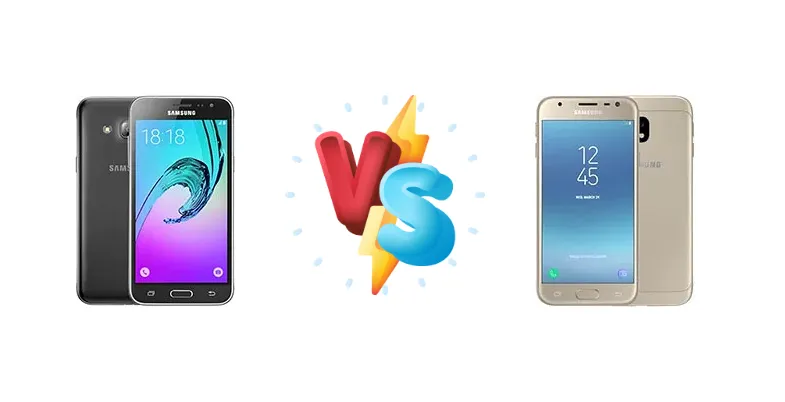
|
🏆 Quick Verdict
The Galaxy J3 (2017) is the clear winner. While the 2016 model boasts impressive battery life, the 2017's more modern chipset and improved efficiency provide a smoother, more responsive experience overall, making it a better long-term choice.
| PHONES | ||
|---|---|---|
| Phone Names | Samsung Galaxy J3 (2016) | Samsung Galaxy J3 (2017) |
| Network | ||
|---|---|---|
| 2G bands | GSM 850 / 900 / 1800 / 1900 - SIM 1 & SIM 2 (dual-SIM model only) | GSM 850 / 900 / 1800 / 1900 - SIM 1 & SIM 2 (dual-SIM model only) |
| 3G bands | HSDPA 850 / 900 / 1900 / 2100 | HSDPA 850 / 900 / 1700(AWS) / 1900 / 2100 |
| 4G bands | 1, 3, 5, 7, 8, 20 | 1, 2, 3, 4, 5, 7, 8, 17, 38, 40 |
| Speed | HSPA 42.2/5.76 Mbps, LTE Cat4 150/50 Mbps | HSPA 42.2/5.76 Mbps, LTE Cat4 150/50 Mbps |
| Technology | GSM / HSPA / LTE | GSM / HSPA / LTE |
| Launch | ||
|---|---|---|
| Announced | 2016, March 31. Released 2016, May 06 | 2017, June. Released 2017, July |
| Status | Discontinued | Discontinued |
| Body | ||
|---|---|---|
| Build | Glass front (Asahi Dragontrail), plastic back, plastic frame | Glass front, aluminum back, aluminum frame |
| Dimensions | 142.3 x 71 x 7.9 mm (5.60 x 2.80 x 0.31 in) | 143.2 x 70.3 x 8.2 mm (5.64 x 2.77 x 0.32 in) |
| SIM | · Micro-SIM· Micro-SIM + Micro-SIM· Nano-SIM (USA models only) | · Nano-SIM· Nano-SIM + Nano-SIM |
| Weight | 138 g (4.87 oz) | 142 g (5.01 oz) |
| Display | ||
|---|---|---|
| Protection | Asahi Dragontrail Glass | - |
| Resolution | 720 x 1280 pixels, 16:9 ratio (~294 ppi density) | 720 x 1280 pixels, 16:9 ratio (~294 ppi density) |
| Size | 5.0 inches, 68.9 cm2 (~68.2% screen-to-body ratio) | 5.0 inches, 68.9 cm2 (~68.5% screen-to-body ratio) |
| Type | Super AMOLED | PLS |
| Platform | ||
|---|---|---|
| CPU | Quad-core 1.5 GHz Cortex-A7Quad-core 1.3 GHz Cortex-A7 - USA | Quad-core 1.4 GHz Cortex-A53 |
| Chipset | Spreadtrum SC9830Exynos 3475 Quad (28 nm) - USA | Exynos 7570 Quad (14 nm) |
| GPU | Mali-400Mali-T720 - USA | Mali-T720 MP2 |
| OS | Android 5.1.1 (Lollipop) or Android 6.0 (Marshmallow), upgradable to 7.1.1 (Nougat) | Android 7.0 (Nougat), 8.0 (Oreo), upgradable to Android 9.0 (Pie) |
| Memory | ||
|---|---|---|
| Card slot | microSDXC (dedicated slot) | microSDXC (dedicated slot) |
| Internal | 8GB 1.5GB RAM, 16GB 2GB RAM | 16GB 2GB RAM |
| eMMC 4.5 | eMMC 5.0 | |
| Main Camera | ||
|---|---|---|
| Features | LED flash, HDR | LED flash, HDR, panorama |
| Single | 8 MP, f/2.2, AF 5 MP, f/2.2, AF - USA | 13 MP, f/1.9, AF |
| Video | 720p@30fps | 1080p@30fps |
| Selfie camera | ||
|---|---|---|
| Features | - | LED flash |
| Single | 2 MP (USA) 5 MP, f/2.2 (all other regions) | 5 MP, f/2.2 |
| Video | 720p@30fps | - |
| Sound | ||
|---|---|---|
| 3.5mm jack | Yes | Yes |
| 35mm jack | Yes | Yes |
| Loudspeaker | Yes | Yes |
| Comms | ||
|---|---|---|
| Bluetooth | 4.0/4.1, A2DP, LE | 4.2, A2DP, LE |
| NFC | Yes (market dependent) | Yes (optional) |
| Positioning | GPS, GLONASS | GPS, GLONASS, BDS |
| Radio | FM radio, RDS, recording (market dependent) | FM radio |
| USB | microUSB 2.0, OTG | microUSB 2.0, OTG |
| WLAN | Wi-Fi 802.11 b/g/n, Wi-Fi Direct | Wi-Fi 802.11 b/g/n, Wi-Fi Direct |
| Features | ||
|---|---|---|
| Sensors | Accelerometer, proximity | Accelerometer, proximity |
| Battery | ||
|---|---|---|
| Music play | Up to 77 h | Up to 61 h |
| Stand-by | Up to 349 h | - |
| Talk time | Up to 22 h | Up to 15 h (3G) |
| Type | Li-Ion 2600 mAh, removable | Li-Ion 2400 mAh, non-removable |
| Misc | ||
|---|---|---|
| Colors | White, Black, Gold | White, Black, Gold, Blue |
| Models | SM-J320H, SM-J3109, SM-J320FN, SM-J320P, SM-J320F, SM-J320M, SM-J320Y, SM-J320A, SM-J320G, SM-J327T1, SM-J320V, SM-J320YZ, SM-J320W8, SM-J320ZN, SM-J320N0, SM-J320R4 | SM-J330F, J330F, J330G, SM-J330G, SM-J330FN, SM-J3308, SM-J327F, SM-S337TL, SM-J3300, SM-J330L, SM-J327U, SM-J330N |
| Price | About 120 EUR | About 110 EUR |
| SAR | 1.17 W/kg (head) 1.12 W/kg (body) | - |
| SAR EU | 0.48 W/kg (head) 0.42 W/kg (body) | 0.66 W/kg (head) 1.32 W/kg (body) |
| Tests | ||
|---|---|---|
| Audio quality | Noise -92.4dB / Crosstalk -91.3dB | - |
| Battery life | Endurance rating 66h | - |
| Camera | Photo / Video | - |
| Display | Contrast ratio: Infinite (nominal), 3.523 (sunlight) | - |
| Loudspeaker | Voice 64dB / Noise 65dB / Ring 68dB | - |
| Performance | Basemark OS II 2.0: 326Basemark X: 1424 | - |
Samsung Galaxy J3 (2016)
- Exceptional battery life
- Affordable price (when new)
- Super AMOLED display
- Slow performance
- Outdated chipset
- Limited storage
- Potentially outdated software support
Samsung Galaxy J3 (2017)
- Improved performance
- More modern chipset
- Slightly better camera (likely)
- Better software support (potentially)
- Shorter battery life than 2016 model
- Still a budget phone with limitations
- Limited storage
Display Comparison
Both models featured a 5.0-inch Super AMOLED display, offering vibrant colors and good viewing angles. However, the 2017 model likely had slightly improved brightness and color accuracy due to advancements in display technology. The 2016 model's contrast ratio data is unusual ('Infinite' nominal), suggesting a marketing term rather than a measurable value.
Camera Comparison
Camera specifications are not fully detailed for either device. However, the 2017 model likely had a slightly improved camera sensor and image processing algorithms, resulting in better image quality, particularly in low-light conditions. Both likely featured a standard rear camera and a front-facing camera for selfies.
Performance
This is where the 2017 model shines. The Exynos 7570 chipset (14nm) is significantly more efficient and powerful than the Spreadtrum SC9830/Exynos 3475 combination (28nm) in the 2016 model. Expect smoother multitasking, faster app loading times, and better overall responsiveness on the 2017 device. The 2016 model could feel sluggish, especially with demanding apps.
Battery Life
The Galaxy J3 (2016) is the standout here. Its endurance rating of 66h is exceptional, suggesting a very large battery and efficient power management. The 2017 model, while still offering decent battery life, couldn't match this endurance due to the more power-hungry chipset.
Buying Guide
The Samsung Galaxy J3 (2016) might be suitable for users prioritizing extreme battery life and are on a very tight budget, accepting slower performance. The Samsung Galaxy J3 (2017) is ideal for those seeking a more modern, responsive experience with better performance and a slightly more refined design, even if it means sacrificing some battery endurance.