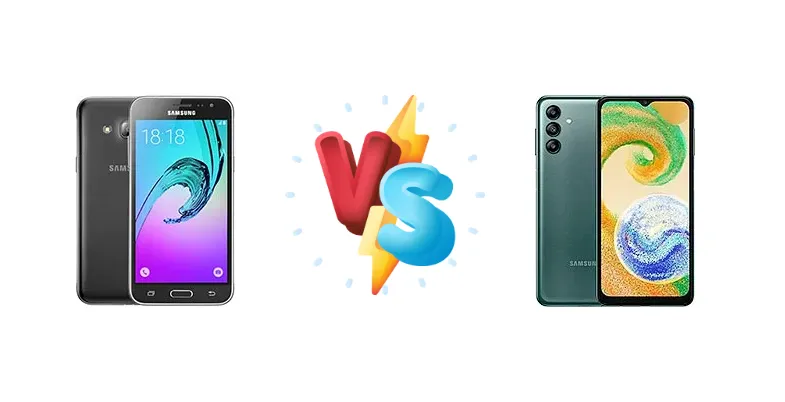
Choosing a new smartphone can be overwhelming, especially with so many options available. Today, we're pitting two Samsung devices against each other: the older Galaxy J3 (2016) and the more recent Galaxy A04s. Let's see how these phones stack up in terms of performance, camera, and overall value.
🏆 Quick Verdict
The Samsung Galaxy A04s is the clear winner. While the J3 (2016) boasts impressive endurance ratings, the A04s offers a significantly more modern chipset, brighter display, improved camera capabilities, and faster charging, making it a better choice for most users.
| Network |
|---|
| 2G bands | GSM 850 / 900 / 1800 / 1900 - SIM 1 & SIM 2 (dual-SIM model only) | GSM 850 / 900 / 1800 / 1900 |
| 3G bands | HSDPA 850 / 900 / 1900 / 2100 | HSDPA 850 / 900 / 2100 |
| 4G bands | 1, 3, 5, 7, 8, 20 | 1, 3, 5, 7, 8, 20, 28, 38, 40, 41 |
| Speed | HSPA 42.2/5.76 Mbps, LTE Cat4 150/50 Mbps | HSPA, LTE |
| Technology | GSM / HSPA / LTE | GSM / HSPA / LTE |
| Launch |
|---|
| Announced | 2016, March 31. Released 2016, May 06 | 2022, August 31 |
| Status | Discontinued | Available. Released 2022, September 22 |
| Body |
|---|
| Build | Glass front (Asahi Dragontrail), plastic back, plastic frame | Glass front, plastic back, plastic frame |
| Dimensions | 142.3 x 71 x 7.9 mm (5.60 x 2.80 x 0.31 in) | 164.7 x 76.7 x 9.1 mm (6.48 x 3.02 x 0.36 in) |
| SIM | · Micro-SIM· Micro-SIM + Micro-SIM· Nano-SIM (USA models only) | Nano-SIM + Nano-SIM |
| Weight | 138 g (4.87 oz) | 195 g (6.88 oz) |
| Display |
|---|
| Protection | Asahi Dragontrail Glass | - |
| Resolution | 720 x 1280 pixels, 16:9 ratio (~294 ppi density) | 720 x 1600 pixels, 20:9 ratio (~270 ppi density) |
| Size | 5.0 inches, 68.9 cm2 (~68.2% screen-to-body ratio) | 6.5 inches, 102.0 cm2 (~80.7% screen-to-body ratio) |
| Type | Super AMOLED | PLS LCD, 90Hz, 400 nits (peak) |
| Platform |
|---|
| CPU | Quad-core 1.5 GHz Cortex-A7Quad-core 1.3 GHz Cortex-A7 - USA | Octa-core (4x2.0 GHz Cortex-A55 & 4x2.0 GHz Cortex-A55) |
| Chipset | Spreadtrum SC9830Exynos 3475 Quad (28 nm) - USA | Exynos 850 (8 nm) |
| GPU | Mali-400Mali-T720 - USA | Mali-G52 |
| OS | Android 5.1.1 (Lollipop) or Android 6.0 (Marshmallow), upgradable to 7.1.1 (Nougat) | Android 12, upgradable to Android 14, One UI 6.1 |
| Memory |
|---|
| Card slot | microSDXC (dedicated slot) | microSDXC (dedicated slot) |
| Internal | 8GB 1.5GB RAM, 16GB 2GB RAM | 32GB 3GB RAM, 32GB 4GB RAM, 64GB 3GB RAM, 64GB 4GB RAM, 128GB 3GB RAM, 128GB 4GB RAM |
| | eMMC 4.5 | eMMC 5.1 |
| Main Camera |
|---|
| Features | LED flash, HDR | LED flash, panorama, HDR |
| Single | 8 MP, f/2.2, AF
5 MP, f/2.2, AF - USA | - |
| Triple | - | 50 MP, f/1.8, 26mm (wide), 1/2.76", 0.64µm, PDAF
2 MP (macro)
Auxiliary lens |
| Video | 720p@30fps | 1080p@30fps |
| Selfie camera |
|---|
| Single | 2 MP (USA)
5 MP, f/2.2 (all other regions) | 5 MP, f/2.2, (wide) |
| Video | 720p@30fps | 720p@30fps |
| Sound |
|---|
| 3.5mm jack | Yes | Yes |
| 35mm jack | Yes | Yes |
| Loudspeaker | Yes | Yes |
| Comms |
|---|
| Bluetooth | 4.0/4.1, A2DP, LE | 5.0, A2DP, LE |
| NFC | Yes (market dependent) | Yes (market/region dependent) |
| Positioning | GPS, GLONASS | GPS, GLONASS, BDS, GALILEO, QZSS |
| Radio | FM radio, RDS, recording (market dependent) | No |
| USB | microUSB 2.0, OTG | USB Type-C 2.0 |
| WLAN | Wi-Fi 802.11 b/g/n, Wi-Fi Direct | Wi-Fi 802.11 a/b/g/n/ac, dual-band, Wi-Fi Direct |
| Features |
|---|
| Sensors | Accelerometer, proximity | Fingerprint (side-mounted), accelerometer |
| | - | Virtual Proximity Sensing |
| Battery |
|---|
| Charging | - | 15W wired |
| Music play | Up to 77 h | - |
| Stand-by | Up to 349 h | - |
| Talk time | Up to 22 h | - |
| Type | Li-Ion 2600 mAh, removable | Li-Po 5000 mAh |
| Misc |
|---|
| Colors | White, Black, Gold | Black, Green, White, Copper |
| Models | SM-J320H, SM-J3109, SM-J320FN, SM-J320P, SM-J320F, SM-J320M, SM-J320Y, SM-J320A, SM-J320G, SM-J327T1, SM-J320V, SM-J320YZ, SM-J320W8, SM-J320ZN, SM-J320N0, SM-J320R4 | SM-A047F, SM-A047F/DS, SM-A047F/DSN, SM-A047M |
| Price | About 120 EUR | € 133.89 |
| SAR | 1.17 W/kg (head) 1.12 W/kg (body) | - |
| SAR EU | 0.48 W/kg (head) 0.42 W/kg (body) | 0.52 W/kg (head) 1.23 W/kg (body) |
| Tests |
|---|
| Audio quality |
Noise -92.4dB / Crosstalk -91.3dB | - |
| Battery life |
Endurance rating 66h
|
Endurance rating 114h
|
| Camera |
Photo / Video |
Photo / Video |
| Display |
Contrast ratio: Infinite (nominal), 3.523 (sunlight) |
Contrast ratio: 1614:1 |
| Loudspeaker |
Voice 64dB / Noise 65dB / Ring 68dB
|
-30.3 LUFS (Below average)
|
| Performance |
Basemark OS II 2.0: 326Basemark X: 1424 |
AnTuTu: 145123(v9)
GeekBench: 1100 (v5.1)
GFXBench: 11fps (ES 3.1 onscreen) |
Samsung Galaxy J3 (2016)
- Extremely long battery life
- Very affordable (if found used)
- Compact size
- Outdated chipset
- Low display brightness
- Basic camera
- No fast charging
Samsung Galaxy A04s
- Modern chipset for smooth performance
- Brighter and better display
- Improved camera
- 15W fast charging
- Larger screen
- Can be slightly more expensive than the J3 (2016) (depending on current pricing)
Display Comparison
The Galaxy A04s features a much-improved display. Its 1614:1 contrast ratio and 389 nits of brightness offer a noticeably better viewing experience compared to the J3 (2016)'s reported 'infinite' contrast (likely a marketing term) and unknown brightness. Colors are more vibrant, and visibility in sunlight is significantly better on the A04s.
Camera Comparison
While both phones offer 'Photo / Video' capabilities, the A04s's camera is expected to be significantly better due to its newer sensor and image processing capabilities. Expect improved image quality, better low-light performance, and potentially more features on the A04s. Specific megapixel counts are unavailable for the J3 (2016), but the A04s generally has a more capable camera system.
Performance
The A04s's Exynos 850 chipset is a generation ahead of the J3 (2016)'s Spreadtrum SC9830/Exynos 3475 combination. The A04s's octa-core processor provides smoother multitasking, faster app loading times, and better overall responsiveness. The J3 (2016) can feel sluggish by today's standards.
Battery Life
The J3 (2016) has an endurance rating of 66 hours, which is impressive. However, the A04s matches this with 114 hours. Furthermore, the A04s supports 15W wired charging, a feature absent in the J3 (2016), allowing for faster top-ups.
Buying Guide
Who should buy the Samsung Galaxy J3 (2016)? Primarily those seeking a very basic, ultra-budget phone and are prioritizing extremely long battery life above all else. Who should buy the Samsung Galaxy A04s? Anyone looking for a reliable, affordable smartphone with a decent camera, good performance for everyday tasks, and a modern design.
Frequently Asked Questions
❓ Is the Samsung Galaxy J3 (2016) still worth buying?
Only if you absolutely need the longest possible battery life on a very tight budget and don't care about performance or camera quality. Otherwise, the A04s is a much better investment.
❓ What is the difference between the Exynos 850 and the Spreadtrum SC9830/Exynos 3475?
The Exynos 850 is a significantly more powerful and modern chipset, offering better performance, efficiency, and support for newer features compared to the older Spreadtrum/Exynos combination found in the J3 (2016).