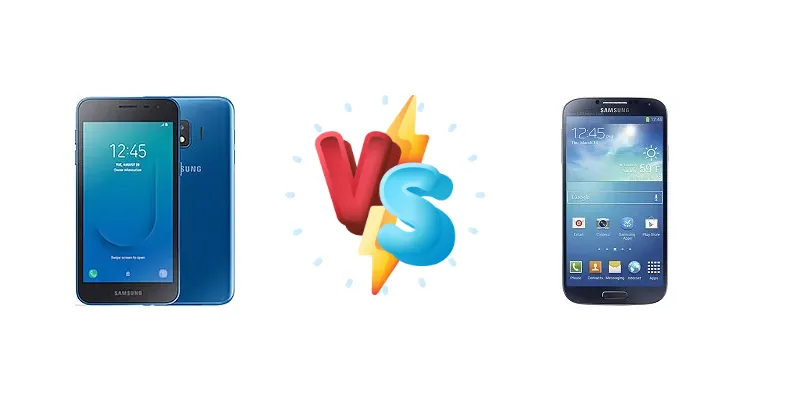
Choosing between a budget-friendly option and a classic flagship can be tough. We're pitting the Samsung Galaxy J2 Core 2020 against the iconic Galaxy S4 to see which phone offers the best value and performance in today's market. This comparison will help you decide which device best suits your needs.
🏆 Quick Verdict
The Galaxy S4, despite its age, still holds a significant advantage due to its superior processor, display technology, and wireless charging. While the J2 Core 2020 is a budget-friendly option, the S4's overall performance and features make it the winner for most users.
| Network |
|---|
| 2G bands | GSM 850 / 900 / 1800 / 1900 | GSM 850 / 900 / 1800 / 1900 |
| 3G bands | HSDPA 850 / 900 / 2100 | HSDPA 850 / 900 / 1900 / 2100 |
| 4G bands | 1, 3, 5, 8, 40, 41 | - |
| EDGE | - | Yes |
| GPRS | - | Yes |
| Speed | HSPA 42.2/5.76 Mbps, LTE Cat4 150/50 Mbps | HSPA 42.2/5.76 Mbps |
| Technology | GSM / HSPA / LTE | GSM / HSPA |
| Launch |
|---|
| Announced | 2020, April 27. Released 2020, April 27 | 2013, March. Released 2013, April |
| Status | Discontinued | Discontinued |
| Body |
|---|
| Build | Glass front, plastic back, plastic frame | Glass front (Gorilla Glass 3), plastic back, plastic frame |
| Dimensions | 143.4 x 72.1 x 8.9 mm (5.65 x 2.84 x 0.35 in) | 136.6 x 69.8 x 7.9 mm (5.38 x 2.75 x 0.31 in) |
| SIM | Dual SIM (Micro-SIM, dual stand-by) | Micro-SIM |
| Weight | 154 g (5.43 oz) | 130 g (4.59 oz) |
| Display |
|---|
| Protection | - | Corning Gorilla Glass 3 |
| Resolution | 540 x 960 pixels, 16:9 ratio (~220 ppi density) | 1080 x 1920 pixels, 16:9 ratio (~441 ppi density) |
| Size | 5.0 inches, 68.9 cm2 (~66.7% screen-to-body ratio) | 5.0 inches, 68.9 cm2 (~72.3% screen-to-body ratio) |
| Type | PLS LCD | Super AMOLED |
| Platform |
|---|
| CPU | Quad-core 1.4 GHz Cortex-A53 | Octa-core (4x1.6 GHz Cortex-A15 & 4x1.2 GHz Cortex-A7) |
| Chipset | Qualcomm MSM8917 Snapdragon 425 (28 nm) | Exynos 5410 Octa (28 nm) |
| GPU | Adreno 308 | PowerVR SGX544MP3 |
| OS | Android 8.1 Oreo (Go edition) | Android 4.2.2 (Jelly Bean), upgradable to 5.0.1 (Lollipop), TouchWiz UI |
| Memory |
|---|
| Call records | - | Yes |
| Card slot | microSDXC (dedicated slot) | microSDXC (dedicated slot) |
| Internal | 16GB 1GB RAM | 16GB 2GB RAM, 32GB 2GB RAM, 64GB 2GB RAM |
| Phonebook | - | 2000 entries |
| | eMMC 5.0 | eMMC 5.0 |
| Main Camera |
|---|
| Features | LED flash, HDR, panorama | LED flash, HDR |
| Single | 8 MP, f/2.2, AF | 13 MP, f/2.2, 31mm (standard), 1/3.1", 1.14µm, AF |
| Video | 1080p@30fps | 1080p@30fps |
| Selfie camera |
|---|
| Features | - | Dual video call |
| Single | 5 MP, f/2.2 | 2 MP, f/2.4, 31mm (standard) |
| Video | - | 1080p@30fps |
| Sound |
|---|
| 3.5mm jack | Yes | Yes |
| 35mm jack | Yes | Yes |
| Loudspeaker | Yes | Yes |
| Comms |
|---|
| Bluetooth | 4.2, A2DP | 4.0, A2DP, EDR, LE, aptX |
| Infrared port | - | Yes |
| NFC | No | Yes |
| Positioning | GPS, GLONASS, BDS | GPS, GLONASS |
| Radio | FM radio | No |
| USB | microUSB 2.0, OTG | microUSB 2.0 (MHL 2 TV-out), OTG |
| WLAN | Wi-Fi 802.11 b/g/n, Wi-Fi Direct | Wi-Fi 802.11 a/b/g/n/ac, dual-band, Wi-Fi Direct, DLNA, hotspot |
| Features |
|---|
| Games | - | Downloadable |
| Java | - | Yes |
| Messaging | - | SMS(threaded view), MMS, Email, IM |
| Sensors | Accelerometer, proximity | Accelerometer, gyro, proximity, compass, barometer, temperature, humidity, gesture |
| | - | ANT+
S-Voice natural language commands and dictation
Air gestures |
| Battery |
|---|
| Charging | - | Wireless (Qi) (market dependent) |
| Music play | - | Up to 62 h |
| Stand-by | - | Up to 370 h (3G) |
| Talk time | - | Up to 17 h (3G) |
| Type | Li-Ion 2600 mAh, removable | Li-Ion 2600 mAh, removable |
| Misc |
|---|
| Colors | Black, Gold, Blue | White Frost, Black Mist, Arctic Blue, Black Edition |
| Models | SM-J260GU, SM-J260GU/DS, SM-J260FU, SM-J260MU | GT-I9500, SGH-I337M, SGH-M919, GT-I9507V, SHV-E330L, SPH-L720T, SHV-E300S, SHV-E300L, SHV-E300K, GT-I9507, SGH-M919N |
| Price | About 130 EUR | About 320 EUR |
| SAR | 0.99 W/kg (head) | 0.85 W/kg (head) 1.55 W/kg (body) |
| SAR EU | - | 0.42 W/kg (head) 0.54 W/kg (body) |
| Tests |
|---|
| Audio quality | - |
Noise -95.9dB / Crosstalk -96.4dB |
| Battery life | - |
Endurance rating 65h
|
| Camera | - |
Photo / Video |
| Display | - |
Contrast ratio: Infinite (nominal) / 3.352:1 (sunlight) |
| Loudspeaker | - |
Voice 70dB / Noise 66dB / Ring 77dB
|
Samsung Galaxy J2 Core (2020)
- Very affordable
- Lightweight
- Android Go Edition (optimized for low-end hardware)
- Slow performance
- Low-resolution display
- Basic camera
- Limited storage
Samsung I9500 Galaxy S4
- Faster processor
- Better display (Super AMOLED)
- Wireless charging (market dependent)
- More RAM
- More storage options
- Older device (potential battery degradation)
- Outdated software
- Limited software updates
- May lack modern features
Display Comparison
The Galaxy S4 boasts a significantly better display. While both offer decent sunlight readability (3.352:1 contrast), the S4's Super AMOLED technology provides richer colors, deeper blacks, and a more vibrant viewing experience compared to the J2 Core 2020's likely LCD panel. The S4's resolution is also higher, resulting in sharper images.
Camera Comparison
While both phones have 'Photo / Video' capabilities listed, the Galaxy S4 generally had a better camera for its time. Expect better image quality, dynamic range, and low-light performance from the S4. The J2 Core 2020's camera is likely adequate for basic snapshots but won't compete with the S4's capabilities.
Performance
The Galaxy S4's Octa-core Exynos 5410 processor is considerably faster than the J2 Core 2020's Quad-core Snapdragon 425. The S4's processor architecture (with both Cortex-A15 and A7 cores) allows for better multitasking and smoother performance in demanding apps. The J2 Core 2020 will struggle with more intensive tasks.
Battery Life
Both phones are reported to have an endurance rating of 65h. However, battery degradation over time is a factor. The S4's battery will likely be significantly degraded compared to a new J2 Core 2020 battery. Wireless charging on the S4 (market dependent) is a notable advantage.
Buying Guide
Who should buy the Samsung Galaxy J2 Core (2020)? Users on a very tight budget who primarily need a basic smartphone for calls, texts, and light app usage. Who should buy the Samsung Galaxy S4? Those seeking a reliable, albeit older, smartphone with a better display, faster processor, and features like wireless charging, and who don't mind the age of the device.
Frequently Asked Questions
❓ Is the Galaxy S4 still worth buying in 2024?
Yes, if you're on a tight budget and prioritize performance and a good display over the latest features. However, be aware of its age and potential battery degradation.
❓ What operating system do these phones use?
The Galaxy J2 Core 2020 runs Android Go Edition. The Galaxy S4 originally ran Android 4.2.2 Jelly Bean and has been updated to Android 5.0 Lollipop, but further updates are unlikely.