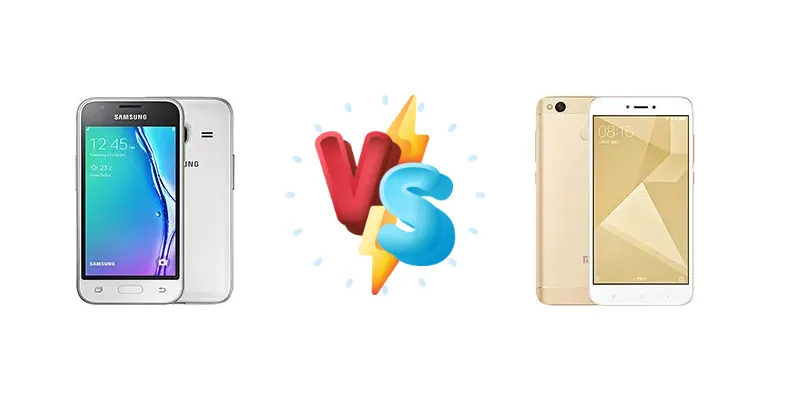
Looking for an affordable smartphone that doesn't completely break the bank? The Samsung Galaxy J1 Nxt and Xiaomi Redmi 4 (4X) are popular contenders in the budget phone arena. But which one reigns supreme? Let's dive into a detailed comparison to help you decide.
🏆 Quick Verdict
The Xiaomi Redmi 4 (4X) emerges as the clear winner. Its superior Snapdragon 435 chipset provides significantly better performance, coupled with excellent battery life and a competitive camera. The J1 Nxt is a basic option, but the Redmi 4 (4X) offers a much more complete package for the price.
| Network |
|---|
| 2G bands | GSM 850 / 900 / 1800 / 1900 - SIM 1 & SIM 2 | GSM 850 / 900 / 1800 / 1900 - SIM 1 & SIM 2 |
| 3G bands | HSDPA 900 / 2100 | HSDPA 850 / 900 / 1900 / 2100 |
| 4G bands | - | 1, 3, 5, 7, 8, 38, 39, 40, 41 |
| Speed | HSPA 21.1/5.76 Mbps | HSPA 42.2/5.76 Mbps, LTE (2CA) Cat6 300/100 Mbps |
| Technology | GSM / HSPA | GSM / HSPA / LTE |
| Launch |
|---|
| Announced | 2016, February. Released 2016, February | 2017, May. Released 2017, May |
| Status | Discontinued | Discontinued |
| Body |
|---|
| Build | - | Glass front (Gorilla Glass), aluminum back, aluminum frame, plastic ends |
| Dimensions | 126.6 x 63.1 x 10.8 mm (4.98 x 2.48 x 0.43 in) | 139.2 x 70 x 8.7 mm (5.48 x 2.76 x 0.34 in) |
| SIM | Hybrid Dual SIM (Micro-SIM, dual stand-by) | Nano-SIM + Micro-SIM |
| Weight | 123 g (4.34 oz) | 150 g (5.29 oz) |
| Display |
|---|
| Protection | - | Corning Gorilla Glass (unspecified version) |
| Resolution | 480 x 800 pixels, 5:3 ratio (~233 ppi density) | 720 x 1280 pixels, 16:9 ratio (~294 ppi density) |
| Size | 4.0 inches, 45.5 cm2 (~57.0% screen-to-body ratio) | 5.0 inches, 68.9 cm2 (~70.7% screen-to-body ratio) |
| Type | TFT, 256K colors | IPS LCD |
| Platform |
|---|
| CPU | Quad-core 1.2 GHz Cortex-A7 | Octa-core 1.4 GHz Cortex-A53 |
| Chipset | Spreadtrum SC9830 | Qualcomm MSM8940 Snapdragon 435 (28 nm) |
| GPU | Mali-400MP2 | Adreno 505 |
| OS | Android 5.1 (Lollipop) | Android 6.0.1 (Marshmallow), upgradable to 7.1.2 (Nougat), MIUI 11 |
| Memory |
|---|
| Card slot | microSDXC (uses shared SIM slot) | microSDXC (uses shared SIM slot) |
| Internal | 8GB 768MB RAM (J1 mini), 8GB 1GB RAM (J1 Nxt) | 16GB 2GB RAM, 16GB 3GB RAM, 32GB 3GB RAM, 64GB 3GB RAM, 64GB 4GB RAM |
| | - | eMMC 5.1 |
| Main Camera |
|---|
| Features | - | LED flash, HDR, panorama |
| Single | 5 MP | 13 MP, f/2.0, PDAF |
| Video | 720p@30fps | 1080p@30fps |
| Selfie camera |
|---|
| Single | VGA | 5 MP, f/2.2 |
| Video | - | 1080p@30fps |
| Sound |
|---|
| 3.5mm jack | Yes | Yes |
| 35mm jack | Yes | Yes |
| Loudspeaker | Yes | Yes |
| Comms |
|---|
| Bluetooth | 4.0, A2DP | 4.2, A2DP, LE |
| Infrared port | - | Yes |
| NFC | No | No |
| Positioning | GPS, GLONASS | GPS, GLONASS, BDS |
| Radio | FM radio | FM radio |
| USB | microUSB 2.0 | microUSB 2.0 |
| WLAN | Wi-Fi 802.11 b/g/n, Wi-Fi Direct, hotspot | Wi-Fi 802.11 b/g/n, Wi-Fi Direct |
| Features |
|---|
| Sensors | Accelerometer | Fingerprint (rear-mounted), accelerometer, gyro, proximity, compass |
| Battery |
|---|
| Music play | Up to 29 h | Up to 87 h |
| Stand-by | - | Up to 432 h (3G) |
| Talk time | Up to 8 h (3G) | Up to 36 h (3G) |
| Type | Li-Ion 1500 mAh, removable | Li-Po 4100 mAh, non-removable |
| Misc |
|---|
| Colors | White, Gold, Black | Black, Gold |
| Models | SM-J105F, SM-j105H, SM-J105H, SM-J105B, SM-J105Y, SM-J105M | 2016060, 2016090, MAG138, MAE136, Redmi 4, Redmi 4X |
| Price | About 90 EUR | About 110 EUR |
| SAR | - | 0.77 W/kg (head) 0.83 W/kg (body) |
| SAR EU | 0.76 W/kg (head) 0.47 W/kg (body) | - |
| Tests |
|---|
| Audio quality | - |
Noise -94.3dB / Crosstalk -94dB |
| Battery life | - |
Endurance rating 80h
|
| Camera | - |
Photo / Video |
| Display | - |
Contrast ratio: 915 (nominal), 2.920 (sunlight) |
| Loudspeaker | - |
Voice 64dB / Noise 70dB / Ring 72dB
|
| Performance | - |
GeekBench: 1819 (v4.4)
GFXBench: 5.1fps (ES 3.1 onscreen) |
Samsung Galaxy J1 Nxt
- Samsung Brand Recognition
- Simple and Easy to Use
- Compact Size
- Weak Performance
- Basic Camera
- Short Battery Life
- Outdated Chipset
Xiaomi Redmi 4 (4X)
- Excellent Performance for the Price
- Long Battery Life
- Decent Camera
- Good Value
- Xiaomi's MIUI can be polarizing
- Plastic Build Quality
Display Comparison
Both phones feature a 5-inch display, likely with a resolution of 720p (HD). While contrast ratios are reported at 915 (nominal) and 2.920 (sunlight) for the Redmi 4 (4X), the J1 Nxt's display quality is likely to be more basic. The Redmi 4 (4X) likely offers slightly better viewing angles and color reproduction.
Camera Comparison
The Redmi 4 (4X) generally has a better camera setup. While both offer Photo/Video capabilities, the Redmi 4 (4X)'s Snapdragon chipset often allows for better image processing and potentially a slightly higher resolution sensor. Expect better low-light performance and more detail in photos from the Redmi 4 (4X).
Performance
This is where the Redmi 4 (4X) truly shines. Its Qualcomm Snapdragon 435 octa-core processor is significantly more powerful than the J1 Nxt's Spreadtrum SC9830 quad-core. Expect smoother multitasking, faster app loading times, and a more responsive user experience on the Redmi 4 (4X). The J1 Nxt will feel sluggish by comparison.
Battery Life
The Redmi 4 (4X) boasts an impressive endurance rating of 80 hours, indicating exceptional battery life. The J1 Nxt's battery capacity is likely smaller, resulting in shorter usage times. The Redmi 4 (4X) will easily last a full day, even with moderate use.
Buying Guide
Who should buy the Samsung Galaxy J1 Nxt? Users prioritizing Samsung's brand recognition and a very basic, no-frills experience. Who should buy the Xiaomi Redmi 4 (4X)? Anyone seeking a reliable, well-rounded budget phone with good performance, battery life, and a decent camera – a much better value overall.
Frequently Asked Questions
❓ Is the Samsung Galaxy J1 Nxt good for gaming?
No, the J1 Nxt's weak processor makes it unsuitable for demanding games. Even simple games may experience lag and stuttering.
❓ Which phone has better software support?
Samsung generally provides better software updates and security patches, although both phones are now quite old. Xiaomi's MIUI can be feature-rich but may have occasional bloatware.