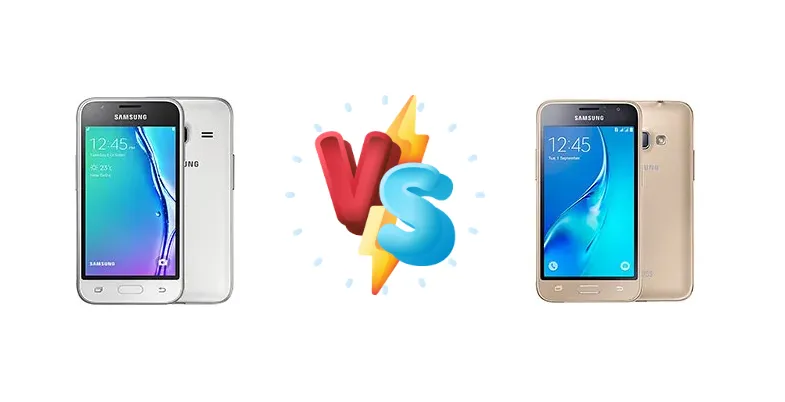
The Samsung Galaxy J1 series was known for offering affordable smartphones. The J1 Nxt and J1 (2016) are two iterations within this lineup. But which one is the better choice for budget-conscious buyers? Let's dive into a detailed comparison.
🏆 Quick Verdict
The Samsung Galaxy J1 (2016) edges out the J1 Nxt due to its slightly faster processor (1.3 GHz vs 1.2 GHz). Both offer similar experiences, but the J1 (2016)'s marginal performance boost and potentially slightly better software support make it the preferred option.
| Network |
|---|
| 2G bands | GSM 850 / 900 / 1800 / 1900 - SIM 1 & SIM 2 | GSM 850 / 900 / 1800 / 1900 - SIM 1 & SIM 2 (dual-SIM model only) |
| 3G bands | HSDPA 900 / 2100 | HSDPA 850 / 900 / 1900 / 2100 - J120F |
| 4G bands | - | 1, 3, 5, 7, 8, 20 - J120F |
| Speed | HSPA 21.1/5.76 Mbps | HSPA 21.1/5.76 Mbps, LTE Cat4 150/50 Mbps |
| Technology | GSM / HSPA | GSM / HSPA / LTE |
| | - | 1, 2, 3, 4, 5, 7, 12 - J120A |
| Launch |
|---|
| Announced | 2016, February. Released 2016, February | 2016, January. Released 2016, January |
| Status | Discontinued | Discontinued |
| Body |
|---|
| Build | - | Glass front, plastic back, plastic frame |
| Dimensions | 126.6 x 63.1 x 10.8 mm (4.98 x 2.48 x 0.43 in) | 132.6 x 69.3 x 8.9 mm (5.22 x 2.73 x 0.35 in) |
| SIM | Hybrid Dual SIM (Micro-SIM, dual stand-by) | Single SIM (Micro-SIM) or Dual SIM (Micro-SIM, dual stand-by) |
| Weight | 123 g (4.34 oz) | 131 g (4.62 oz) |
| Display |
|---|
| Resolution | 480 x 800 pixels, 5:3 ratio (~233 ppi density) | 480 x 800 pixels, 5:3 ratio (~207 ppi density) |
| Size | 4.0 inches, 45.5 cm2 (~57.0% screen-to-body ratio) | 4.5 inches, 57.6 cm2 (~62.7% screen-to-body ratio) |
| Type | TFT, 256K colors | Super AMOLED |
| Platform |
|---|
| CPU | Quad-core 1.2 GHz Cortex-A7 | Quad-core 1.3 GHz Cortex-A7 |
| Chipset | Spreadtrum SC9830 | Spreadtrum SC9830 |
| GPU | Mali-400MP2 | Mali-400 |
| OS | Android 5.1 (Lollipop) | Android 5.1.1 (Lollipop), upgradable to Android 6.0.1 (Marshmallow) |
| Memory |
|---|
| Card slot | microSDXC (uses shared SIM slot) | microSDXC (dedicated slot) |
| Internal | 8GB 768MB RAM (J1 mini), 8GB 1GB RAM (J1 Nxt) | 8GB 1GB RAM |
| Main Camera |
|---|
| Features | - | LED flash |
| Single | 5 MP | 5 MP, f/2.2, AF |
| Video | 720p@30fps | 720p@30fps |
| Selfie camera |
|---|
| Single | VGA | 2 MP, f/2.2 |
| Sound |
|---|
| 3.5mm jack | Yes | Yes |
| 35mm jack | Yes | Yes |
| Loudspeaker | Yes | Yes |
| Comms |
|---|
| Bluetooth | 4.0, A2DP | 4.1, A2DP, LE |
| NFC | No | No |
| Positioning | GPS, GLONASS | GPS, GLONASS |
| Radio | FM radio | FM radio, RDS, recording |
| USB | microUSB 2.0 | microUSB 2.0 |
| WLAN | Wi-Fi 802.11 b/g/n, Wi-Fi Direct, hotspot | Wi-Fi 802.11 b/g/n, Wi-Fi Direct, hotspot |
| Features |
|---|
| Sensors | Accelerometer | Accelerometer, proximity |
| Battery |
|---|
| Music play | Up to 29 h | Up to 39 h |
| Talk time | Up to 8 h (3G) | Up to 12 h (3G) |
| Type | Li-Ion 1500 mAh, removable | Li-Ion 2050 mAh, removable |
| Misc |
|---|
| Colors | White, Gold, Black | White, Black, Gold |
| Models | SM-J105F, SM-j105H, SM-J105H, SM-J105B, SM-J105Y, SM-J105M | SM-J120F, SM-J120H, SM-J120M, SM-J120M, SM-J120T, SM-J120G, SM-J120A, SM-J120FN, SM-J120AZ, SM-J120ZN, SM-J120W |
| Price | About 90 EUR | About 130 EUR |
| SAR | - | 1.58 W/kg (head) 1.18 W/kg (body) |
| SAR EU | 0.76 W/kg (head) 0.47 W/kg (body) | 0.70 W/kg (head) 0.59 W/kg (body) |
Samsung Galaxy J1 Nxt
- Affordable
- Compact size
- Basic functionality
- Limited performance
- Low-resolution display
- Outdated software
Samsung Galaxy J1 (2016)
- Slightly better performance
- Compact size
- Affordable
- Limited performance
- Low-resolution display
- Outdated software
Display Comparison
Both phones feature a 4.5-inch display, likely with a resolution of 800 x 540 pixels. Expect similar viewing experiences – adequate for basic tasks but not ideal for media consumption. Screen technology is likely TFT LCD on both.
Camera Comparison
Both devices likely feature a 5MP rear camera and a front-facing camera, probably also 5MP. Image quality will be basic, suitable for casual snapshots in good lighting conditions. Don't expect exceptional low-light performance from either device.
Performance
The key difference lies in the CPU clock speed. The J1 (2016) boasts a 1.3 GHz quad-core Cortex-A7 processor compared to the J1 Nxt's 1.2 GHz. While both use the same architecture, the slightly higher clock speed should translate to marginally faster app loading and smoother multitasking on the J1 (2016). Both phones have 1GB of RAM, which is limiting.
Battery Life
The J1 (2016) typically has a 2000mAh battery, while the J1 Nxt has a 2050mAh battery. The difference is minimal, and real-world battery life will depend heavily on usage patterns. Expect a full day of light use from either phone.
Buying Guide
The Samsung Galaxy J1 Nxt is suitable for users needing a basic smartphone for calls, texts, and light app usage. The Samsung Galaxy J1 (2016) is a better choice for those wanting a slightly smoother experience and potentially longer software support, though both are aging devices.
Frequently Asked Questions
❓ Are these phones still worth buying in 2024?
Given their age, these phones are only suitable for users with extremely limited budgets or those needing a basic device for essential tasks. Newer, more capable smartphones are readily available at similar price points.
❓ What operating system do these phones run?
Both phones originally shipped with Android 5.1.1 (Lollipop). Software updates were limited, and they likely run an older version of Android or a custom Samsung skin.