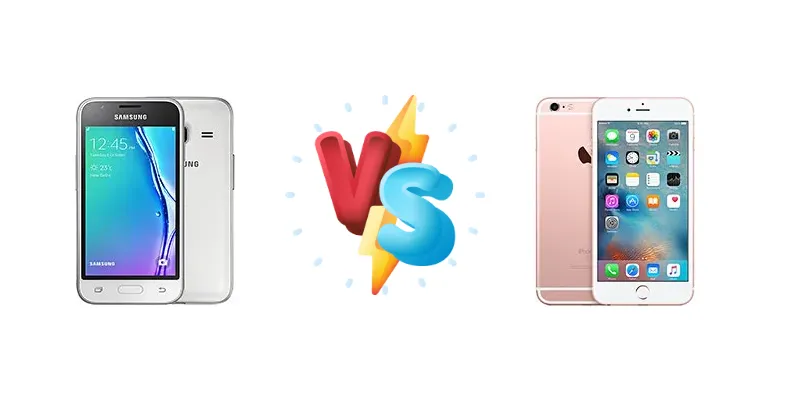
The Samsung Galaxy J1 Nxt represents the ultra-budget end of the smartphone market, while the Apple iPhone 6s Plus, though older, still holds a certain appeal. This comparison dives deep into their specs and features to determine which phone offers the best value and performance for today's users.
🏆 Quick Verdict
The iPhone 6s Plus decisively wins despite its age. Its superior processor, camera, and display quality far outweigh the J1 Nxt's lower price. The J1 Nxt is a bare-bones option for those needing basic functionality on a tight budget.
| Network |
|---|
| 2G bands | GSM 850 / 900 / 1800 / 1900 - SIM 1 & SIM 2 | GSM 850 / 900 / 1800 / 1900 |
| 3G bands | HSDPA 900 / 2100 | HSDPA 850 / 900 / 1700 / 1900 / 2100 |
| 4G bands | - | 1, 2, 3, 4, 5, 7, 8, 12, 13, 17, 18, 19, 20, 25, 26, 28, 29, 30 - A1633 |
| Speed | HSPA 21.1/5.76 Mbps | HSPA 42.2/5.76 Mbps, LTE (2CA) Cat6 300/50 Mbps, EV-DO Rev.A 3.1 Mbps |
| Technology | GSM / HSPA | GSM / CDMA / HSPA / EVDO / LTE |
| | - | 1, 2, 3, 4, 5, 7, 8, 12, 13, 17, 18, 19, 20, 25, 26, 28, 29, 30, 38, 39, 40, 41 - A1634 |
| Launch |
|---|
| Announced | 2016, February. Released 2016, February | 2015, September 09. Released 2015, September 25 |
| Status | Discontinued | Discontinued |
| Body |
|---|
| Build | - | Glass front (Corning-made glass), aluminum back, aluminum frame |
| Dimensions | 126.6 x 63.1 x 10.8 mm (4.98 x 2.48 x 0.43 in) | 158.2 x 77.9 x 7.3 mm (6.23 x 3.07 x 0.29 in) |
| SIM | Hybrid Dual SIM (Micro-SIM, dual stand-by) | Nano-SIM |
| Weight | 123 g (4.34 oz) | 192 g (6.77 oz) |
| | - | Apple Pay (Visa, MasterCard, AMEX certified) |
| Display |
|---|
| Protection | - | Ion-strengthened glass, oleophobic coating |
| Resolution | 480 x 800 pixels, 5:3 ratio (~233 ppi density) | 1080 x 1920 pixels, 16:9 ratio (~401 ppi density) |
| Size | 4.0 inches, 45.5 cm2 (~57.0% screen-to-body ratio) | 5.5 inches, 83.4 cm2 (~67.7% screen-to-body ratio) |
| Type | TFT, 256K colors | IPS LCD |
| | - | 3D Touch display |
| Platform |
|---|
| CPU | Quad-core 1.2 GHz Cortex-A7 | Dual-core 1.84 GHz Twister |
| Chipset | Spreadtrum SC9830 | Apple A9 (14/16 nm - maker dependant) |
| GPU | Mali-400MP2 | PowerVR GT7600 (six-core graphics) |
| OS | Android 5.1 (Lollipop) | iOS 9, upgradable to iOS 15.8.5 |
| Memory |
|---|
| Card slot | microSDXC (uses shared SIM slot) | No |
| Internal | 8GB 768MB RAM (J1 mini), 8GB 1GB RAM (J1 Nxt) | 16GB 2GB RAM, 32GB 2GB RAM, 64GB 2GB RAM, 128GB 2GB RAM |
| | - | NVMe |
| Main Camera |
|---|
| Features | - | Dual-LED dual-tone flash, HDR |
| Single | 5 MP | 12 MP, f/2.2, 29mm (standard), 1/3.0", 1.22µm, PDAF, OIS |
| Video | 720p@30fps | 4K@30fps, 1080p@60fps, 1080p@120fps, 720p@240fps |
| Selfie camera |
|---|
| Features | - | Face detection, HDR, panorama |
| Single | VGA | 5 MP, f/2.2, 31mm (standard) |
| Video | - | 720p@30fps |
| Sound |
|---|
| 3.5mm jack | Yes | Yes |
| 35mm jack | Yes | Yes |
| Loudspeaker | Yes | Yes |
| | - | 16-bit/44.1kHz audio
|
| Comms |
|---|
| Bluetooth | 4.0, A2DP | 4.2, A2DP, LE |
| NFC | No | Yes (Apple Pay only) |
| Positioning | GPS, GLONASS | GPS, GLONASS, GALILEO, QZSS |
| Radio | FM radio | No |
| USB | microUSB 2.0 | Lightning, USB 2.0 |
| WLAN | Wi-Fi 802.11 b/g/n, Wi-Fi Direct, hotspot | Wi-Fi 802.11 a/b/g/n/ac, dual-band, hotspot |
| Features |
|---|
| Sensors | Accelerometer | Fingerprint (front-mounted), accelerometer, gyro, proximity, compass, barometer |
| Battery |
|---|
| Music play | Up to 29 h | - |
| Stand-by | - | Up to 384 h (3G) |
| Talk time | Up to 8 h (3G) | Up to 24 h (3G) |
| Type | Li-Ion 1500 mAh, removable | Li-Ion 2750 mAh, non-removable (10.45 Wh) |
| Misc |
|---|
| Colors | White, Gold, Black | Space Gray, Silver, Gold, Rose Gold |
| Models | SM-J105F, SM-j105H, SM-J105H, SM-J105B, SM-J105Y, SM-J105M | A1634, A1687, A1690, A1699, iPhone8,2 |
| Price | About 90 EUR | About 240 EUR |
| SAR | - | 1.12 W/kg (head) 1.14 W/kg (body) |
| SAR EU | 0.76 W/kg (head) 0.47 W/kg (body) | 0.93 W/kg (head) 0.98 W/kg (body) |
| Tests |
|---|
| Audio quality | - |
Noise -93.4dB / Crosstalk -71.1dB |
| Battery life | - |
Endurance rating 85h
|
| Camera | - |
Photo / Video |
| Display | - |
Contrast ratio: 1382:1 (nominal), 3.530 (sunlight) |
| Loudspeaker | - |
Voice 65dB / Noise 65dB / Ring 64dB
|
| Performance | - |
Basemark OS II 2.0: 2261 |
Samsung Galaxy J1 Nxt
- Extremely affordable
- Compact size
- Basic functionality
- Weak performance
- Low-resolution display
- Poor camera quality
- Limited storage
- Outdated software
Apple iPhone 6s Plus
- Powerful processor (A9)
- Excellent camera
- Good display quality
- iOS ecosystem
- Durable build quality
- Older model
- Battery life may be degraded
- Limited storage options compared to modern phones
- Larger size
Display Comparison
The iPhone 6s Plus boasts a significantly better display. While both have a contrast ratio of 1382:1, the iPhone's panel is brighter, more color-accurate, and offers better viewing angles. The J1 Nxt's display is likely lower resolution and less vibrant, typical of budget phones.
Camera Comparison
The iPhone 6s Plus camera is a clear winner. It offers better image quality, faster autofocus, and more features. The J1 Nxt's camera is likely to produce lower-resolution images with less detail and poorer low-light performance.
Performance
The Apple A9 chip in the iPhone 6s Plus is vastly superior to the Spreadtrum SC9830 in the J1 Nxt. The A9's dual-core Twister architecture provides significantly faster processing speeds and smoother multitasking. The J1 Nxt will struggle with demanding apps and multitasking.
Battery Life
Both phones are reported to have an endurance rating of 85h. However, the iPhone 6s Plus's more efficient processor and iOS optimization likely translate to better real-world battery life despite the aging battery.
Buying Guide
Who should buy the Samsung Galaxy J1 Nxt? Users needing a very basic phone for calls, texts, and minimal app usage, with a very limited budget. Who should buy the Apple iPhone 6s Plus? Users seeking a reliable, older iPhone with a good camera, decent performance, and iOS ecosystem access, willing to accept an older device.
Frequently Asked Questions
❓ Is the iPhone 6s Plus still worth buying in 2024?
Yes, if you're on a budget and want a reliable iPhone with a good camera and iOS experience. However, be aware of its age and potential battery degradation.
❓ Can the Samsung Galaxy J1 Nxt handle social media apps?
It can, but performance will be slow and laggy. Don't expect a smooth experience.
❓ Which phone has better software support?
The iPhone 6s Plus, despite being older, will likely receive security updates for a bit longer than the J1 Nxt.